
From the very moment JoBeth Coleby-Davis told Opposition Leader Michael Pintard that she would only answer his parliamentary questions if he first survived an internal leadership contest within the Free National Movement (FNM), the tone was set—not for accountability, but for deflection. It was a remark that revealed more about the government’s posture than any formal statement ever could. Years later, those questions remain unanswered, and the pattern has only deepened.
Now we arrive at the latest episode involving Bahamas Power and Light (BPL), Bahamas Grid Company, and the much-touted energy reform arrangement tied to U.S. executive Eric Pike. According to reporting from The Tribune, a deal described as central to modernizing New Providence’s grid has effectively unravelled less than two years into what was supposed to be a 25-year agreement. When pressed, Minister Coleby-Davis offered little more than a rehearsed line — “a statement went out”—before cutting off further inquiry.
That is not transparency. That is choreography.
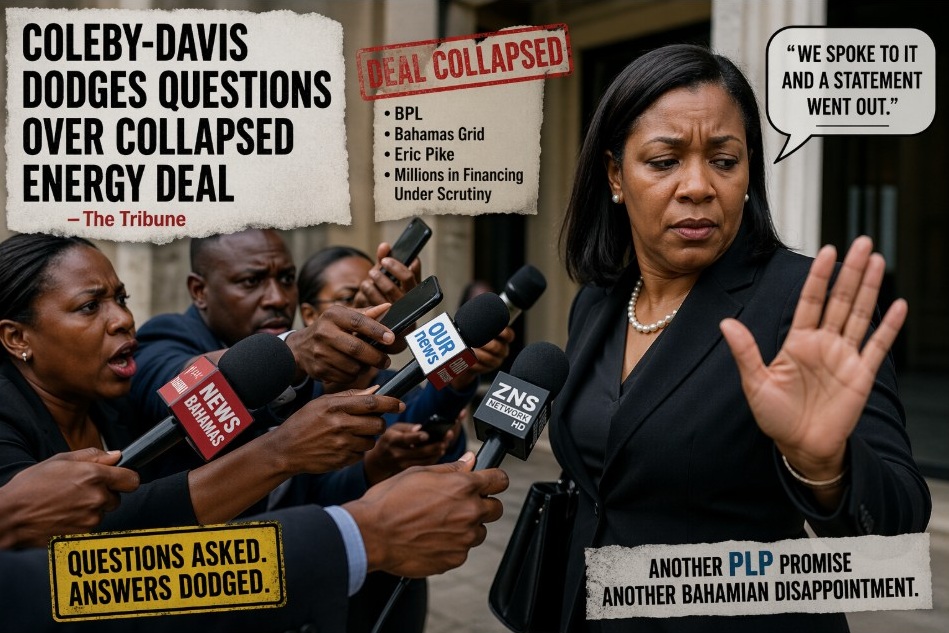
The government’s attempt to rebrand what appears to be a breakdown as a “transition” follows a now-familiar script. Bahamians have seen this before, most notably with the Our Lucayan situation in Grand Bahama, where optimistic framing was used to soften hard realities. In this case, the public is again being asked to accept reassurance in place of explanation, confidence in place of clarity.
But the facts, as presented, raise legitimate concerns. A key partner has exited. A flagship agreement has faltered prematurely. Millions in financing are under scrutiny. Yet, the level of detail provided to the public remains minimal, controlled, and carefully filtered.
This is where the broader criticism of the Progressive Liberal Party (PLP) finds its footing—not in partisan rhetoric, but in observable governing habits. The administration campaigned heavily on accountability and transparency, presenting these as cornerstones of its mandate. However, instances like this BPL matter, alongside others such as the Beaches and Parks controversy, suggest a governing style that prefers managed messaging over open scrutiny.
Even when responses are eventually given, they often generate more questions than answers—sometimes contradicting earlier positions or introducing new ambiguities. Press engagements become limited. Questions are deflected. And substantive engagement is replaced with carefully staged communication.
It creates the impression of a government more comfortable speaking at the public than to it.
The irony is hard to ignore. The same administration that once championed a “Blueprint for Change” now promotes a “Blueprint to Progress.” But progress, by any reasonable standard, requires measurable outcomes, clear communication, and public trust built on transparency—not semantics.
So, the question naturally follows: what exactly constitutes this “progress”?
Because for many observers, the list of unanswered questions—from Parliament to press briefings to national projects—continues to grow. And until those questions are met with direct, consistent, and verifiable answers, the gap between promise and practice will remain impossible to ignore.
The Progressive Liberal Party (PLP) fails for one reason; it is their nature.
END

