
If politics is often described as a game, then what you’re describing looks less like a fair contest and more like a very deliberate chess strategy—one where the focus isn’t just on winning the board, but on psychologically cornering the opposing king.
In this case, the Progressive Liberal Party appears to be treating Michael Pintard not as a fresh piece on the board, but as if he’s still carrying the baggage of the previous Hubert Minnis administration.
Think of it like this:
In chess, there’s a strategy where instead of attacking your opponent’s current position directly, you repeatedly target squares that were weak in a previous phase of the game—hoping your opponent either hasn’t fully recovered or can be forced into defending something that no longer truly applies. It’s not always about the present board; it’s about dragging the game back into a narrative where your opponent is already compromised.
That’s essentially what this political approach resembles.
The PLP’s messaging strategy, presently, functions like a positional squeeze. Rather than engaging Pintard solely on his current leadership or policies, they keep reopening the “Minnis file”—a kind of political pinned piece. Even though Pintard was not the king at the time, he’s being treated as though he must defend every move made during that administration.
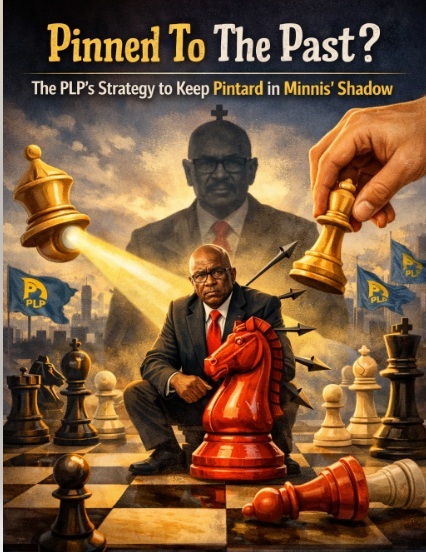
In chess terms, it’s akin to:
- Pinning the knight to the king: Pintard, as leader, is forced to answer for the Minnis era, limiting his ability to maneuver freely with his own agenda.
- Controlling the center through narrative: By keeping public discourse anchored in past controversies, the PLP attempts to dominate the “center squares” of political conversation.
- Forcing defensive play: If the FNM is constantly responding to historical criticisms, they’re not advancing new policy positions—much like a player stuck reacting instead of attacking.
But here’s where the analogy cuts both ways.
A strategy that relies too heavily on past positions can become predictable. In chess, if you keep attacking where the pieces used to be, a skilled opponent can reposition and counterattack—sometimes decisively. If Pintard successfully reframes himself as distinct from the Minnis administration, the FNM could flip the board dynamic entirely, turning what was meant to be a pin into an overextension.
Because in chess—as in politics—overcommitting to one line of attack can leave your own king exposed.
So the real question isn’t just what strategy the PLP is using. It’s whether the FNM, under Pintard, can recognize the pattern and shift the game from defense to initiative.
That’s when the match actually gets interesting.
What is actually interesting is that the New Day Progressive Liberal Party (PLP) is attacking Micheal Pintard on his time served, though the past leader and also though his present leadership, based on the word of disgruntled former Free National Movement (FNM) supporters, who seem to have abandoned the basic principles of the FNM to now back those of the PLP; which they once despised.
So, the New Day PLP is focused on attempting to drag things back to a time where the felt that Pintard was compromised and attempt to exploit these situations but to date they have not been able to accomplish this.
Also, one of Pintard’s greatest attributes to date has been that he has not allowed the PLP to corner him as he continues to “attack” the questionable/poor governance of the New Day Progressive Liberal Party (PLP); thereby distinguishing himself as a real and true leader.
End
 My Morning Paper