
There’s political spin… and then there’s whatever performance Fred Mitchell delivered in that voice note. At some point, you stop wondering whether the facts are being bent and start realizing they’ve been tied into a full pretzel.
Let’s start with the central claim: that Dwayne Sands and the Free National Movement (FNM) by somehow “forcing” the Grand Bahama Port Authority to remove PLP signs—as though the GBPA is a puppet and the FNM is backstage pulling strings or even the other way around.
That version might make for good late-night storytelling, but it collapses under even the lightest scrutiny.
What actually happened is far less theatrical and far more inconvenient for the Progressive Liberal Party narrative:
The PLP put up signs where they were not supposed to, before they were legally allowed to, and outside established guidelines. When complaints were initially ignored, the FNM called their bluff—putting up their own signs to force equal enforcement. Suddenly, rules mattered again. The GBPA acted. And just like that, order was restored.
Not collusion. Not conspiracy. Just compliance—something the PLP seems to treat like an optional suggestion rather than a requirement.
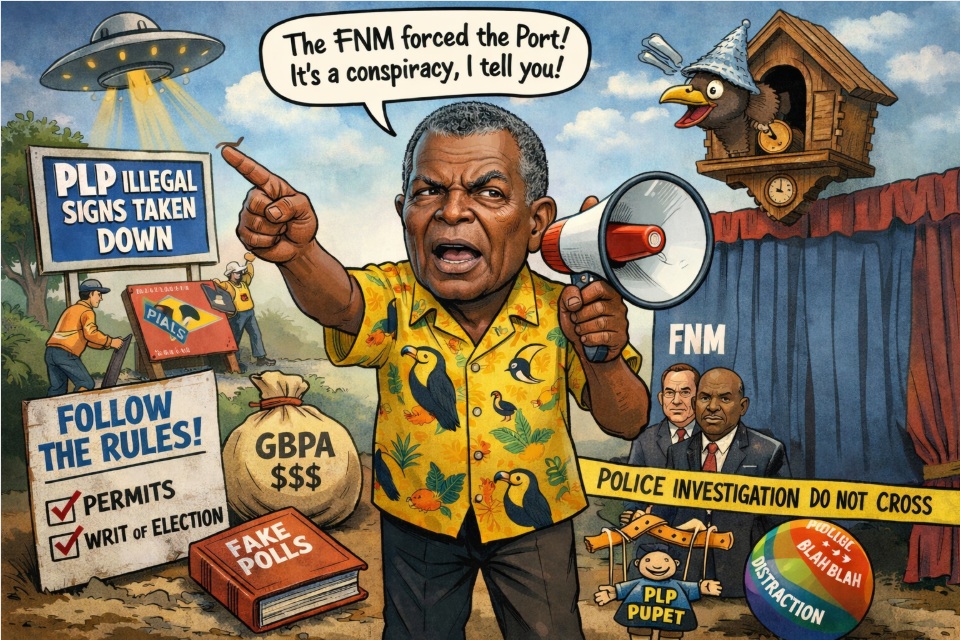
And that’s really the heart of the issue: a party that behaves as though laws are for “other people,” then cries foul when those same laws are finally applied.
Mitchell’s outrage, then, isn’t about injustice—it’s about inconvenience.
Even more curious is his attempt to revive the tired tale that the GBPA is somehow bankrolling the FNM. This from a party that now proudly claims it takes no money from the GBPA—as though that erases decades of political entanglements overnight. One is left to wonder: when exactly did this newfound moral purity begin? Before or after it became politically useful to say so?
Then comes the usual detour into personality politics—taking shots at Michael Pintard while attempting to canonize Philip Davis as the face on every billboard, every poster, every conceivable surface. The irony is thick: a party claiming “team unity” while plastering one man’s image everywhere like a national security blanket.
If that’s confidence, it’s a very nervous kind.
And just when you think the rant couldn’t drift further off course, Mitchell attempts to bait the FNM into commenting on an active police matter involving Marvin Dames. That’s not just reckless—it’s transparently desperate. When you can’t win on facts, you try to drag your opponent into controversy, even if it means undermining due process.
It’s a tactic, yes—but not a particularly respectable one.
At some stage, the performance stops being sharp political commentary and starts resembling something else entirely: the ramblings of a man more interested in noise than nuance, more committed to deflection than truth. There’s a difference between seasoned and stale—and increasingly, Mitchell’s interventions feel less like strategy and more like static.
If this is the PLP’s idea of leadership messaging, then the real question isn’t whether the public is being misled—it’s how much longer they’re expected to take it seriously.
The Progressive Liberal Party (PLP) fails for one reason; it is their nature.
END
 My Morning Paper