
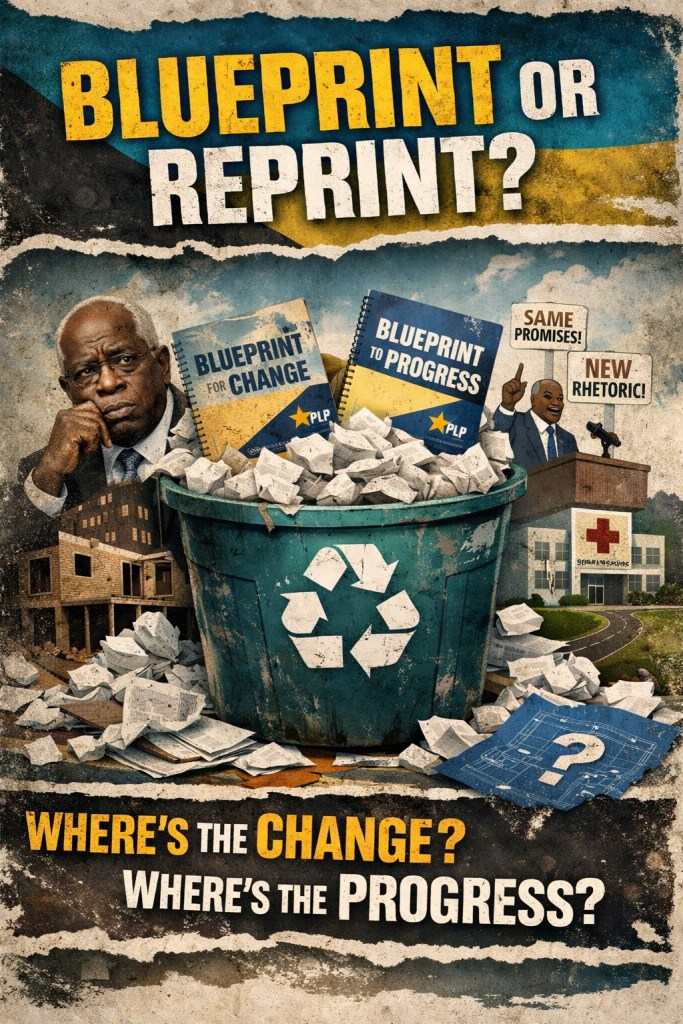
Wednesday night’s unveiling of the Progressive Liberal Party’s (PLP) so-called “Blueprint to Progress” was less a bold step forward and more a weary déjà vu—an echo of the very same “Blueprint for Change” that carried them into office. One could be forgiven for wondering whether this was a policy launch or a reprint.
The obvious questions right-thinking Bahamians ask themselves is what exactly changed, and where precisely is this promised progress?
According to reporting from The Nassau Guardian, the event was polished, choreographed, and heavy on rhetoric—but conspicuously light on tangible documentation. No physical plan was released at the time, only a parade of promises. That alone should give pause. Serious governance is not theatre; it demands substance over spectacle.
More troubling, however, is the substance that did emerge. A careful review of the announcements reveals a pattern that is difficult to ignore: many of the pledges presented as part of this “new” blueprint are, in fact, recycled commitments—initiatives that were either explicitly promised or reasonably expected during the PLP’s first term.
Take immigration enforcement. The proposal for biometric systems, stricter penalties, and tighter employer compliance sounds decisive—until one recalls that immigration reform has been a persistent national issue for years. If these measures are as straightforward and necessary as now suggested, why were they not meaningfully implemented earlier in the administration’s tenure?
The same question applies across multiple sectors.
Housing? The promise of affordable housing pipelines, public-private partnerships, and rehabilitation of abandoned properties is not novel. These are foundational policy tools—ones that could have been activated early to alleviate the very crisis now being highlighted.
Healthcare? Commitments to complete the Freeport Health Campus and expand services in New Providence have been ongoing talking points. Yet, years into governance, these projects remain works in progress rather than completed achievements.
Energy, agriculture, education, and labour reforms follow a similar script: ambitious targets, familiar language, and timelines that extend conveniently into a future contingent on re-election.
Even the proposal to reduce food imports by 25% by 2030 raises an eyebrow. Food security has long been identified as a national priority. Why does a concrete benchmark emerge now, rather than at the outset of the administration when decisive early action could have yielded compounding benefits?
None of this is to suggest that these policies are inherently flawed. On the contrary, many are sensible and, if executed effectively, could provide real benefits. But that is precisely the issue: if these ideas were always sensible, why were they not treated with urgency from day one?
The uncomfortable inference is that the line between governance and campaigning has blurred. Promises that could have been fulfilled—or at least substantially advanced—during the first term are being repackaged as incentives for a second.
This raises a deeper concern about the New Day PLP’s political strategy. There is an old, cynical theory in politics: to position oneself as the solution, one must first ensure the persistence of the problem. Whether intentional or not, the effect here is similar. Challenges that could have been mitigated earlier are now being reintroduced as justifications for renewed trust.
And so, we return to the central contradiction. The PLP asks the Bahamian people to “choose progress,” yet the evidence suggests that much of what is being offered as progress is, in reality, deferred change.
If the “Blueprint for Change” did not deliver the transformative impact implied by its name, then what confidence should the public have that a “Blueprint to Progress” will fare any better—especially when it appears to rely on the same foundation?
This is not merely a matter of political point-scoring. It is a question of accountability. Governance is not judged by the elegance of its promises but by the consistency of its delivery. Reintroducing prior commitments as new initiatives risks undermining public trust and invites scepticism about both capacity and intent.
In the end, the issue is not whether the PLP can articulate a vision for the future. It clearly can. The issue is whether that vision represents genuine forward movement or simply a reframing of what should have already been achieved.
Because if there was no meaningful change, then the question remains—what exactly is this progress the Bahamian people are being asked to choose?
The Progressive Liberal Party (PLP) government fails for one reason; it is their nature.
END
 My Morning Paper