
Today the Progressive Liberal Party (PLP) proudly thumps its chest and declares “PROGRESS” after overseeing yet another signing ceremony tied to the long-suffering Grand Lucayan Resort. One might be forgiven for thinking that after years of false starts, aborted agreements, and recycled optimism, Bahamians would have learned to ask a very simple question: progress compared to what?
Because let us not forget—this is the very same administration that, upon taking office, swiftly abandoned a deal left in place by the Free National Movement (FNM). That deal, we were told, was fundamentally flawed, not in the best interest of the Bahamian people, and unworthy of proceeding. It was cast aside with confidence, replaced with promises of something better, stronger, more credible.
And yet here we are.
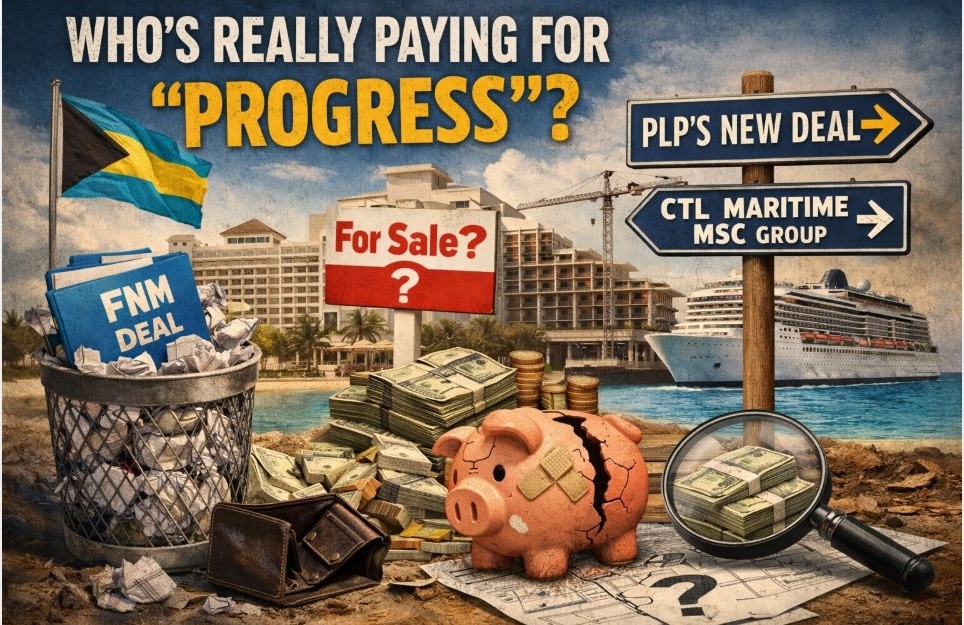
After multiple failed attempts and shifting narratives, the PLP now points to an agreement involving the Concord Wilshire Capital as evidence that their judgment was sound all along. But if this is “progress,” it is a peculiar kind—one that seems to require constant revision, external reinforcement, and, most tellingly, new partners to make the numbers work.
Because buried within the celebratory headlines is a rather inconvenient detail: Concord Wilshire has now entered into an arrangement with CTL Maritime, a subsidiary of the MSC Group. And suddenly, the questions that should have been asked a year ago become unavoidable today.
If Concord Wilshire had the financial capacity to execute a $120 million purchase and redevelopment, why is it only now, nearly a year later, that a major international player must step in to “advance the project”? Why does ownership seem to materialize only after this partnership is announced? And perhaps most importantly, who is really carrying the financial weight here?
The Bahamian people were once assured—quite memorably by Deputy Prime Minister Chester Cooper—that the money would “hit the bank.” It was a bold, confident declaration meant to signal certainty. Today, however, it feels less like a promise fulfilled and more like a question deferred.
Because if CTL Maritime is now acquiring parcels of the development and spearheading key components such as the proposed MSC Beach Club, one must reasonably ask whether Concord Wilshire was ever fully capitalized to deliver the project on its own. And if not, why was the Bahamian public led to believe otherwise?
This is not merely a matter of technical financing arrangements; it strikes at the heart of the PLP’s decision-making. They scrapped an existing deal on the grounds of national interest, only to replace it with an arrangement that now appears dependent on external rescue or reinforcement. That is not strategic foresight—it is, at best, hopeful improvisation.
And the concerns do not end there. Beyond the initial acquisition, the broader vision for the Grand Lucayan includes multiple phases: cruise resorts, a mega yacht marina, a casino, and extensive redevelopment works. These are not minor undertakings. They require deep, sustained capital and a proven capacity to execute at scale.
So, the obvious question arises: if there are already signs of financial strain or dependency at this early stage, what confidence should Bahamians have that the remaining phases will be completed? Will each new milestone require yet another partner, another announcement, another reconfiguration of the deal?
Meanwhile, the government, led by Philip Davis, speaks glowingly of “enhanced capacity” and “global reach.” These are fine words, polished for press releases and podiums. But they do little to address the growing perception that this project, like so many before it, is being held together by shifting alliances rather than firm foundations.
None of this is to suggest that Bahamians do not want the Grand Lucayan revitalized. On the contrary, the desire for economic renewal in Grand Bahama is both genuine and urgent. But hope is not a substitute for transparency, and optimism cannot replace accountability.
If this is indeed a transformational deal, then the details should withstand scrutiny. The financing should be clear. The ownership structure should be unambiguous. And the path to completion should not depend on a revolving door of new participants stepping in to steady the ship.
Until then, “progress” remains a word in quotation marks—proclaimed loudly, but proven quietly, if at all.
The Progressive Liberal Party (PLP) government fails for one reason; it is their nature.
END
 My Morning Paper