My Morning Paper -25. March.2025 – “Signed, Sealed… and Still Negotiating?”

Yesterday in the Business Section of The Nassau Guardian, it was reported that stocks rallied and oil sinks after Trump hints at a possible end to war, even as Iran denies talks”, on the very same page as this story was another article that entitled; “GBPC buyout one step closer – Govt. seeks House approval to guarantee $280 loan for GBPC shares and working capital – New SPV created”

Nothing says sound fiscal management quite like reaching for the national credit card before you’ve even confirmed what’s in the shopping cart.

Let’s walk through this carefully, because beneath the comedy is a sequence of events that is, factually, exactly as puzzling as it sounds.

According to reporting from The Nassau Guardian, the administration led by Philip Davis has moved to guarantee $280 million in borrowing through a newly created vehicle, Grand Bahama Energy Company Limited. The purpose? To acquire the voting shares of Grand Bahama Power Company (GBPC), with financing structured as:

  • $200 million for acquisition (via a consortium led by Standard Chartered)
  • $80 million for capital expenditure and working capital (via RBC Bahamas)

So far, so decisive. So confident. So… premature?

Because in the very same news cycle, the CEO of GBPC — Dave McGregor — felt compelled to gently remind everyone that while discussions with Emera (GBPC’s parent) are “productive,” there is no final agreement.

Not “agreement pending signature.”
Not “terms finalized.”
Not even “we’re basically there.”

No. Final. Agreement.

Which raises the obvious question: what exactly is Parliament being asked to approve borrowing for?

Because what we appear to have here is a government:

  • advancing loan guarantees,
  • establishing a special purpose vehicle,
  • signalling near-certainty of acquisition,

…while the seller is still publicly saying, “We’re talking.”

That’s not closing a deal. That’s manifesting one.

Now, to be fair — and this is where we separate satire from reality — governments often move ahead with financing structures in anticipation of a deal. This is not unheard of. In large infrastructure or utility acquisitions, especially involving state interests, you prepare the financing early so you can act quickly once terms are finalized.

But here’s where it gets politically awkward:

The public posture has been one of confidence bordering on inevitability, while the counterparty is still emphasizing uncertainty and ongoing negotiation. That mismatch creates the impression — fair or not — that the government may be trying to:

  1. Signal seriousness to the seller (i.e., “we have financing ready, let’s close”),
  2. Box itself into a political commitment to force momentum, or
  3. Shape public expectations so that backing away becomes politically costly.

In other words, this may not be confusion — it may be strategy.

A risky one.

Because if the deal falls through, the administration is left explaining why it sought approval to guarantee hundreds of millions in debt for an acquisition that never materialized. And if the deal does go through, the obvious follow-up becomes: on what terms, and at what price, given the apparent urgency?

There’s also a deeper governance question here. When a government moves this far ahead of a finalized agreement, it shifts Parliament’s role from scrutinizing a completed deal to effectively endorsing a negotiating position mid-stream. That’s a subtle but important difference.

So yes, as the House debates borrowing $280 million, the Bahamian public is left watching what feels like a financial version of Schrödinger’s acquisition:

The Grand Bahama Power Company is both being bought and not yet for sale — at the exact same time.

And the only thing that seems fully confirmed…
is the loan.

END

My Morning Paper 23rd March 2026 –  Governing by Dream Book: The PLP’s Fantasy-Based Leadership Manual

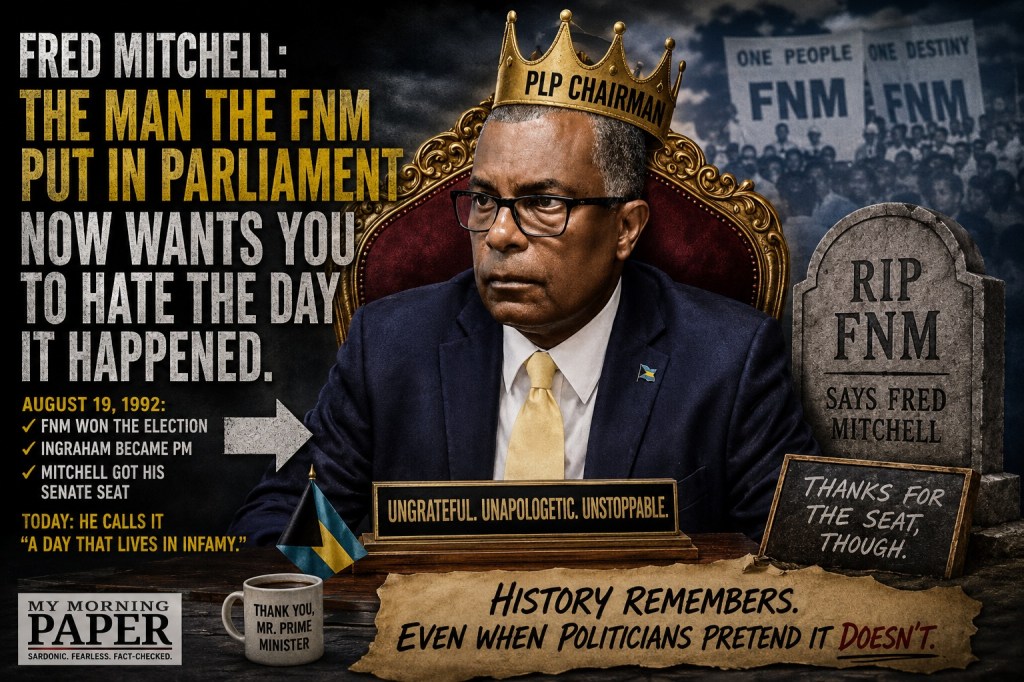
Fred Mitchell—yes, that Fred Mitchell, now wearing the dual hats of PLP Chairman and part-time Sunday school narrator—has once again taken to the podium to critique the FNM with all the confidence of a man who has apparently never met irony… or a mirror.

His review of the FNM’s campaign launch under Michael Pintard reads less like analysis and more like a dramatic reading of a prophecy he found scribbled in the margins of his “dream book”—a document which, judging by PLP governance, appears to be less strategic plan and more bedtime fiction. According to Mitchell, the event was underwhelming. Which is interesting, because by his own admission, he wasn’t even there. One assumes his “scouts” were dispatched with the same precision as PLP policy execution—enthusiastic, but not at all reliable.

But let’s get to the real performance: Mitchell’s attempt to diminish Pintard by tying him to his time as a Cabinet Minister under Hubert Minnis. Now, that’s a bold strategy—bold in the sense that it requires the audience to forget that Mitchell himself has been a Cabinet Minister under multiple PLP administrations. Not one. Not two. But enough to qualify for a loyalty punch card.

And how did those administrations fare? Well, let’s just say the electoral results were so “impressive” that both Mitchell and then-Prime Minister Perry Christie managed the rare political feat of losing their seats. That’s not just a bad night—that’s a full-blown democratic eviction notice.

So, when Mitchell lectures about performance and credibility, it lands a bit like a chef with a long history of kitchen fires critiquing someone else’s seasoning.

Even more curious is his ongoing commentary about Marvin Dames, whom he references with the kind of certainty usually reserved for court verdicts—except, inconveniently, there hasn’t been one. For a man trained in law, Mitchell seems remarkably comfortable skipping past the “innocent until proven guilty” part and heading straight to the closing arguments… in the court of public opinion.

Which brings us to his pearl-clutching over “jeopardizing investigations” and “defaming possibly innocent people.” A fascinating concern—particularly when viewed alongside his own public commentary. It’s the political equivalent of someone setting off fireworks indoors and then complaining about the smoke.

Mitchell also seemed deeply troubled by who was not at the FNM event, listing names like a substitute teacher taking attendance. But in doing so, he conveniently ignored who was there—because that might disrupt the narrative. It’s a bit like reviewing a movie by focusing only on the empty seats in the theatre rather than the film itself.

And then there’s the sudden, almost tender concern for former leaders like Hubert Ingraham—a man the PLP has historically treated with all the warmth of a tax audit. Now, apparently, he’s being invoked like a long-lost uncle at a family reunion. One can only assume this newfound affection is less about respect and more about political convenience.

In the end, Mitchell’s critique tells us far more about the PLP’s current playbook than it does about the FNM. It’s a mix of selective outrage, historical amnesia, and theatrical indignation—seasoned, of course, with a generous helping of biblical references for dramatic effect.

Because if there’s one thing we’ve learned, it’s this: when the substance is thin, the sermon gets longer.

The Progressive Liberal Party (PLP) fails for one reason; it is their nature.

END

My Morning Paper 21 March 2026 – The Passport Office Paradox: When Renewals Somehow Create New Fraud

Ah yes, the classic political two-step: “Bring the evidence!” swiftly followed by “How dare you bring the evidence!” — a maneuverer so elegant it deserves its own Olympic category.

Let’s walk through this slowly, because apparently clarity is now a controversial concept.

The Leader of the Opposition, Michael Pintard, raises concerns about fraud at the Passport Office — serious concerns, mind you, involving individuals allegedly obtaining Bahamian passports using fraudulent documents. The government, led by Philip Brave Davis and with Fred Mitchell leading the charge rhetorically, responds with the predictable bravado: “Table the documents in Parliament.”

So, he does.

And suddenly, we’re told — clutch your pearls — that he may have compromised an ongoing investigation.

Which raises an uncomfortable but necessary question: Which is it?

Was the Opposition supposed to present evidence, or perform interpretive dance around it?

Because demanding documentation and then condemning its presentation isn’t governance — it’s gaslighting with a parliamentary soundtrack.

Now, let’s get to the truly impressive bit of logical gymnastics.

We’re told that 98 cases of suspected passport fraud have been referred to the Royal Bahamas Police Force. Not two. Not five. Ninety-eight. That is not a rounding error — that is a flashing red alarm bell with a megaphone.

And yet, somehow, the explanation offered is that a 2019 policy under the previous FNM administration — a policy dealing with passport renewals — is to blame.

Renewals.

Not new applications.

Not fraudulent documentation.

Renewals… for people who already had valid passports.

So, unless Bahamians have recently developed the ability to retroactively fake identities they already possessed, this explanation doesn’t just stretch credibility — it snap-cracks it in half.

Let’s be very clear about the distinction the public is being asked to ignore:

Renewals: Existing passport holders updating valid documents.

Fraud cases in question: Individuals allegedly obtaining passports using fraudulent supporting documents.

These are not the same thing. Not legally. Not administratively. Not even philosophically.

And pretending they are is not just misleading — it’s an insult to the intelligence of the average right-thinking Bahamian.

What we are witnessing is a government attempting to:

Deflect responsibility for issues occurring squarely under its watch.

Reframe the narrative to blame a prior administration.

Simultaneously claim credit for “fixing” a problem they insist they didn’t create.

It’s political alchemy: turning accountability into accusation, and failure into a press release.

But here’s the part that deserves far more attention than it’s getting:

Whatever became of the audit of the Passport Office that was reportedly conducted after this administration came to office?

An audit, by definition, is supposed to identify weaknesses, risks, and — stay with me here — fraud vulnerabilities.

So, if:

An audit was done,

Weaknesses were presumably identified, and

Nearly 100 fraud cases have now emerged…

Then the obvious question is not “Who can we blame?”

It is: What did the government know, and what did they do about it?

Because if the audit found issues and they weren’t addressed, that’s negligence.

And if the audit didn’t find issues that now clearly exist, that raises questions about competence.

Either way, pointing backward doesn’t absolve responsibility moving forward.

What makes this all the more remarkable is the contradiction baked into the government’s own messaging:

On one hand: “The system is working because we caught the fraud.”

On the other: “The fraud exists because of the previous administration.”

So, which is it? A newly strengthened system under this administration — or a broken one inherited from the last?

Because it cannot logically be both without admitting that the current administration has had both the time and the authority to fix it.

Instead, what we’re getting is a masterclass in political deflection — where every problem is inherited, every solution is self-congratulatory, and every contradiction is treated as if the public simply won’t notice.

But people are noticing.

And the truth is far simpler than the spin:

Fraudulent passports being issued — if proven — are not a theoretical policy debate. They are a current administrative failure with serious implications for national security, electoral integrity, and public trust.

No amount of rhetorical gymnastics changes that.

The Bahamian people don’t need blame-shifting.

They don’t need selective outrage.

And they certainly don’t need a government that demands evidence only to panic when it appears.

They need accountability.

And right now, that seems to be the one document no one in authority is willing to table.

The Progressive Liberal Party (PLP) fails for one reason; it is their nature.

END

My Morning Paper 19th March 2026 – The Pope and a smell of Fish

Ah yes—because nothing says “healthy, thriving democracy” quite like a poll you can’t see, can’t verify, and apparently wasn’t meant to be looked at too closely… like the political equivalent of “trust me, bro.”

Now, let’s talk about this with the appropriate level of raised eyebrow, shall we?

Back in 2022, Philip Davis was enjoying a very respectable post-election honeymoon glow, buoyed by an approval rating reportedly around 67% after his first 100 days. Perfectly normal. Governments win elections, people feel hopeful, and for a brief, shining moment everyone pretends potholes are “temporary character features.”

But—and this is important—that number came from a sample of 1,064 people in a country of roughly 400,000. Statistically speaking, that’s about 0.26% of the population. Which is fine, by the way, if the poll is scientifically conducted, transparent in its methodology, and properly randomized.

Because here’s the thing: small samples can absolutely be valid. That’s how polling works. But only when you can actually see how the sausage was made. Otherwise, it’s not polling—it’s numerology with better branding.

And now, fast forward to today, where the Progressive Liberal Party proudly points to a new poll—surveying 805 people—as evidence that they are cruising toward victory in the next general election. Eight hundred and five people. Roughly 0.2% of the population.

Again, not inherently invalid… if the methodology is sound, disclosed, and independently credible.

But here’s where things get delightfully murky.

According to The Nassau Guardian, the PLP claims 38% support versus 18% for the Free National Movement. To which the FNM responded, in what might be the most relatable political statement ever: “Fishermen never say their fish stink.”

And honestly, that might be the most statistically rigorous part of this entire situation.

Because when a poll is commissioned, released, and promoted by the same political party that benefits from it—without clear disclosure of sampling methods, margins of error, weighting, or even basic transparency—you don’t have a crystal ball. You have a mirror.

A very flattering mirror. The kind found in a carnival funhouse, where somehow, you are both taller and more popular than reality suggests.

Now, to be fair—and this is where we stay grounded—random sampling can produce reliable insights even with a few hundred respondents. That’s Polling 101. But secrecy and science are not natural allies. If anything, secrecy is what science actively tries to avoid. You publish your methods. You show your work. You invite scrutiny.

You do not conduct what appears to be a politically convenient survey and then ask the public to accept it on vibes alone.

Because when you look at numbers like these, they don’t scream “data-driven certainty.” They whisper, “internal reassurance.” The kind of numbers that say, “Everything is fine,” while the political equivalent of a check engine light is blinking quietly in the background.

And that’s the real question here: if everything is fine—if support is genuinely strong and growing—why the need for a poll that feels like it was conducted somewhere between a strategy meeting and a group chat?

Why not publish the full methodology? Why not let independent analysts tear it apart and confirm its strength?

Unless of course… you’re not entirely sure they would.

Because projecting confidence and having confidence are not the same thing. One is a press release. The other survives scrutiny.

So, are they sensing trouble? Not necessarily panic—but perhaps enough uncertainty to start shaping the narrative early. To say, “We’re winning,” not just to the public, but maybe to themselves.

And if this is the new standard, then fantastic. I, too, will be commissioning a poll. Sample size: me, two friends, and a cousin

And I’m delighted to report that early findings show overwhelming support for my candidacy as the next Pope.

Because apparently, in this Brave New world of mystery polling, anything is possible… as long as you don’t ask too many questions.

The Progressive Liberal Party (PLP) fails for one reason, it is their nature.

END

My Morning Paper- 18th March 2026 – Told You Already: Michael Darville vs. The World’s Most Surprised Prime Minister

If this were a sitcom, it would be called “Everybody Talks to the Prime Minister… Except the Prime Minister.” And yes, somehow, he’s also the Minister of Finance in this episode.

Let’s start with the star of the show: Philip Davis — who, in a moment of what we’ll generously call “selective surprise,” told the public: he had “just been hearing about this” regarding delayed NHI payments and couldn’t quite figure out why doctors and labs weren’t being paid.

Now, that’s already a tough sell. Because when you are both Prime Minister and Minister of Finance, “I just heard about it” sounds less like leadership and more like someone forgetting to check their own email… that they sent to themselves.

Enter Act Two: Michael Darville — who, apparently unaware he was about to ruin the plot twist — stood up in Parliament and calmly explained that the Prime Minister was in fact aware of what was happening in the Ministry of Health and Wellness… because they have regular meetings.

Regular meetings.

So now we have a fascinating constitutional mystery:

  • The Prime Minister says he didn’t know
  • The Health Minister says he told him
  • And both statements are happening in the same government… at the same time… in the same country

At this point, the only logical conclusion is that the weekly meetings are either:

  1. A deeply immersive role-playing exercise where no one remembers what was said, or
  2. A historic breakthrough in political physics where information enters the room… and immediately evaporates upon contact with responsibility

Because let’s be clear: the issue of delayed National Health Insurance (NHI) payments to physicians and laboratories isn’t a minor clerical hiccup. It’s a core operational function of the healthcare system. When payments stall, care stalls. And when care stalls, explanations like “I just heard about it” start to sound less like updates and more like excuses.

So, the real question isn’t whether someone is confused.

The real question is:
Who exactly is running the Ministry of Finance — and did they think to inform the Minister of Finance?

Because if the Prime Minister didn’t know what the Minister of Finance was doing… and the Minister of Finance is the Prime Minister… then congratulations — The Bahamas has achieved what few governments ever have:

A full internal breakdown of communication… within a single individual.

The Progressive Liberal Party fails for one reason; it is their nature and the Bahamian people really do deserve much better.

END

My Morning Paper – 16th March 2026 – “Choose Actual Progress… or Choose ‘Pending’ Progress?”

Let’s talk about progress. Not the kind you campaign on… the kind you can actually point to without needing a PowerPoint, a press release, and a small prayer circle.

Because right now, when it comes to the Grand Lucayan Resort, the Progressive Liberal Party is starting to look less like a government and more like a group project where nobody did their part—but everyone still shows up to present.

I made an observation a few days ago about Grand Bahama and the electoral survival strategy of the PLP. It’s actually pretty simple—three things need to happen before the next election:

  • A signed and advancing redevelopment contract for the Grand Bahama International Airport
  • A clearly articulated economic path forward for Freeport post-tribunal
  • And—this is the big one—a finalized deal and visible construction activity at the Grand Lucayan Resort

Now, based on current reporting, it appears the government has decided to tackle this ambitious agenda using a bold new strategy called… “eventual vibes.”

According to The Nassau Guardian article “Silence on Grand Lucayan,” we’ve now entered week three of a two-week promise. Which, mathematically, is impressive if you’re working in a system where time is more of a suggestion than a measurement.

Let’s review the facts:

  • In May 2025, a deal was announced with Concord Wilshire to purchase and redevelop the resort.
  • On February 23, the developer said detailed plans and timelines would be announced within two weeks.
  • Two weeks came. Two weeks went. Two weeks packed their bags, left the island, and still—nothing.

Now, to be fair, the developer did say they are “advancing planning, design coordination, capital structuring, and development scheduling.” Which is corporate for: “We’re doing things… somewhere… trust us.”

Meanwhile, Philip Davis—who, at this point, deserves frequent flyer miles for traveling between “progressing” and “nothing to add”—assured the public that “developments take time.”

And he’s right. Development does take time.

But here’s the issue: this particular project has been taking time across multiple administrations, multiple announcements, and at least one cancelled deal that already existed.

That’s the part that’s hard to ignore.

The PLP scrapped the previous arrangement under the Free National Movement, arguing it wasn’t in the best interest of Bahamians. Fair enough—that’s their prerogative.

But what followed?

A signing ceremony.
A “demolition” that looked suspiciously like a photo-op with hard hats.
And now… a prolonged national exercise in “just wait, we got this.”

At some point, “Choose Progress” starts to sound less like a slogan and more like a multiple-choice question where none of the answers are correct.

Because what exactly is the progress here?

  • No visible construction
  • No detailed timeline
  • No clear public roadmap
  • And now, not even updated communication beyond “soon”

“Soon,” by the way, is doing a lot of heavy lifting in this administration. At this rate, “soon” might qualify for a Cabinet position.

And look—governing is hard. Large-scale developments are complicated. No serious person expects overnight transformation.

But what people do expect is clarity.

They expect consistency.
They expect measurable movement.
And most importantly—they expect that if you cancel something that was already in motion, you replace it with something better… not something quieter.

Right now, the silence surrounding the Grand Lucayan isn’t just awkward—it’s politically dangerous.

Because silence invites a very simple question:

What exactly is going on?

And if the answer is still “progressing,” then the follow-up is even simpler:

Progressing to where?

At this point, the Grand Lucayan saga feels less like a development project and more like a long-running series where every season finale promises answers… and every new season starts with, “Previously on Nothing Happened…”

The Bahamas deserve better than that.

We deserve more than renderings.
More than reassurances.
And definitely more than ribbon-cutting ceremonies for things that haven’t actually been built yet.

We deserve a government that doesn’t just announce progress…but one that can actually show it.

The Progressive Liberal Party (PLP) fails for one reason; it is their nature.

END

My Morning Paper – 15th March 2026 – NHI Delays: A Mystery to the Man in Charge, When the Prime Minister is the last to know

Buried on page three of The Tribune is a headline that reads less like leadership and more like a man discovering his job description almost at the end of his term: the Prime Minister is “trying to get his head wrapped around” NHI payment delays.

Now, ordinarily, that might be a fair admission—if the person speaking were not Philip “Brave” Davis… who just also happens to be the Minister of Finance, just imagine that.

Yes, the same office ultimately responsible for the flow of government payments, including those tied to National Health Insurance.

So, let’s get this straight: doctors aren’t being paid on time, laboratories are frustrated, providers are organizing themselves into associations just to advocate for basic compensation—and the man in charge of the country’s finances is publicly “just hearing about this” and “only now going to look into it.”

One is left to wonder: looking into what, exactly? His own ministry?

Because if the Prime Minister, in his capacity as Minister of Finance, does not know why payments are delayed… then who does? And more importantly—who is actually in control of the Ministry of Finance?

This isn’t a minor administrative hiccup. The NHI programme is not some obscure line item buried deep in a budget appendix. It is a central pillar of public healthcare, affecting doctors, providers, and ultimately the lives of Bahamians. Payment delays in such a system are not “glitches”—they are systemic failures with real consequences.

The explanation offered—those ever-convenient “bureaucratic glitches”—has become the governmental equivalent of “the dog ate my homework.” Reliable, repeatable, and increasingly unconvincing.

Even more concerning is the contradiction: on one hand, the government previously suggested “irregularities” in billing; on the other, providers themselves have pushed back, stating that such characterizations misunderstand how the system actually operates. So, which is it? Faulty billing, or faulty administration?

Many right-thinking Bahamians are now thinking the latter.

And while this back-and-forth plays out in the press, doctors wait. Laboratories wait. Patients—whether they realize it or not—wait too.

There is something almost comical, in a darkly ironic way, about a Prime Minister expressing frustration at a problem that falls squarely under his own ministerial portfolio. It’s like watching a man file a complaint against himself, then promise to investigate himself thoroughly.

Perhaps the most charitable interpretation is that there is a breakdown in communication within the Ministry of Finance. The less charitable interpretation? That there is no communication to break down.

Either way, the conclusion is the same: leadership cannot function on surprise. A Prime Minister cannot afford to be the last to know—especially when he is also supposed to be the first responsible.

One hopes that Philip Davis does, in fact, “get his head wrapped around this” soon. Because while the phrasing may be light, the situation is anything but. This is not an abstract policy debate—it is the operational backbone of healthcare in the Bahamas.

And if the Minister of Finance needs to be briefed on what the Minister of Finance is doing, then the country has a far bigger problem than delayed payments.

The Progressive Liberal Party (PLP) fails for one reason; it is their nature.

END

My Morning Paper – 13 March 2026 – Patriotism, Port Authority, and Plenty of Noise: The PLP’s Freeport Drumbeat

There are mornings when you open the newspaper expecting clarity and instead receive a theatrical production. Yesterday’s installment from Fred Mitchell, chairman of the New Day Progressive Liberal Party (PLP), was very much in the category of political theatre — dramatic, loud, and curiously short on specifics.

In a recent broadside, Mr. Mitchell accused the Leader of the Opposition, Michael Pintard of being everything short of a saboteur for daring to articulate a vision for Freeport that does not perfectly mirror the government’s daily talking points about the Grand Bahama Port Authority (GBPA).

Apparently, in the new political dictionary of the PLP, disagreement equals “unpatriotic.”

One imagines the framers of the Hawksbill Creek Agreement rolling gently in their archives at the idea.

When Disagreement Becomes “Unpatriotic”

Mr. Mitchell claims that Mr. Pintard’s views are “perilously close” to those of the GBPA. A serious allegation, if true. But as usual, the chairman neglected to explain how.

In fact, publicly available statements from Mr. Pintard tell a rather different story. The Opposition leader has repeatedly said that the two families who control the GBPA — the Haywards and the St. Georges — should divest their shares to allow greater Bahamian ownership of the Port.

That hardly sounds like a love letter to the Port Authority.

Mr. Pintard has also argued that reforms can be made to give Bahamians more say while preserving the Hawksbill Creek Agreement, which governs the relationship between the government and the Port Authority and is set to expire in 2054.

If recognizing a binding agreement that still has nearly three decades left to run is now considered “unpatriotic,” then contract law everywhere may wish to take a seat and steady itself.

The fact is that The Tribunal Has Already Changed the Landscape.

Lost in the government’s daily drumbeat is a rather important fact.

Following arbitration between the government and the GBPA, a tribunal ruling clarified that the Bahamian government does possess regulatory authority within Freeport, while the GBPA remains responsible for certain obligations outlined in the Hawksbill Creek Agreement.

In other words:

  • The government has regulatory powers.
  • The Port Authority must meet its obligations under the agreement.

For most observers, that seemed a fairly straightforward outcome. Not quite the revolutionary overthrow of the Port Authority some had promised, but certainly not the catastrophe some feared either.

Which raises an awkward question.

If the legal framework is now clarified, what exactly is the government’s plan going forward?

The Sound of Drums, But No Map

Instead of a detailed blueprint for the economic revival of Freeport, Bahamians are treated to a daily recital of who is or is not sufficiently patriotic.

Yet the same government that now proclaims a crusade against the Port Authority also presided over:

  • The unresolved saga of the Freeport airport redevelopment, and
  • The collapse and resale complications surrounding the Grand Lucayan resort.

Both were once presented as cornerstones of Grand Bahama’s revival. Both remain, shall we say, works very much in progress.

One might reasonably expect that a government so eager to expel the GBPA would at least outline what replaces it, especially considering the Hawksbill Creek Agreement remains legally in force until 2054.

Expelling the Port Authority tomorrow would not simply be a matter of political will. It would almost certainly involve legal and financial consequences, none of which the public has been told about.

Curiously, the loudest voices calling for immediate expulsion rarely discuss the bill that might follow.

The Curious Case of the “Status Quo”

Mr. Mitchell also accuses the Opposition of supporting the “status quo.”

But if the tribunal has already clarified the government’s regulatory powers — something the government itself celebrates — then the status quo has already changed.

Which leaves us wondering:

If the government now has the authority it sought, why the continuing political war drums?

Could it be that the original objectives of the arbitration were not achieved exactly as planned, and the public now requires a steady supply of rhetorical fireworks to compensate?

A Final Morning Thought

Bahamians deserve more than political name-calling dressed up as patriotism.

The residents of Freeport, in particular, deserve something even more radical: a clear plan.

The government now has confirmed regulatory authority.

It would therefore seem like an excellent moment to present a detailed roadmap for revitalizing the city — investment strategy, governance reforms, infrastructure development, and timelines.

Unless, of course, the reason for the daily speeches about the GBPA is much simpler.

Sometimes when the drums are loud enough, no one notices that there is no marching plan at all.

The Progressive Liberal Party fails for one reason; it is their nature.

END

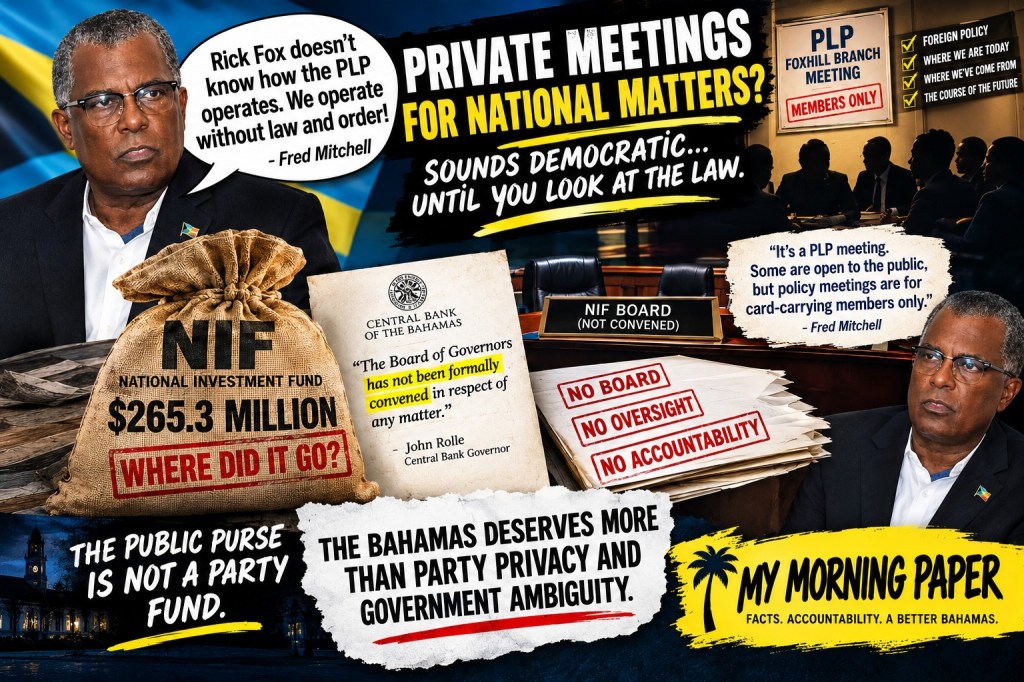
My Morning Paper 11th March 2026 – A Public Town Hall… or Private Party Meeting? The Curious Case of Fred Mitchell’s “Civic-Minded Bahamians”

Listening to the recent voice note by Fred Mitchell, chairman of the governing Progressive Liberal Party, one could be forgiven for thinking that a dramatic political ambush took place at a quiet, noble gathering of “civic-minded Bahamians” in Freeport.

According to Mitchell’s retelling, the meeting was meant to “clear the air” about the arbitration ruling between the Government of The Bahamas and the Grand Bahama Port Authority.

But then—cue the dramatic music—Opposition Leader Michael Pintard allegedly “crashed the party,” only to be booed and condemned for daring to defend the Port Authority families.

Now that is quite a story. Almost cinematic.

But it raises a few awkward questions.

First, Pintard is not exactly a random passer-by who wandered into the wrong wedding reception. He is an elected Member of Parliament representing a constituency in Grand Bahama and the leader of the Free National Movement. He also lives on the island.

If a meeting is held in Freeport about the future governance and economic structure of Freeport, one would imagine the island’s elected national leader of the opposition might have a legitimate reason to attend.

Unless, of course, “town hall meeting” actually meant something closer to “PLP supporters’ appreciation night with optional booing.”

Because Mitchell described the gathering as public.

Yet the reaction suggests it may have been public in the same way some birthday parties are public: everyone is welcome… as long as they agree with the host.

What Pintard Actually Said (Versus What the PLP Claims)

Mitchell’s voice note suggests that Pintard was “taking the side” of Rupert Hayward and the families controlling the GBPA.

That characterization is politically convenient—but not entirely accurate.

What Pintard has actually argued publicly is far narrower:

• The arbitration ruling clarified the legal obligations between the parties.
• The tribunal did not determine that the GBPA currently owes a specific amount in back fees.
• Any future obligations must be assessed according to the ruling and applicable agreements.

In other words, Pintard’s position was essentially: follow the ruling as written.

That is not quite the same thing as defending the Port Authority families.

But in modern politics, nuance is often the first casualty—especially when a good booing opportunity presents itself.

What the Tribunal Actually Decided

The arbitration between the Grand Bahama Port Authority and the Government of The Bahamas centered on regulatory authority and fees in the Freeport area governed under the Hawksbill Creek Agreement framework.

Key points widely reported from the ruling include:

• The tribunal rejected the government’s attempt to immediately collect large sums in alleged historical arrears from the GBPA.
• The ruling clarified regulatory responsibilities between the parties going forward.
• The issue of any specific financial liability was not resolved as a payable lump sum in the way the government had initially framed it.

Which is why the government declaring total victory—and critics declaring total defeat—both sound a bit like fans arguing over a cricket match that was actually called off for rain.

A “Dead Issue”… Except for the Political Theatre

Ironically, even Mitchell himself has suggested the matter is effectively settled.

Which raises the obvious question:

If the issue is “dead,” why are we still holding revival meetings for it?

The reality is that the tribunal has ruled, the legal framework has been clarified, and both sides must now operate within that framework.

The Grand Bahama Port Authority has indicated it will comply with obligations moving forward. The historic arrears claim—at least in the sweeping form originally presented—did not survive the arbitration process.

So perhaps the bigger question for the New Day Progressive Liberal Party government is this:

After more than four years in office, what exactly is the development plan for Grand Bahama?

Because while political voice notes and town-hall theatrics may entertain the faithful, they do not rebuild roads, attract investors, or revive an economy.

At some point, the speeches must give way to actual work.

Grand Bahama has heard quite enough talking.

The Bahamian people deserve better.

END

My Morning Paper – 10th March , 2026 – Clearing the Air… or Clearing the Narrative?

Just as the dust had begun to settle following the arbitration ruling between the Government of The Bahamas and the Grand Bahama Port Authority (GBPA), the New Day Progressive Liberal Party (PLP) suddenly found the need to convene a town hall meeting in Freeport to “clear the air.”

This is curious, because the air—at least legally—had already been cleared.

The international tribunal’s ruling was quite plain: the government’s claim that the GBPA owed $357 million for administrative services between 2018 and 2022 was dismissed.

Instead, the tribunal determined that the mechanism the government relied upon had been replaced by a later arrangement negotiated in the 1990s, meaning the government could not retroactively calculate and enforce those claims in the way it attempted.

In short, the headline number that fueled years of political rhetoric—$357 million—did not survive arbitration.

Yet, somehow, once the ruling landed, the country was suddenly invited to a political “clarification session.”

One must ask: if the tribunal’s findings were already on record, what exactly needed clearing?

Then came the convenient narrative shift, according to reporting in The Nassau Guardian, Prime Minister Philip “Brave” Davis told attendees at the Belinda M. Wilson Centre that the GBPA may now be building a legal strategy claiming it “cannot pay” the liabilities the government says it is owed.

If that is indeed the Port Authority’s strategy, then the obvious question becomes:

Is the PLP now building its own defense—an “at least we tried” defense?

Because the uncomfortable political reality remains unchanged.

The government entered arbitration seeking $357 million, and that claim was dismissed in full by the tribunal.

Yes, the ruling confirmed that a payment mechanism between the government and GBPA exists and can be reviewed going forward, but the specific financial windfall that had been repeatedly invoked in speeches, press conferences, and political commentary did not materialize.

That fact alone explains why a sudden town hall meeting might now be necessary.

It is my opinion that the Davis administration entered this legal battle knowing the path to recovering $357 million would be extremely difficult—if not legally untenable.

Prime Minister Davis is widely regarded as an experienced attorney, a King’s Council. It strains credibility to believe that someone with his legal background would not have carefully weighed the strength of the claim before proceeding.

But politics often operates by a different set of incentives.

If you bring the claim and lose, you can still claim that you fought for the people.

If you bring the claim and win, you are a national hero.

And if you lose?

Well, you simply hold a town hall meeting and start explaining why the real story is something else entirely.

After all, if the government gambled with the people’s money in pursuit of political mileage, what’s the harm? The Minister of Finance assures us there will still be a $75 million surplus.

So why worry?

In the end the Hawksbill Agreement Was Clarified — But The Money Was Not Recovered

To be fair, the tribunal did clarify important aspects of the Hawksbill Creek Agreement.

It confirmed that the government retains regulatory authority in Freeport and that a payment mechanism between the GBPA and the state remains enforceable through 2054.

Those are legitimate outcomes.

But they are not the same as recovering $357 million.

And for months, that $357 million figure was the centrepiece of the government’s public messaging.

Now, with that claim dismissed, the narrative appears to be shifting.

From Arbitration to Political Theatre, which brings us back to the town hall meeting.

What was presented as an effort to “clear the air” looked, to many observers, more like a political rally. The event featured the Prime Minister alongside attorneys Gregory Moss, Ernie Wallace, and Terrence Gape, while opposition figures attempting to speak were reportedly heckled by attendees.

For an event supposedly focused on national clarity, it appeared to have a very partisan atmosphere.

Opposition leader Michael Pintard went so far as to describe the gathering as essentially a PLP rally rather than a neutral forum for discussion.

And perhaps that is precisely the point.

Because if the main objective—recovering $357 million—was not achieved, then the next best strategy is to reframe the conversation.

Suddenly the issue is no longer the missing $357 million.

Now the focus is on future payment mechanisms, potential negotiations, and hypothetical defences the GBPA might raise.

In politics, the best distraction from a failed objective is often a brand-new narrative.

What makes the entire episode even more troubling is the tone the government adopted throughout the process.

From the beginning, the Davis administration and its political allies aggressively attacked anyone who questioned the strategy. Critics were accused of siding with the Port Authority or failing to support The Bahamas.

But in a democracy, it is entirely possible—and entirely reasonable—to support the national interest while questioning the method used to pursue it.

Apparently, that nuance was unwelcome.

The tribunal’s findings were clear.

The $357 million claim did not succeed.

And yet the public is now being asked to attend political meetings designed to “explain” a ruling that already speaks for itself.

Which leaves many Bahamians asking a very simple question:

If recovering $357 million was the central objective of this entire legal battle…

What exactly happened?

Or, to put it in the language many frustrated observers might use:

“Daddy Brave… what happened?”

The Bahamas deserves better.

The Progressive Liberal Party (PLP) fails for one reason; it is their nature.

END