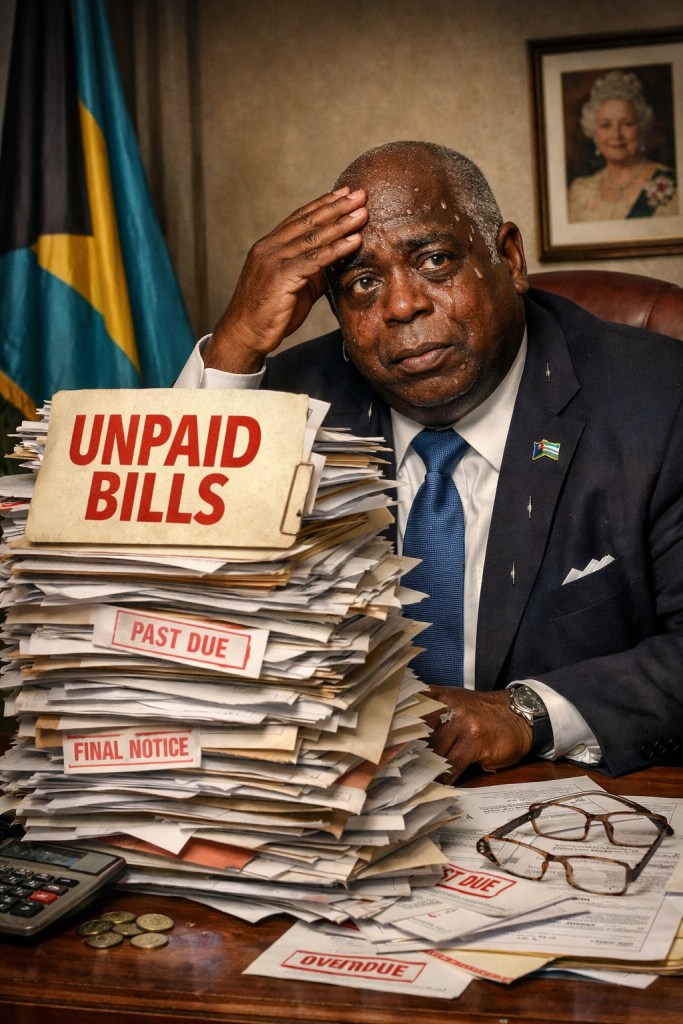
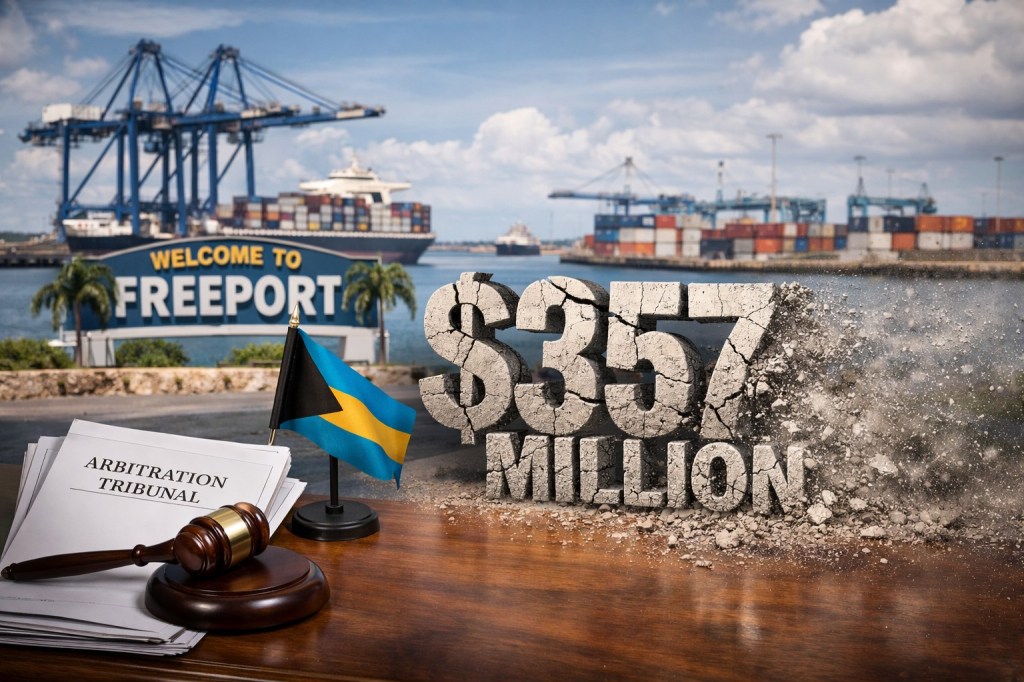
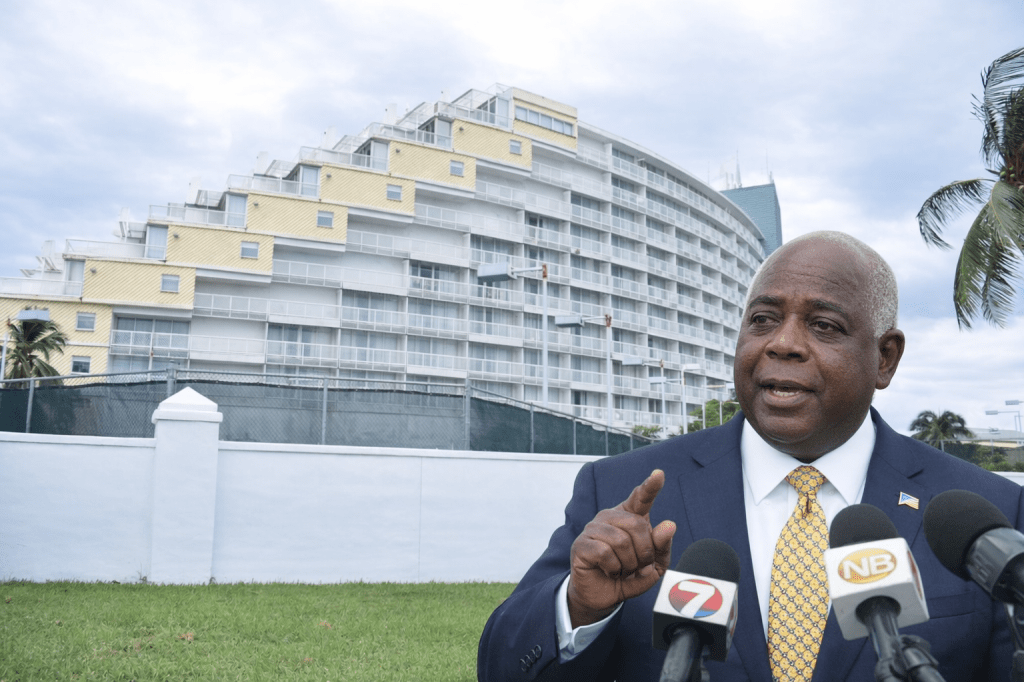
My Morning Paper – 13 March 2026 – Patriotism, Port Authority, and Plenty of Noise: The PLP’s Freeport Drumbeat

There are mornings when you open the newspaper expecting clarity and instead receive a theatrical production. Yesterday’s installment from Fred Mitchell, chairman of the New Day Progressive Liberal Party (PLP), was very much in the category of political theatre — dramatic, loud, and curiously short on specifics.

In a recent broadside, Mr. Mitchell accused the Leader of the Opposition, Michael Pintard of being everything short of a saboteur for daring to articulate a vision for Freeport that does not perfectly mirror the government’s daily talking points about the Grand Bahama Port Authority (GBPA).

Apparently, in the new political dictionary of the PLP, disagreement equals “unpatriotic.”

One imagines the framers of the Hawksbill Creek Agreement rolling gently in their archives at the idea.

When Disagreement Becomes “Unpatriotic”

Mr. Mitchell claims that Mr. Pintard’s views are “perilously close” to those of the GBPA. A serious allegation, if true. But as usual, the chairman neglected to explain how.

In fact, publicly available statements from Mr. Pintard tell a rather different story. The Opposition leader has repeatedly said that the two families who control the GBPA — the Haywards and the St. Georges — should divest their shares to allow greater Bahamian ownership of the Port.

That hardly sounds like a love letter to the Port Authority.

Mr. Pintard has also argued that reforms can be made to give Bahamians more say while preserving the Hawksbill Creek Agreement, which governs the relationship between the government and the Port Authority and is set to expire in 2054.

If recognizing a binding agreement that still has nearly three decades left to run is now considered “unpatriotic,” then contract law everywhere may wish to take a seat and steady itself.

The fact is that The Tribunal Has Already Changed the Landscape.

Lost in the government’s daily drumbeat is a rather important fact.

Following arbitration between the government and the GBPA, a tribunal ruling clarified that the Bahamian government does possess regulatory authority within Freeport, while the GBPA remains responsible for certain obligations outlined in the Hawksbill Creek Agreement.

In other words:

  • The government has regulatory powers.
  • The Port Authority must meet its obligations under the agreement.

For most observers, that seemed a fairly straightforward outcome. Not quite the revolutionary overthrow of the Port Authority some had promised, but certainly not the catastrophe some feared either.

Which raises an awkward question.

If the legal framework is now clarified, what exactly is the government’s plan going forward?
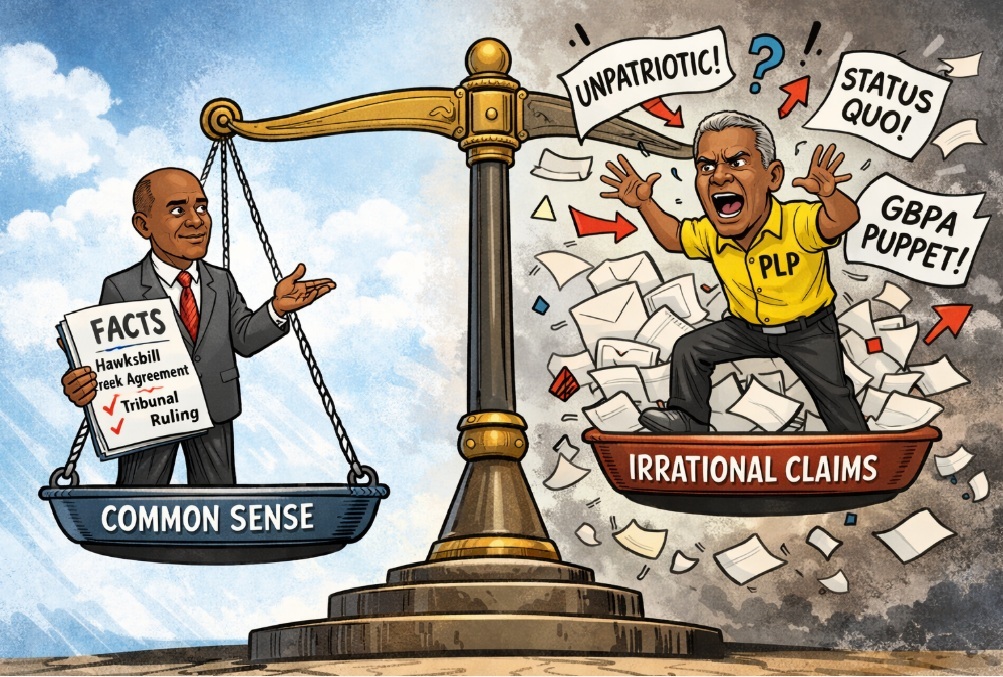
The Sound of Drums, But No Map

Instead of a detailed blueprint for the economic revival of Freeport, Bahamians are treated to a daily recital of who is or is not sufficiently patriotic.

Yet the same government that now proclaims a crusade against the Port Authority also presided over:

  • The unresolved saga of the Freeport airport redevelopment, and
  • The collapse and resale complications surrounding the Grand Lucayan resort.

Both were once presented as cornerstones of Grand Bahama’s revival. Both remain, shall we say, works very much in progress.

One might reasonably expect that a government so eager to expel the GBPA would at least outline what replaces it, especially considering the Hawksbill Creek Agreement remains legally in force until 2054.

Expelling the Port Authority tomorrow would not simply be a matter of political will. It would almost certainly involve legal and financial consequences, none of which the public has been told about.

Curiously, the loudest voices calling for immediate expulsion rarely discuss the bill that might follow.

The Curious Case of the “Status Quo”

Mr. Mitchell also accuses the Opposition of supporting the “status quo.”

But if the tribunal has already clarified the government’s regulatory powers — something the government itself celebrates — then the status quo has already changed.

Which leaves us wondering:

If the government now has the authority it sought, why the continuing political war drums?

Could it be that the original objectives of the arbitration were not achieved exactly as planned, and the public now requires a steady supply of rhetorical fireworks to compensate?

A Final Morning Thought

Bahamians deserve more than political name-calling dressed up as patriotism.

The residents of Freeport, in particular, deserve something even more radical: a clear plan.

The government now has confirmed regulatory authority.

It would therefore seem like an excellent moment to present a detailed roadmap for revitalizing the city — investment strategy, governance reforms, infrastructure development, and timelines.

Unless, of course, the reason for the daily speeches about the GBPA is much simpler.

Sometimes when the drums are loud enough, no one notices that there is no marching plan at all.

The Progressive Liberal Party fails for one reason; it is their nature.

END
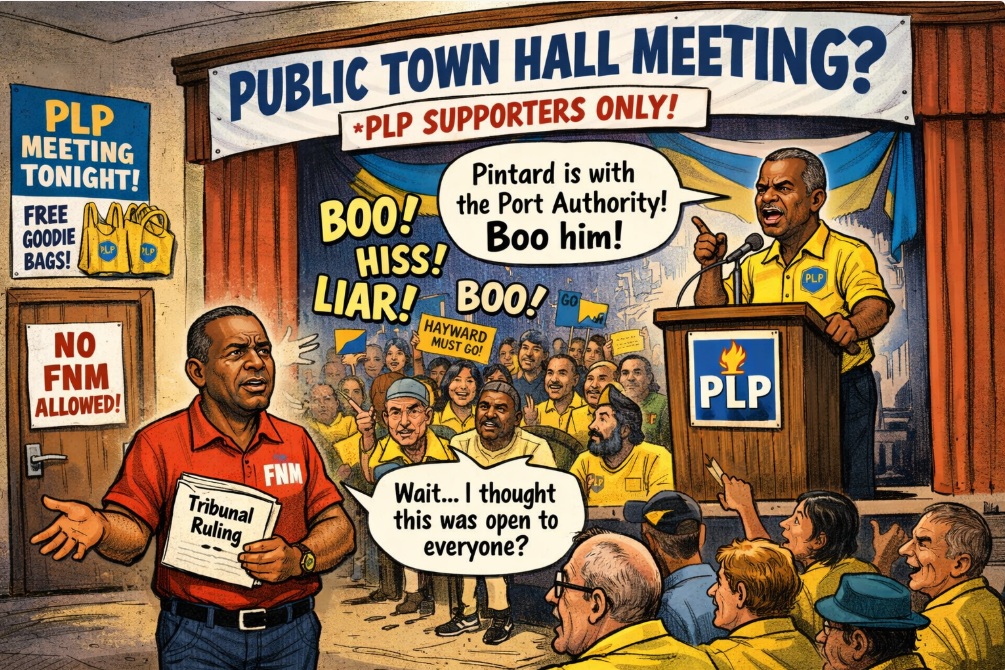
My Morning Paper 11th March 2026 – A Public Town Hall… or Private Party Meeting? The Curious Case of Fred Mitchell’s “Civic-Minded Bahamians”

Listening to the recent voice note by Fred Mitchell, chairman of the governing Progressive Liberal Party, one could be forgiven for thinking that a dramatic political ambush took place at a quiet, noble gathering of “civic-minded Bahamians” in Freeport.

According to Mitchell’s retelling, the meeting was meant to “clear the air” about the arbitration ruling between the Government of The Bahamas and the Grand Bahama Port Authority.

But then—cue the dramatic music—Opposition Leader Michael Pintard allegedly “crashed the party,” only to be booed and condemned for daring to defend the Port Authority families.

Now that is quite a story. Almost cinematic.

But it raises a few awkward questions.

First, Pintard is not exactly a random passer-by who wandered into the wrong wedding reception. He is an elected Member of Parliament representing a constituency in Grand Bahama and the leader of the Free National Movement. He also lives on the island.

If a meeting is held in Freeport about the future governance and economic structure of Freeport, one would imagine the island’s elected national leader of the opposition might have a legitimate reason to attend.

Unless, of course, “town hall meeting” actually meant something closer to “PLP supporters’ appreciation night with optional booing.”

Because Mitchell described the gathering as public.

Yet the reaction suggests it may have been public in the same way some birthday parties are public: everyone is welcome… as long as they agree with the host.

What Pintard Actually Said (Versus What the PLP Claims)

Mitchell’s voice note suggests that Pintard was “taking the side” of Rupert Hayward and the families controlling the GBPA.

That characterization is politically convenient—but not entirely accurate.

What Pintard has actually argued publicly is far narrower:

• The arbitration ruling clarified the legal obligations between the parties.
• The tribunal did not determine that the GBPA currently owes a specific amount in back fees.
• Any future obligations must be assessed according to the ruling and applicable agreements.

In other words, Pintard’s position was essentially: follow the ruling as written.

That is not quite the same thing as defending the Port Authority families.

But in modern politics, nuance is often the first casualty—especially when a good booing opportunity presents itself.

What the Tribunal Actually Decided

The arbitration between the Grand Bahama Port Authority and the Government of The Bahamas centered on regulatory authority and fees in the Freeport area governed under the Hawksbill Creek Agreement framework.

Key points widely reported from the ruling include:

• The tribunal rejected the government’s attempt to immediately collect large sums in alleged historical arrears from the GBPA.
• The ruling clarified regulatory responsibilities between the parties going forward.
• The issue of any specific financial liability was not resolved as a payable lump sum in the way the government had initially framed it.

Which is why the government declaring total victory—and critics declaring total defeat—both sound a bit like fans arguing over a cricket match that was actually called off for rain.

A “Dead Issue”… Except for the Political Theatre

Ironically, even Mitchell himself has suggested the matter is effectively settled.

Which raises the obvious question:

If the issue is “dead,” why are we still holding revival meetings for it?

The reality is that the tribunal has ruled, the legal framework has been clarified, and both sides must now operate within that framework.

The Grand Bahama Port Authority has indicated it will comply with obligations moving forward. The historic arrears claim—at least in the sweeping form originally presented—did not survive the arbitration process.

So perhaps the bigger question for the New Day Progressive Liberal Party government is this:

After more than four years in office, what exactly is the development plan for Grand Bahama?

Because while political voice notes and town-hall theatrics may entertain the faithful, they do not rebuild roads, attract investors, or revive an economy.

At some point, the speeches must give way to actual work.

Grand Bahama has heard quite enough talking.

The Bahamian people deserve better.

END

My Morning Paper – 10th March , 2026 – Clearing the Air… or Clearing the Narrative?

Just as the dust had begun to settle following the arbitration ruling between the Government of The Bahamas and the Grand Bahama Port Authority (GBPA), the New Day Progressive Liberal Party (PLP) suddenly found the need to convene a town hall meeting in Freeport to “clear the air.”

This is curious, because the air—at least legally—had already been cleared.

The international tribunal’s ruling was quite plain: the government’s claim that the GBPA owed $357 million for administrative services between 2018 and 2022 was dismissed.

Instead, the tribunal determined that the mechanism the government relied upon had been replaced by a later arrangement negotiated in the 1990s, meaning the government could not retroactively calculate and enforce those claims in the way it attempted.

In short, the headline number that fueled years of political rhetoric—$357 million—did not survive arbitration.

Yet, somehow, once the ruling landed, the country was suddenly invited to a political “clarification session.”

One must ask: if the tribunal’s findings were already on record, what exactly needed clearing?

Then came the convenient narrative shift, according to reporting in The Nassau Guardian, Prime Minister Philip “Brave” Davis told attendees at the Belinda M. Wilson Centre that the GBPA may now be building a legal strategy claiming it “cannot pay” the liabilities the government says it is owed.

If that is indeed the Port Authority’s strategy, then the obvious question becomes:

Is the PLP now building its own defense—an “at least we tried” defense?

Because the uncomfortable political reality remains unchanged.

The government entered arbitration seeking $357 million, and that claim was dismissed in full by the tribunal.

Yes, the ruling confirmed that a payment mechanism between the government and GBPA exists and can be reviewed going forward, but the specific financial windfall that had been repeatedly invoked in speeches, press conferences, and political commentary did not materialize.

That fact alone explains why a sudden town hall meeting might now be necessary.

It is my opinion that the Davis administration entered this legal battle knowing the path to recovering $357 million would be extremely difficult—if not legally untenable.

Prime Minister Davis is widely regarded as an experienced attorney, a King’s Council. It strains credibility to believe that someone with his legal background would not have carefully weighed the strength of the claim before proceeding.

But politics often operates by a different set of incentives.

If you bring the claim and lose, you can still claim that you fought for the people.

If you bring the claim and win, you are a national hero.

And if you lose?

Well, you simply hold a town hall meeting and start explaining why the real story is something else entirely.

After all, if the government gambled with the people’s money in pursuit of political mileage, what’s the harm? The Minister of Finance assures us there will still be a $75 million surplus.

So why worry?

In the end the Hawksbill Agreement Was Clarified — But The Money Was Not Recovered

To be fair, the tribunal did clarify important aspects of the Hawksbill Creek Agreement.

It confirmed that the government retains regulatory authority in Freeport and that a payment mechanism between the GBPA and the state remains enforceable through 2054.

Those are legitimate outcomes.

But they are not the same as recovering $357 million.

And for months, that $357 million figure was the centrepiece of the government’s public messaging.

Now, with that claim dismissed, the narrative appears to be shifting.

From Arbitration to Political Theatre, which brings us back to the town hall meeting.

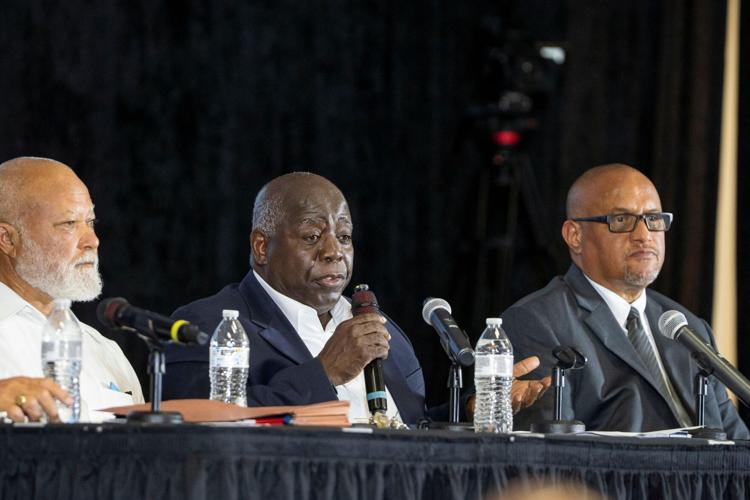
What was presented as an effort to “clear the air” looked, to many observers, more like a political rally. The event featured the Prime Minister alongside attorneys Gregory Moss, Ernie Wallace, and Terrence Gape, while opposition figures attempting to speak were reportedly heckled by attendees.

For an event supposedly focused on national clarity, it appeared to have a very partisan atmosphere.

Opposition leader Michael Pintard went so far as to describe the gathering as essentially a PLP rally rather than a neutral forum for discussion.

And perhaps that is precisely the point.

Because if the main objective—recovering $357 million—was not achieved, then the next best strategy is to reframe the conversation.

Suddenly the issue is no longer the missing $357 million.

Now the focus is on future payment mechanisms, potential negotiations, and hypothetical defences the GBPA might raise.

In politics, the best distraction from a failed objective is often a brand-new narrative.

What makes the entire episode even more troubling is the tone the government adopted throughout the process.

From the beginning, the Davis administration and its political allies aggressively attacked anyone who questioned the strategy. Critics were accused of siding with the Port Authority or failing to support The Bahamas.

But in a democracy, it is entirely possible—and entirely reasonable—to support the national interest while questioning the method used to pursue it.

Apparently, that nuance was unwelcome.

The tribunal’s findings were clear.

The $357 million claim did not succeed.

And yet the public is now being asked to attend political meetings designed to “explain” a ruling that already speaks for itself.

Which leaves many Bahamians asking a very simple question:

If recovering $357 million was the central objective of this entire legal battle…

What exactly happened?

Or, to put it in the language many frustrated observers might use:

“Daddy Brave… what happened?”

The Bahamas deserves better.

The Progressive Liberal Party (PLP) fails for one reason; it is their nature.

END
My Moring Paper 09 March 2026 – Arbitration Theatre While the Bills Pile Up

One would think that after an arbitration ruling, the matter would be settled.

That, after all, is the point of arbitration.

Yet here we are.

Despite a ruling in the dispute between the Government of The Bahamas and the Grand Bahama Port Authority (GBPA), the public is now being treated to a prolonged back-and-forth that feels less like governance and more like theatre. Each side appears determined to squeeze a few more headlines from a matter that was supposedly resolved by a tribunal.

For the GBPA, perhaps the continued sparring is about protecting its institutional position in Freeport.

For the government, however, the motivations appear far more convenient.

Because while the public is invited to watch this constitutional ping-pong match, another story quietly unfolds in the nation’s finances.

On 27 February 2026, The Nassau Guardian reported under the headline “Growing arrears raise fiscal concerns” that the government’s unpaid invoices and arrears had ballooned to $241 million, compared with $121 million at the same point the previous year.

That is not a rounding error.

That is a doubling.

The report noted that the administration of Philip Davis still expects revenue intake in the second half of the 2025/2026 fiscal year to bring the government’s finances back in line with its target of a $75 million surplus.

This raises a rather basic question.

Did the same miracle occur last year?

When the government promised that revenue intake during the second half of the 2024/2025 fiscal year would also align the numbers with its fiscal goals, did it actually happen? And if it did, why are arrears now climbing so dramatically?

Because here lies the curious logic of what might best be described as superstitious economics.

According to the government’s narrative, the public should not worry about the growing mountain of unpaid bills. Yes, the country may currently be hundreds of millions of dollars in arrears — but apparently, we are all meant to relax and trust that the latter half of the fiscal year will arrive like a benevolent economic fairy, wave its wand, and transform those arrears into a surplus.

One might call that optimism.

Others might call it accounting by wishful thinking.

Which brings us back to the GBPA dispute.

If the arbitration ruling has already reset the legal and commercial relationship between the parties, why is the matter still dominating public discourse? Why are government officials still trading rhetorical blows with the GBPA?

Could it be that the political value of the fight now outweighs the legal value of the ruling?

After all, it is far easier to keep the public focused on a quarrel in Freeport than to explain why government arrears have doubled in a year while officials simultaneously promise a surplus.

In politics, distraction is often the most convenient fiscal policy.

And if the public conversation remains fixed on arbitration drama rather than the country’s growing pile of unpaid bills, then perhaps the spectacle has already served its purpose.

The Bahamian people deserve better.

END

My Morning Paper 05 March – “Borrowing Pindling’s Words, But Not His Moment” – The $357 Million Question: What Did the Government Really Win?”

For the past several days, one could be forgiven for thinking that the government had just fought and won some historic constitutional battle over the governance of Freeport. The speeches have been fiery. The declarations dramatic. The comparisons to history unmistakable.

But once the dust settles and the arbitration tribunal’s findings are actually read, a far less triumphant picture begins to emerge.

Prime Minister Philip Davis now appears determined to ride what he describes as a “victory” over the Grand Bahama Port Authority (GBPA) for as much political mileage as possible as the country edges closer to a general election. Yet many Bahamians, after examining the ruling itself, are asking a very simple question: what exactly was won?

According to reporting by The Nassau Guardian, the Prime Minister declared in Parliament that the “old order” in Freeport was coming to an end. In doing so, he dismissed critics as “tissue leaders” and “jelly backs” while pledging to “break” the existing GBPA order.

The language was unmistakably evocative of the historic rhetoric of Sir. Lynden Pindling and his famous Bend or Break Speech delivered in 1969 — a moment that confronted discrimination and immigration practices in the port area during a very different era.

But invoking Pindling’s historic stand raises an uncomfortable question: is this truly a similar moment of national confrontation, or simply political theatre attempting to borrow the gravity of history?

Because if one returns to the beginning of this dispute, the government’s objective was very clear.

The administration of the Progressive Liberal Party asserted that the GBPA owed the government $357 million in back fees and payments under the Hawksbill Creek Agreement framework. That was the central claim. That was the headline number. And that was the basis upon which the confrontation was launched.

Yet when the arbitration tribunal issued its award, that massive financial claim did not materialize as a victory for the government.

Instead, the ruling largely clarified legal principles that were already widely understood but it would appear that Prime Minister is still dangling the promise of a “payout”; much like Lincoln Bain and his claim of $100,000.

What the Tribunal Confirmed:

The tribunal did affirm certain points:

  • The GBPA does not possess exclusive or “pre-eminent” powers that override Bahamian law.
  • The laws of the Government of The Bahamas have always applied in Freeport and continue to apply.

But these were not revolutionary discoveries.

Parliamentary sovereignty over Freeport has long existed under:

  • The Bahamian Constitution
  • Clause 3(9) of the Hawksbill Creek Agreement
  • Various statutes enacted by Parliament over the past six decades

In other words, the tribunal largely acknowledged a legal reality that already existed.

What the Tribunal Did Not Do:

Equally important is what the award did not grant.

Despite some political messaging suggesting otherwise, the tribunal did not provide the government with new legal authority to unilaterally rewrite or nullify provisions of the Hawksbill Creek Agreement.

It did not suddenly arm the government with sweeping new powers over the GBPA structure.

Rather, it simply recognized the validity of the legal framework already in place.

A Victory… or a Pivot?

Which brings us back to the original claim.

If the dispute began with a demand for $357 million in back payments, and the arbitration ruling does not deliver that financial windfall, then it is reasonable to ask whether the government’s current celebration represents a victory — or a pivot.

A pivot from a financial claim that failed to materialize into a political narrative that “we stood up to the GBPA.”

One cannot help but notice the rhetorical shift.

First it was about recovering hundreds of millions of dollars owed to the Bahamian people.

Now it is about breaking an “old order.”

The question remains: if the government always possessed the legal authority, it now claims to have “won,” what exactly required breaking?

A Curious Contrast

In Parliament, the Prime Minister argued that he could not accept an arrangement in which “two families decide the fate of tens of thousands of Bahamians in Freeport.”

That may sound compelling in a speech.

But it also invites an awkward observation. Critics have long pointed out that the economic life of New Providence itself is heavily influenced by a small circle of powerful families and business interests.

Yet that reality appears far less troubling when it occurs outside the boundaries of Freeport.

What Happens Next?

The tribunal’s ruling effectively confirms that the Government of The Bahamas has always possessed the authority to legislate for Freeport if it chooses to do so.

Which leads to the real question — the one that actually matters.

If the government already had the power, and the tribunal merely confirmed that reality, what will it now do with it?

Will new policies follow?

Will reforms actually be implemented?

Or will this moment simply fade into the long tradition of political victories that exist more in speeches than in tangible change?

Because while history remembers moments like Pindling’s Bend or Break speech for the profound transformations that followed, history is far less generous to moments when rhetoric exceeds results.

And for the residents and businesses of Freeport, Grand Bahama, what ultimately matters is not who claims victory — but whether anything meaningful has actually changed.

END

My Morning Paper – 2nd March 2, 2026- The Four-Year Night

Once again, Philip Davis asks the people of Grand Bahama to trust him—and to find yet more patience—over the stalled redevelopment of the Grand Lucayan Hotel, reminding reporters that “developments do not happen overnight.”

That statement, reported by The Nassau Guardian under the headline “Pressed on Grand Lucayan, PM says developments don’t happen overnight,” might sound reasonable—if the present situation itself had not, in many respects, developed almost overnight.

Pressed on the issue following the redundancy of more than 200 Grand Lucayan employees, the Prime Minister told reporters during an event in Mayaguana that major investments take time and that the development is “progressing,” pointing to assurances previously given by the developer.

All well and good. Except for one inconvenient fact.

When the New Day Progressive Liberal Party came to office over four and a half years ago, one of its earliest actions regarding the Grand Lucayan was to cancel the redevelopment deal that had already been negotiated and put in place by the former Free National Movement administration. That deal was scrapped on the grounds that it was allegedly not in the best interest of Grand Bahama.

That decision carried two unavoidable implications:

  1. That the PLP already had a better deal lined up—or at least well advanced; and
  2. That redevelopment efforts would continue seamlessly from the moment the previous agreement was cancelled.

Neither appears to have been true.

Instead, more than four years later, Bahamians are now being told—again—that development takes time, that patience is required, and that trust must be extended once more. If things truly “do not happen overnight,” then one is left to ask: what exactly has been happening for the last four and a half years?

What is clear is that the PLP government cancelled a live arrangement without a replacement ready to go, leaving Grand Bahama in limbo while workers, families, and the wider economy absorbed the fallout. The current posture—feeling its way forward, hoping that negotiations eventually bear fruit—suggests not strategic governance, but improvisation after the fact.

This is not the steady hand of leadership Grand Bahama was promised.
It looks far more like gambling with the island’s economy—and with the livelihoods of its people—while asking them to applaud the roll of the dice.

Patience may be a virtue.
But after four and a half years, it is no substitute for results.

The Bahamas deserves better.

The Progressive Liberal Party (PLP) fails for one reason; it is their nature.

END