
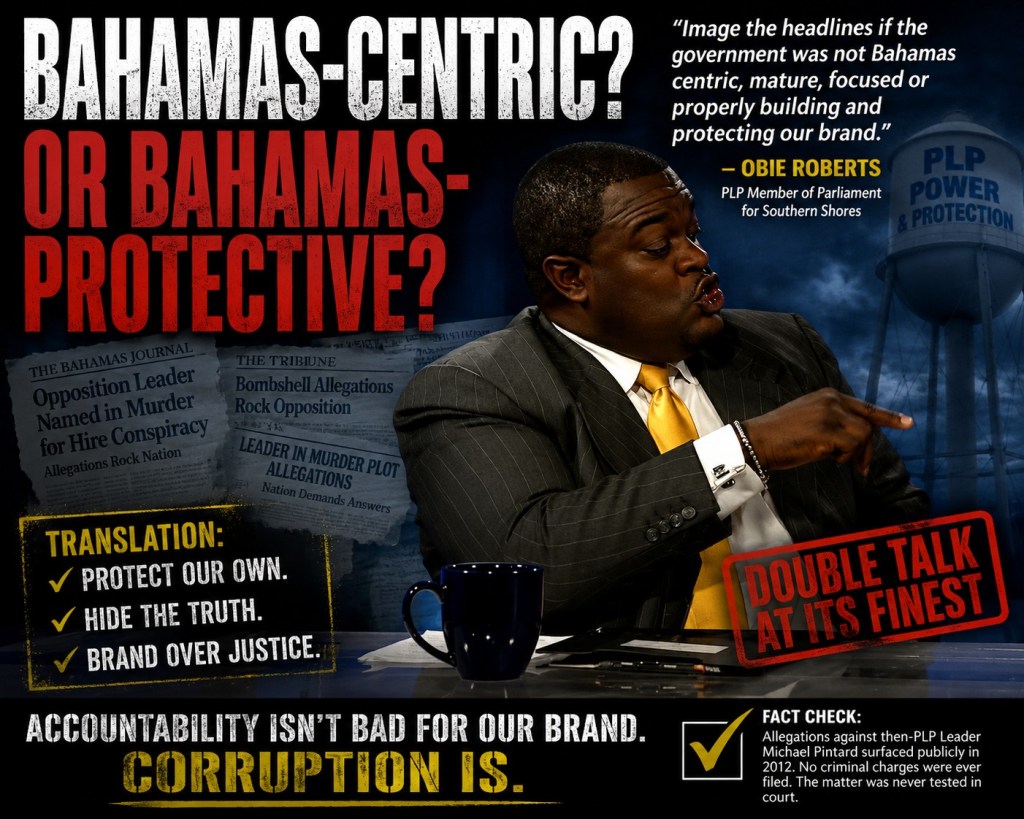
During his contribution to the Budget Debate, Southern Shores Progressive Liberal Party (PLP) MP Obie Roberts offered what may be one of the more remarkable defense of political discretion heard in Parliament this year.
He sought to have taken to the floor like his late father but fell extremely short.
Roberts stated:
“Madame Speaker, what is puzzling to me is that no less than the current leader of the opposition was caught up in a national murder for hire conspiracy, that may have possibly and even probably ended in incarceration if pursued…”
He then suggested that the government’s decision not to publicly amplify the matter was evidence that it was being “Bahamas-centric, mature, focused and properly building and protecting our brand.”
Now, listening to that statement, one might reasonably conclude that Michael Pintard narrowly escaped prison solely because of the restraint and benevolence of the Progressive Liberal Party (PLP). The only problem is that such a conclusion requires a leap of faith so large that it would make an Olympic long-jumper nervous.
Let’s start with a basic fact: allegations are not convictions. Investigations are not guilty verdicts. Political accusations are not evidence. If there was sufficient evidence to support criminal charges, then the proper place for that evidence would have been before the relevant authorities and ultimately the courts—not tucked away in a parliamentary speech years later for dramatic effect during a budget debate.
What Roberts appears to be asking Bahamians to believe is that the government deserves credit for not aggressively publicizing allegations against a political opponent. Yet in the same breath, he proceeds to publicly resurrect those very allegations on the floor of Parliament.
That is a curious definition of restraint.
The circular logic goes something like this:
“We are commendable because we did not publicize this allegation.”
Followed immediately by:
“Allow me to publicize this allegation.”
One almost must admire the efficiency.
But the more troubling aspect of Roberts’ remarks is the implication behind the phrase “Bahamas-centric.”
What exactly does that mean?
Because if being Bahamas-centric means ensuring allegations are properly investigated and due process is respected, then few would object.
If it means protecting the country’s reputation through transparency, accountability, and the rule of law, then most Bahamians would likely agree.
However, if Roberts is suggesting that being Bahamas-centric means political leaders should quietly bury controversies, avoid scrutiny, or shield public officials from uncomfortable questions to preserve some carefully curated image of the country, then we have wandered into dangerous territory.
After all, nations build strong reputations by confronting wrongdoing—not concealing it.
Countries earn credibility when institutions function independently and transparently—not when politicians decide which allegations are too damaging to discuss and which are useful enough to resurrect during parliamentary debates.
Indeed, the greatest threat to “Brand Bahamas” has never been accountability. It has never been transparency. It has never been asking difficult questions.
The greatest threat to any democracy is the belief that protecting politicians is somehow synonymous with protecting the country.
They are not the same thing.
In fact, history repeatedly demonstrates the opposite.
The countries with the strongest international reputations are generally those where public officials are held accountable regardless of political affiliation. Investors trust them. Citizens trust them. International partners trust them.
Why?
Because transparency creates confidence.
Secrecy creates suspicion.
So, when Roberts asks us to imagine the headlines that could have existed had the government not been “Bahamas-centric,” perhaps the better question is this:
Should Bahamians really be celebrating a political philosophy that appears to confuse protecting the nation’s reputation with protecting politicians from scrutiny?
Because if accountability damages the brand, then the problem isn’t accountability.
It’s whatever the accountability is exposing.
And that is a distinction Parliament would do well to remember.
The Bahamas deserves better.
END
 My Morning Paper