
It’s getting harder to tell whether this is governance or a last-minute campaign episode of “Scandal: Nassau Edition.” Because when a government signs off on a reported $250,000-a-month lobbying contract weeks before an election, the public is entitled to raise an eyebrow… and maybe the other one too.
Let’s deal with the facts first.
According to reporting by The Nassau Guardian, the administration of Prime Minister Philip Davis entered into a contract with U.S.-based firm DCI Group AZ to “strengthen relations” with the United States. Filings under the U.S. Foreign Agents Registration Act (FARA) reportedly list figures such as Coreco “CJ” Pearson, Roger Stone, and Doug Davenport as part of the lobbying effort.
So yes—the contract appears real. The price tag appears real. And the timing? Also, very real.
Now comes the part where the public is expected to nod politely and accept that this is all just routine business in “the best interest of the country.”
That’s a tough sell.
Because if “strengthening relations” with the United States is so critical, why does that urgency suddenly materialize two weeks before a general election? Were relations perfectly fine for the last four and a half years? Or did diplomacy, like roadworks and ribbon cuttings, just happen to peak right before voters head to the polls?
Even more puzzling is when these lobbyists weren’t hired.
When The Bahamas was pushing for action on climate vulnerability and access to green financing—particularly around carbon credit frameworks—there was no high-powered Washington lobby blitz.
When tensions arose over Cuban medical professionals and U.S. scrutiny complicated healthcare staffing, there was no emergency deployment of politically connected intermediaries to “uncomplicate” matters.
But now, suddenly, the cavalry has arrived—complete with American political operatives tied to the orbit of Donald Trump.
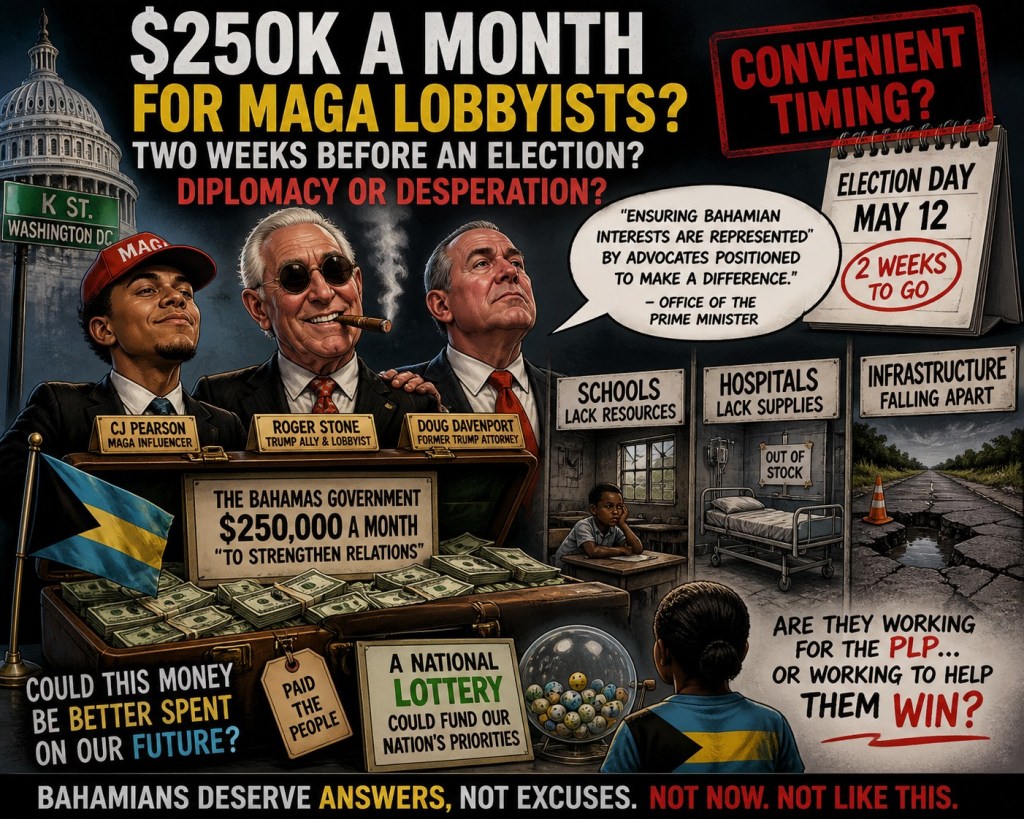
So naturally, people are asking: advocating for what, exactly?
Because at $250,000 per month, Bahamians are not unreasonable for expecting more than vague phrases like “strengthening relations.” That’s not a policy—that’s a brochure tagline.
And then there’s the opportunity cost.
At a time when:
- Schools face resource gaps
- Hospitals reportedly struggle with basic supplies
- Infrastructure projects are being rushed to completion before election day
…we’re told that a quarter-million dollars per month for foreign lobbyists is the best use of public funds?
That’s not just questionable—it borders on theatrical.
One might even ask—purely as a thought exercise, of course—whether this contract is about national interest or political interest. Because the timing, the personalities involved, and the proximity to an election create a rather inconvenient perception problem.
And perception matters in politics. Sometimes more than reality.
This is where the opposition, led by Michael Pintard and the Free National Movement, has floated alternatives like a regulated national lottery as a revenue stream for public services. Whether one agrees or disagrees with that idea, it at least raises a broader question: should the country be exploring sustainable domestic revenue solutions instead of writing sizable monthly checks abroad under unclear circumstances?
Because if the goal is truly to strengthen The Bahamas, then investments in education, healthcare, and infrastructure tend to deliver far more visible returns than political consultants in Washington.
Unless, of course, the return being sought isn’t entirely national.
And that’s the question lingering in the background—quiet, persistent, and increasingly difficult to ignore:
Is this contract about improving The Bahamas’ standing internationally…
or improving someone’s standing electorally?
Because right now, the line between the two looks… conveniently blurred.
The Progressive Liberal Party (PLP) fails for one reason; it is their nature.
END

