
The 2026 Budget Debate opened with the usual political fireworks between the Opposition Free National Movement (FNM) and the governing Progressive Liberal Party (PLP). However, what has attracted almost as much attention as the budget itself has been the conduct of the Speaker of the House, Ms. Patricia Deveaux, the Member of Parliament for Bamboo Town, hereby referred to as Madame Speaker.
The controversy began when members of the Opposition sought to table an affidavit filed in the United States District Court for the Southern District of New York. The affidavit forms part of a federal case involving allegations of a cocaine-importation conspiracy and references an unnamed Bahamian public official identified only as “Politician-1.”
Contrary to some political rhetoric, the affidavit does in fact exist. It is a public court document. Whether the allegations contained within it are true remains unproven, and no court has convicted any Bahamian politician based on the claims contained therein. Nevertheless, the existence of the document itself is not a matter of speculation or “frivolous gossip.”
The Opposition’s effort to table the affidavit followed comments from Fox Hill MP and Foreign Affairs Minister Fred Mitchell, who publicly dismissed discussion surrounding the document as first he seemed to suggest any knowledge of the existence of the document but then resorting to calling it little more than gossip. It was therefore unsurprising that Opposition members sought to place the actual document before Parliament for examination.
What followed raised serious questions about the Speaker’s understanding of her constitutional role and, more importantly, the appearance of impartiality expected of the office she occupies.
Under the Westminster parliamentary tradition, the Speaker is expected to serve as an impartial guardian of parliamentary procedure. While different jurisdictions handle the office differently, the underlying principle remains the same: the Speaker must be seen as protecting the rights of both the government and the opposition equally. The authority of the Speaker depends not only on fairness, but on the public’s confidence that fairness is being exercised.
Unfortunately, that confidence appears to be eroding.
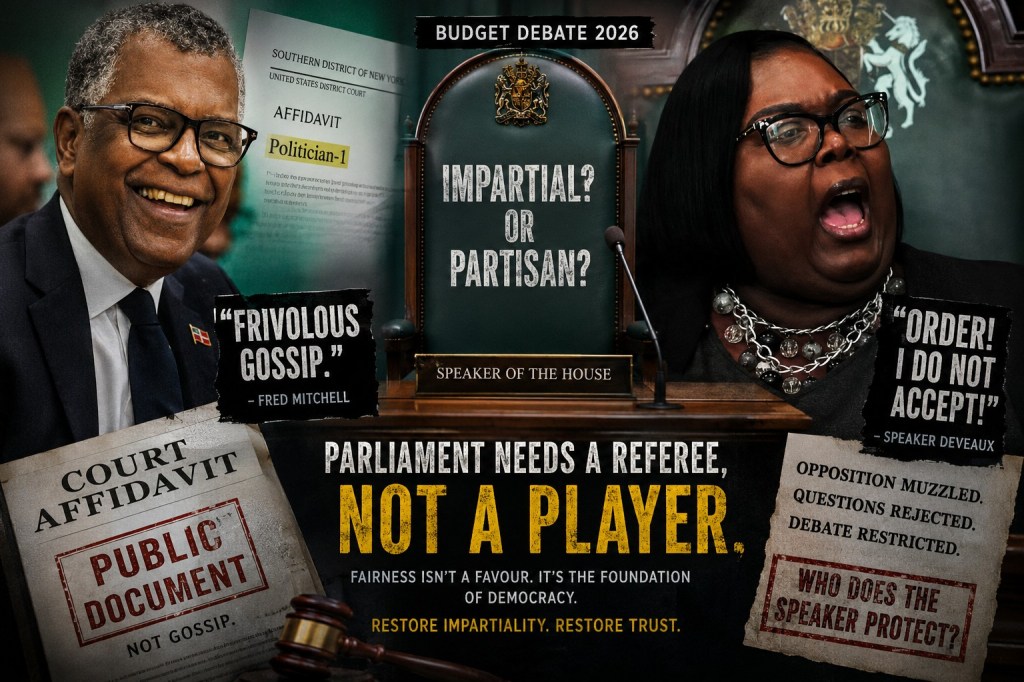
Throughout the opening exchanges of the Budget Debate, Madam Speaker appeared less like an independent referee and more like an active participant in the government’s political defence. Whether intentional or not, the perception created was that rulings and interventions frequently favoured the government’s position while limiting the Opposition’s ability to make its case.
That perception is particularly damaging because the Speaker’s office derives its legitimacy from neutrality. Once the public begins to view the Speaker as merely another government combatant, the office itself suffers.
The Bahamas has chosen not to adopt the British convention whereby Speakers sever party ties and effectively remove themselves from partisan politics after assuming office. That is a legitimate constitutional choice. However, if a Speaker remains an active political figure associated with a governing party, the burden to demonstrate fairness becomes even greater.
Instead, recent parliamentary sessions have often produced the opposite impression.
Critics argue that too many proceedings have devolved into confrontations between the Chair and Opposition members, creating the appearance that parliamentary procedure is being used as a political weapon rather than a tool for maintaining order. Whether one agrees with the Opposition’s arguments or not, Parliament functions best when all sides believe they are being treated fairly.
The comparison with former Speaker Italia Johnson is therefore unavoidable. Johnson, who made history as the first woman to serve as Speaker of the House of Assembly, generally cultivated a reputation for measured conduct and restraint. Her tenure demonstrated that firmness and impartiality are not mutually exclusive qualities.
That comparison is not intended to diminish Madam Speaker’s accomplishments. Rather, it highlights the standard to which every Speaker should aspire.
What makes the current situation particularly puzzling is that Patricia Deveaux previously served as Deputy Speaker during an earlier PLP administration. She entered the role with experience and firsthand knowledge of parliamentary procedure. For that reason, many expected a steadier and more neutral performance.
Instead, the opening of this year’s Budget Debate has reignited concerns that the Speaker’s chair is becoming increasingly politicized.
The issue is not whether the Speaker agrees with the PLP or the FNM. The issue is whether the Bahamian public can trust that parliamentary rules are being applied consistently regardless of who is speaking.
That trust is essential to the credibility of Parliament itself.
And when the Speaker becomes the story during a Budget Debate, it is usually a sign that something has gone wrong.
END

