My Morning Paper April 4th 2026 – The Myth of Progress: How Fear Became the PLP’s Campaign Tool – Fear Is Not Progress

Yesterday morning, on what should have been the serene and reflective morning of Good Friday, I expected a pleasant message from the Chairman of the New Day Progressive Liberal Party (PLP), Fred Mitchell. At first, it appeared that his message might begin on a positive note. But, as has become customary with the PLP’s messaging, the tone quickly took a darker turn.

What began as a story about encouraging a young woman to participate in the democratic process quickly devolved into what has become the hallmark of the PLP’s current campaign: fearmongering disguised as political persuasion.

In recounting his canvassing efforts, Mr. Mitchell described encountering an 18-year-old student who hopes to study medicine but expressed little interest in politics. Rather than inspire the young woman through optimism, policy, or opportunity, Mr. Mitchell instead warned her that if she did not vote for the PLP, the scholarships she hopes to rely on could be cancelled.

That, in essence, is the foundation of the PLP’s current campaign slogan: “Choose Progress.”

But when one examines the messaging closely, it becomes apparent that “Choose Progress” has less to do with progress and far more to do with manufacturing fear.

Mr. Mitchell even went so far as to frame the upcoming election in almost biblical terms, declaring that Bahamians must choose “progress over the work of the devil.” Such rhetoric may make for dramatic political theatre, but it raises a simple question: if the PLP truly had a record of undeniable progress, why rely so heavily on fear?

Because the truth is that when one examines the PLP’s record over the past four and a half years, the results are far less impressive than their slogan suggests.

Nowhere is this clearer than in Grand Bahama.

For years, Grand Bahamians have heard promises of economic revival, transformative development, and renewed opportunity. Yet the island continues to wait. Projects that could have pushed the island forward were instead reviewed, stalled, or abandoned, leaving Grand Bahama residents asking a very simple question: Where exactly is this progress we are being told to choose?

Mr. Mitchell often attempts to deflect attention by accusing the Free National Movement (FNM) of being “servants of the Grand Bahama Port Authority.” The irony of this accusation is difficult to ignore. While the PLP accuses others of allegiance to the Port Authority, Grand Bahama itself has seen little of the economic revival repeatedly promised by this administration.

If the Chairman wishes to tell stories while canvassing, perhaps he should tell the young woman about the government’s own version of “review, stop, and cancel.”

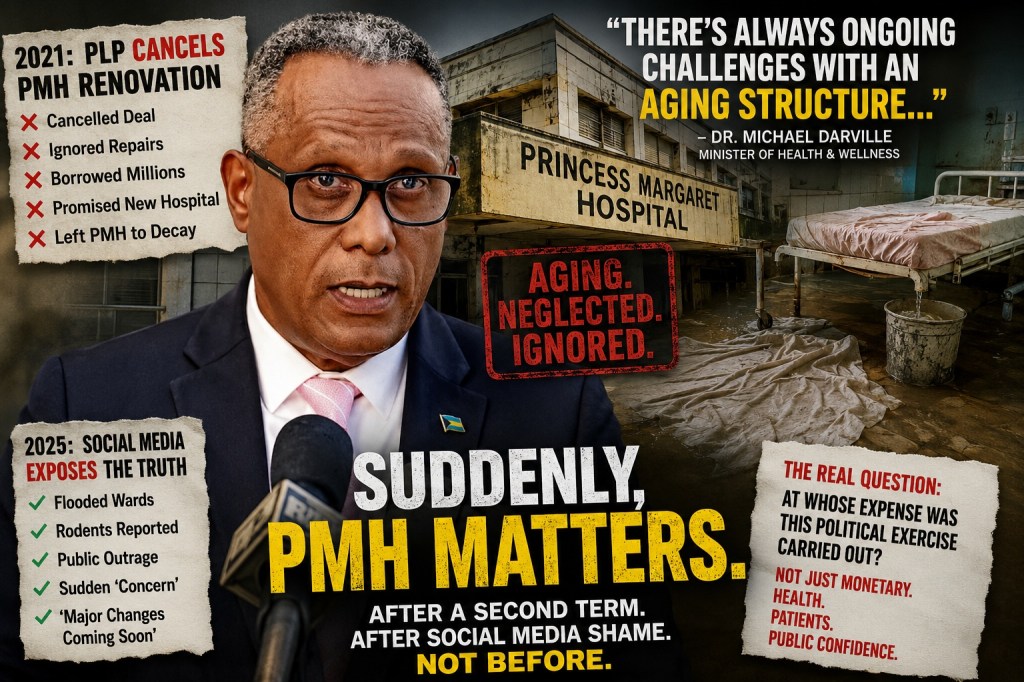
Will he explain how the PLP cancelled the existing arrangements to renovate the Princess Margaret Hospital and returned the funds earmarked for that project—delaying critical improvements to the nation’s healthcare infrastructure?

Will he explain how the government halted or reconsidered several initiatives left in place by the previous Free National Movement (FNM) administration—initiatives that, if carried through, might have moved the country further ahead than it stands today?

Of course, those stories are unlikely to make it into the Chairman’s canvassing speeches. They do not fit neatly into the narrative of a government claiming a “stellar and enviable record.”

I have said before that there is the truth, and then there is PLP truth. Unfortunately, the two rarely occupy the same space.

The Bahamian people deserve better than a government that has spent four and a half years waffling through governance, only to now campaign on a slogan that suggests progress is something voters must protect rather than something they have already experienced.

Progress is not a slogan.
Progress is not fear.
Progress is not telling a young woman that her dreams may disappear unless she votes for a particular party.

If the PLP truly believed in progress, they would not need to frighten Bahamians into choosing it.

They would simply be able to show it.

Instead, after nearly a full term in office, the best argument they can offer the country is a warning: vote for us, or everything may disappear.

That is not progress.

That is political fear dressed up as a campaign motto.

The Progress Liberal Party (PLP) fails for one reason; it is their nature.

END

My Morning Paper 1st April 2026 – Playing the Past: How the PLP’s Chess Strategy Seeks to Keep Pintard in Check”

If politics is often described as a game, then what you’re describing looks less like a fair contest and more like a very deliberate chess strategy—one where the focus isn’t just on winning the board, but on psychologically cornering the opposing king.

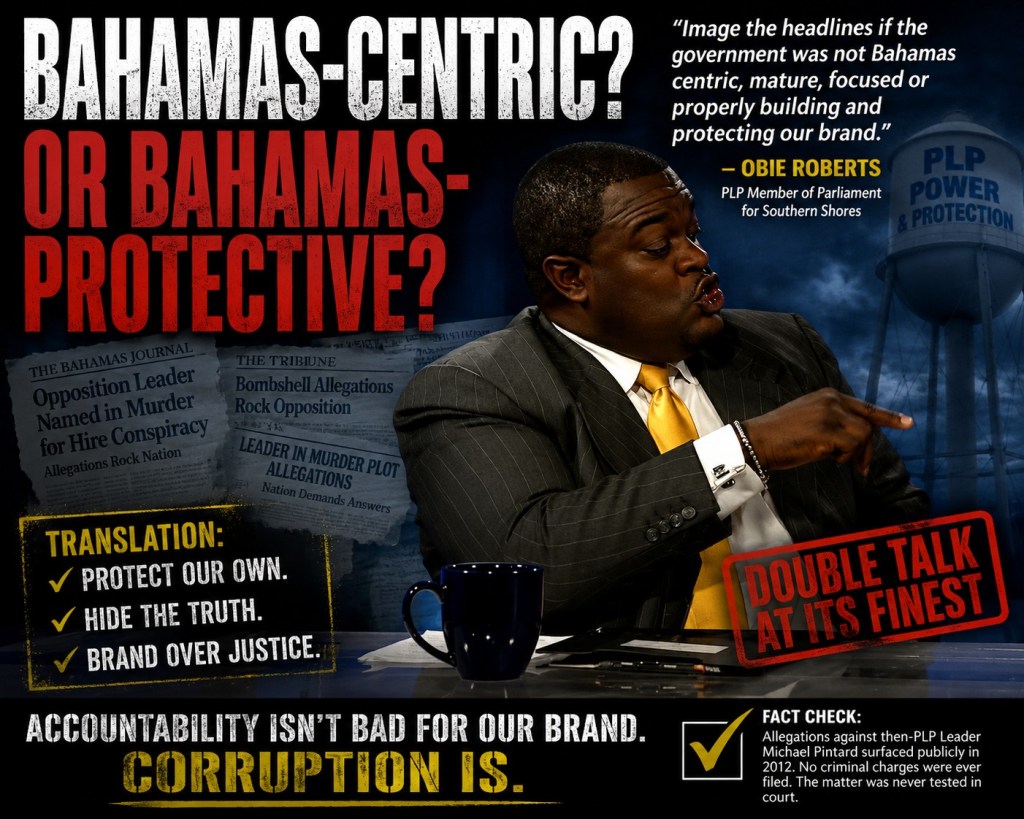
In this case, the Progressive Liberal Party appears to be treating Michael Pintard not as a fresh piece on the board, but as if he’s still carrying the baggage of the previous Hubert Minnis administration.

Think of it like this:

In chess, there’s a strategy where instead of attacking your opponent’s current position directly, you repeatedly target squares that were weak in a previous phase of the game—hoping your opponent either hasn’t fully recovered or can be forced into defending something that no longer truly applies. It’s not always about the present board; it’s about dragging the game back into a narrative where your opponent is already compromised.

That’s essentially what this political approach resembles.

The PLP’s messaging strategy, presently, functions like a positional squeeze. Rather than engaging Pintard solely on his current leadership or policies, they keep reopening the “Minnis file”—a kind of political pinned piece. Even though Pintard was not the king at the time, he’s being treated as though he must defend every move made during that administration.

In chess terms, it’s akin to:

  • Pinning the knight to the king: Pintard, as leader, is forced to answer for the Minnis era, limiting his ability to maneuver freely with his own agenda.
  • Controlling the center through narrative: By keeping public discourse anchored in past controversies, the PLP attempts to dominate the “center squares” of political conversation.
  • Forcing defensive play: If the FNM is constantly responding to historical criticisms, they’re not advancing new policy positions—much like a player stuck reacting instead of attacking.

But here’s where the analogy cuts both ways.

A strategy that relies too heavily on past positions can become predictable. In chess, if you keep attacking where the pieces used to be, a skilled opponent can reposition and counterattack—sometimes decisively. If Pintard successfully reframes himself as distinct from the Minnis administration, the FNM could flip the board dynamic entirely, turning what was meant to be a pin into an overextension.

Because in chess—as in politics—overcommitting to one line of attack can leave your own king exposed.

So the real question isn’t just what strategy the PLP is using. It’s whether the FNM, under Pintard, can recognize the pattern and shift the game from defense to initiative.

That’s when the match actually gets interesting.

What is actually interesting is that the New Day Progressive Liberal Party (PLP) is attacking Micheal Pintard on his time served, though the past leader and also though his present leadership, based on the word of disgruntled former Free National Movement (FNM) supporters, who seem to have abandoned the basic principles of the FNM to now back those of the PLP; which they once despised.

So, the New Day PLP is focused on attempting to drag things back to a time where the felt that Pintard was compromised and attempt to exploit these situations but to date they have not been able to accomplish this.

Also, one of Pintard’s greatest attributes to date has been that he has not allowed the PLP to corner him as he continues to “attack” the questionable/poor governance of the New Day Progressive Liberal Party (PLP); thereby distinguishing himself as a real and true leader.

End

My Morning Paper- 3oth March 2026– 130 Questions, Zero Answers: The Sound of a ‘New Day’ in Silence”

There’s something almost magical about watching Philip Davis rediscover the very behaviour he once condemned—like a man who spent years shouting at a leaking roof, only to inherit the house and quietly put out buckets instead of fixing it.

While in opposition, Davis—then the indignant voice of the Progressive Liberal Party—spared no breath in chastising the Free National Movement (FNM) for dodging questions in the House of Assembly. Transparency, accountability, respect for the Bahamian people—these were not just talking points; they were moral imperatives. Or so we were told.

Then came the much-advertised “New Day.”

And apparently, on this New Day, unanswered questions are just part of the weather forecast.

Over 130 questions—many posed by Opposition Leader Michael Pintard—have been left hanging in parliamentary limbo. Not delayed, not deferred, but effectively ghosted. Among them, a rather inconvenient inquiry about what exactly this government has done to enhance transparency and accountability—you know, those campaign promises that tend to age like milk in the Bahamian sun.

The explanation? Well, according to the Prime Minister, the previous FNM administration did it too.

Ah yes, the timeless defense of the playground: “They started it.”

It’s a fascinating pivot. What was once “arrogance” and “contempt for the Bahamian people”, Davis’s own words in 2021, has now been rebranded as… precedent. One might call it hypocrisy; others might call it political evolution. Either way, it seems the bar for governance has not been raised—just carefully stepped over.

And the unanswered questions are not trivial matters. They touch on issues of governance, transparency mechanisms, national development priorities, and public accountability. In other words, the very things a government might want to clarify if it were, say, asking the public for renewed trust at the ballot box.

Instead, we are given Golden or is it now Blue silence—and an interesting bit of speculative fiction.

Because in defending his record, Davis has taken it upon himself to predict that a future government led by Michael Pintard would behave the same way. Which is quite a claim. Not just a political jab, but a kind of prophetic certainty: that no matter who is elected, the answers will remain elusive.

It’s a convenient argument. If everyone is going to fail, then no one is uniquely accountable for failing now.

But here’s the problem: that logic doesn’t inspire confidence—it erodes it. It tells the Bahamian people that promises of transparency are little more than campaign-season theatre, destined to be shelved alongside manifestos once power is secured.

So, the real question isn’t whether a future administration might follow this pattern. It’s why this one already has.

Because if the standard for leadership is no longer “do better,” but simply “do no worse than the last guy,” then the New Day starts to look suspiciously like the same old night—just with different speeches and fewer answers.

END

My Morning Paper 30th March 2026 -Stop, Review, Rewrite: How the PLP Reimagined the PMH Story

If political storytelling were an Olympic sport, Fred Mitchell would be somewhere on the podium—though perhaps not for consistency.

Let’s take his latest performance: a passionate defense of the New Day Progressive Liberal Party government’s push for a brand-new hospital, wrapped neatly in a critique of Dr. Dwayne Sands and the Free National Movement (FNM). According to Mr. Mitchell, the previous administration left behind plans so disastrously incomplete that they forgot essentials like airflow and, quite memorably, “taking the old pipes out”—a revelation that sounds less like a construction critique and more like a late-night plumbing horror story.

Now, that would be a serious indictment—if, of course, there were any evidence presented to support it.

Because here’s the curious part: these allegedly catastrophic flaws in the Princess Margaret Hospital renovation plans have only now emerged as a central talking point. Not during the transition. Not when the works were underway. Not even when the New Day government made the very consequential decision to halt, review, and ultimately abandon those same plans. No—these details arrive now, conveniently timed, like a plot twist that wasn’t in the original script.

My Morning Paper – 26th March 2026 – The Great Passport Pivot: From ‘No Issue’ to ‘Blame Dem’

There’s an old saying—often attributed to Euripides—that whom the gods wish to destroy, they first make mad. Now, I’m not saying that applies here… but if the rhetorical shoe fits, and it’s doing a full tap dance, who am I to interrupt the performance?

Because what we are witnessing from Philip Davis isn’t just a shift in narrative—it’s a full Olympic-level gymnastics routine, complete with flips, twists, and the occasional “wait, wasn’t this a non-issue last week?”

Let’s walk through this carefully—because facts matter, even when the storyline doesn’t.

At the outset, when Michael Pintard raised concerns about fraudulent passports, the Prime Minister’s response was essentially: prove it or pipe down. That “put up or shut up” energy suggested there was nothing to see here—just another overexcited opposition chasing shadows.

Fair enough. Governments should demand evidence.

But then—plot twist—evidence was presented. Documents were laid. Concerns substantiated.

And suddenly, the script changed.

Now, we’re told that the government knew all along. That there was an ongoing investigation. That somehow, the opposition raising the alarm was actually… inconvenient. Late, even. Possibly disruptive.

So, let’s get this straight:

It was a non-issue… until it was a known issue… that was already under investigation… but also somehow endangered by being exposed?

That’s not a timeline—that’s a riddle wrapped in a contradiction, served with a side of political improv.

And just when you think the plot couldn’t thicken further, the Prime Minister introduces a new villain into the story: the Free National Movement.

Apparently, a policy implemented under the previous administration to streamline passport renewals somehow “weakened” the system—so much so that it allegedly impacted the issuance of new passports, opening the door to fraud.

Now here’s where things move from confusing to downright fascinating.

Because administratively—and this is basic governance, not partisan spin—passport renewals and new passport issuance are typically distinct processes. Renewals often involve verifying existing records, while new passports require fresh identity validation, documentation checks, and biometric safeguards.

So, the obvious question becomes:

How does making it easier for a law-abiding citizen to renew an existing passport suddenly create a loophole for issuing fraudulent new passports—especially after the previous administration has already left office?

Is there evidence that the renewal policy directly altered identity verification standards for new applicants?

Was there a procedural overlap that compromised security protocols?

Or is this simply a case of retroactive blame assignment—where yesterday’s “non-issue” needs a historical scapegoat today?

Because if fraudulent passports were being issued after the Free National Movement demitted office, then the responsibility for oversight, enforcement, and correction lies squarely with the current administration. That’s not political bias, that’s how governance works.

And yet, here we are—being asked to believe that a policy for renewals somehow cast a long bureaucratic shadow into a completely different process, under a completely different government, at a completely different time.

At this point, the narrative isn’t just shifting—it’s shapeshifting.

Meanwhile, the Prime Minister asks the nation: “Who is steady enough to lead?”

It’s a fair question. A very fair question.

But it cuts both ways.

Because steadiness isn’t just about criticizing your opponent—it’s about maintaining a consistent, credible position when issues arise. It’s about clarity when the public is seeking answers, not confusion dressed up as strategy.

And when the story moves from:

“There’s no issue,”

to

“We knew about the issue,”

to

“The issue is actually their fault,”

…well, the Bahamian people are left trying to figure out whether they’re watching leadership—or an audition for political theatre.

Either way, tickets are free. Accountability, unfortunately, is not.

The Bahamas deserves better.

The Progressive Liberal Party (PLP) fails for one reason; it is their nature.

END

My Morning Paper -25. March.2025 – “Signed, Sealed… and Still Negotiating?”

Yesterday in the Business Section of The Nassau Guardian, it was reported that stocks rallied and oil sinks after Trump hints at a possible end to war, even as Iran denies talks”, on the very same page as this story was another article that entitled; “GBPC buyout one step closer – Govt. seeks House approval to guarantee $280 loan for GBPC shares and working capital – New SPV created”

Nothing says sound fiscal management quite like reaching for the national credit card before you’ve even confirmed what’s in the shopping cart.

Let’s walk through this carefully, because beneath the comedy is a sequence of events that is, factually, exactly as puzzling as it sounds.

According to reporting from The Nassau Guardian, the administration led by Philip Davis has moved to guarantee $280 million in borrowing through a newly created vehicle, Grand Bahama Energy Company Limited. The purpose? To acquire the voting shares of Grand Bahama Power Company (GBPC), with financing structured as:

  • $200 million for acquisition (via a consortium led by Standard Chartered)
  • $80 million for capital expenditure and working capital (via RBC Bahamas)

So far, so decisive. So confident. So… premature?

Because in the very same news cycle, the CEO of GBPC — Dave McGregor — felt compelled to gently remind everyone that while discussions with Emera (GBPC’s parent) are “productive,” there is no final agreement.

Not “agreement pending signature.”
Not “terms finalized.”
Not even “we’re basically there.”

No. Final. Agreement.

Which raises the obvious question: what exactly is Parliament being asked to approve borrowing for?

Because what we appear to have here is a government:

  • advancing loan guarantees,
  • establishing a special purpose vehicle,
  • signalling near-certainty of acquisition,

…while the seller is still publicly saying, “We’re talking.”

That’s not closing a deal. That’s manifesting one.

Now, to be fair — and this is where we separate satire from reality — governments often move ahead with financing structures in anticipation of a deal. This is not unheard of. In large infrastructure or utility acquisitions, especially involving state interests, you prepare the financing early so you can act quickly once terms are finalized.

But here’s where it gets politically awkward:

The public posture has been one of confidence bordering on inevitability, while the counterparty is still emphasizing uncertainty and ongoing negotiation. That mismatch creates the impression — fair or not — that the government may be trying to:

  1. Signal seriousness to the seller (i.e., “we have financing ready, let’s close”),
  2. Box itself into a political commitment to force momentum, or
  3. Shape public expectations so that backing away becomes politically costly.

In other words, this may not be confusion — it may be strategy.

A risky one.

Because if the deal falls through, the administration is left explaining why it sought approval to guarantee hundreds of millions in debt for an acquisition that never materialized. And if the deal does go through, the obvious follow-up becomes: on what terms, and at what price, given the apparent urgency?

There’s also a deeper governance question here. When a government moves this far ahead of a finalized agreement, it shifts Parliament’s role from scrutinizing a completed deal to effectively endorsing a negotiating position mid-stream. That’s a subtle but important difference.

So yes, as the House debates borrowing $280 million, the Bahamian public is left watching what feels like a financial version of Schrödinger’s acquisition:

The Grand Bahama Power Company is both being bought and not yet for sale — at the exact same time.

And the only thing that seems fully confirmed…
is the loan.

END

My Morning Paper 23rd March 2026 –  Governing by Dream Book: The PLP’s Fantasy-Based Leadership Manual

Fred Mitchell—yes, that Fred Mitchell, now wearing the dual hats of PLP Chairman and part-time Sunday school narrator—has once again taken to the podium to critique the FNM with all the confidence of a man who has apparently never met irony… or a mirror.

His review of the FNM’s campaign launch under Michael Pintard reads less like analysis and more like a dramatic reading of a prophecy he found scribbled in the margins of his “dream book”—a document which, judging by PLP governance, appears to be less strategic plan and more bedtime fiction. According to Mitchell, the event was underwhelming. Which is interesting, because by his own admission, he wasn’t even there. One assumes his “scouts” were dispatched with the same precision as PLP policy execution—enthusiastic, but not at all reliable.

But let’s get to the real performance: Mitchell’s attempt to diminish Pintard by tying him to his time as a Cabinet Minister under Hubert Minnis. Now, that’s a bold strategy—bold in the sense that it requires the audience to forget that Mitchell himself has been a Cabinet Minister under multiple PLP administrations. Not one. Not two. But enough to qualify for a loyalty punch card.

And how did those administrations fare? Well, let’s just say the electoral results were so “impressive” that both Mitchell and then-Prime Minister Perry Christie managed the rare political feat of losing their seats. That’s not just a bad night—that’s a full-blown democratic eviction notice.

So, when Mitchell lectures about performance and credibility, it lands a bit like a chef with a long history of kitchen fires critiquing someone else’s seasoning.

Even more curious is his ongoing commentary about Marvin Dames, whom he references with the kind of certainty usually reserved for court verdicts—except, inconveniently, there hasn’t been one. For a man trained in law, Mitchell seems remarkably comfortable skipping past the “innocent until proven guilty” part and heading straight to the closing arguments… in the court of public opinion.

Which brings us to his pearl-clutching over “jeopardizing investigations” and “defaming possibly innocent people.” A fascinating concern—particularly when viewed alongside his own public commentary. It’s the political equivalent of someone setting off fireworks indoors and then complaining about the smoke.

Mitchell also seemed deeply troubled by who was not at the FNM event, listing names like a substitute teacher taking attendance. But in doing so, he conveniently ignored who was there—because that might disrupt the narrative. It’s a bit like reviewing a movie by focusing only on the empty seats in the theatre rather than the film itself.

And then there’s the sudden, almost tender concern for former leaders like Hubert Ingraham—a man the PLP has historically treated with all the warmth of a tax audit. Now, apparently, he’s being invoked like a long-lost uncle at a family reunion. One can only assume this newfound affection is less about respect and more about political convenience.

In the end, Mitchell’s critique tells us far more about the PLP’s current playbook than it does about the FNM. It’s a mix of selective outrage, historical amnesia, and theatrical indignation—seasoned, of course, with a generous helping of biblical references for dramatic effect.

Because if there’s one thing we’ve learned, it’s this: when the substance is thin, the sermon gets longer.

The Progressive Liberal Party (PLP) fails for one reason; it is their nature.

END

My Morning Paper 21 March 2026 – The Passport Office Paradox: When Renewals Somehow Create New Fraud

Ah yes, the classic political two-step: “Bring the evidence!” swiftly followed by “How dare you bring the evidence!” — a maneuverer so elegant it deserves its own Olympic category.

Let’s walk through this slowly, because apparently clarity is now a controversial concept.

The Leader of the Opposition, Michael Pintard, raises concerns about fraud at the Passport Office — serious concerns, mind you, involving individuals allegedly obtaining Bahamian passports using fraudulent documents. The government, led by Philip Brave Davis and with Fred Mitchell leading the charge rhetorically, responds with the predictable bravado: “Table the documents in Parliament.”

So, he does.

And suddenly, we’re told — clutch your pearls — that he may have compromised an ongoing investigation.

Which raises an uncomfortable but necessary question: Which is it?

Was the Opposition supposed to present evidence, or perform interpretive dance around it?

Because demanding documentation and then condemning its presentation isn’t governance — it’s gaslighting with a parliamentary soundtrack.

Now, let’s get to the truly impressive bit of logical gymnastics.

We’re told that 98 cases of suspected passport fraud have been referred to the Royal Bahamas Police Force. Not two. Not five. Ninety-eight. That is not a rounding error — that is a flashing red alarm bell with a megaphone.

And yet, somehow, the explanation offered is that a 2019 policy under the previous FNM administration — a policy dealing with passport renewals — is to blame.

Renewals.

Not new applications.

Not fraudulent documentation.

Renewals… for people who already had valid passports.

So, unless Bahamians have recently developed the ability to retroactively fake identities they already possessed, this explanation doesn’t just stretch credibility — it snap-cracks it in half.

Let’s be very clear about the distinction the public is being asked to ignore:

Renewals: Existing passport holders updating valid documents.

Fraud cases in question: Individuals allegedly obtaining passports using fraudulent supporting documents.

These are not the same thing. Not legally. Not administratively. Not even philosophically.

And pretending they are is not just misleading — it’s an insult to the intelligence of the average right-thinking Bahamian.

What we are witnessing is a government attempting to:

Deflect responsibility for issues occurring squarely under its watch.

Reframe the narrative to blame a prior administration.

Simultaneously claim credit for “fixing” a problem they insist they didn’t create.

It’s political alchemy: turning accountability into accusation, and failure into a press release.

But here’s the part that deserves far more attention than it’s getting:

Whatever became of the audit of the Passport Office that was reportedly conducted after this administration came to office?

An audit, by definition, is supposed to identify weaknesses, risks, and — stay with me here — fraud vulnerabilities.

So, if:

An audit was done,

Weaknesses were presumably identified, and

Nearly 100 fraud cases have now emerged…

Then the obvious question is not “Who can we blame?”

It is: What did the government know, and what did they do about it?

Because if the audit found issues and they weren’t addressed, that’s negligence.

And if the audit didn’t find issues that now clearly exist, that raises questions about competence.

Either way, pointing backward doesn’t absolve responsibility moving forward.

What makes this all the more remarkable is the contradiction baked into the government’s own messaging:

On one hand: “The system is working because we caught the fraud.”

On the other: “The fraud exists because of the previous administration.”

So, which is it? A newly strengthened system under this administration — or a broken one inherited from the last?

Because it cannot logically be both without admitting that the current administration has had both the time and the authority to fix it.

Instead, what we’re getting is a masterclass in political deflection — where every problem is inherited, every solution is self-congratulatory, and every contradiction is treated as if the public simply won’t notice.

But people are noticing.

And the truth is far simpler than the spin:

Fraudulent passports being issued — if proven — are not a theoretical policy debate. They are a current administrative failure with serious implications for national security, electoral integrity, and public trust.

No amount of rhetorical gymnastics changes that.

The Bahamian people don’t need blame-shifting.

They don’t need selective outrage.

And they certainly don’t need a government that demands evidence only to panic when it appears.

They need accountability.

And right now, that seems to be the one document no one in authority is willing to table.

The Progressive Liberal Party (PLP) fails for one reason; it is their nature.

END

My Morning Paper 19th March 2026 – The Pope and a smell of Fish

Ah yes—because nothing says “healthy, thriving democracy” quite like a poll you can’t see, can’t verify, and apparently wasn’t meant to be looked at too closely… like the political equivalent of “trust me, bro.”

Now, let’s talk about this with the appropriate level of raised eyebrow, shall we?

Back in 2022, Philip Davis was enjoying a very respectable post-election honeymoon glow, buoyed by an approval rating reportedly around 67% after his first 100 days. Perfectly normal. Governments win elections, people feel hopeful, and for a brief, shining moment everyone pretends potholes are “temporary character features.”

But—and this is important—that number came from a sample of 1,064 people in a country of roughly 400,000. Statistically speaking, that’s about 0.26% of the population. Which is fine, by the way, if the poll is scientifically conducted, transparent in its methodology, and properly randomized.

Because here’s the thing: small samples can absolutely be valid. That’s how polling works. But only when you can actually see how the sausage was made. Otherwise, it’s not polling—it’s numerology with better branding.

And now, fast forward to today, where the Progressive Liberal Party proudly points to a new poll—surveying 805 people—as evidence that they are cruising toward victory in the next general election. Eight hundred and five people. Roughly 0.2% of the population.

Again, not inherently invalid… if the methodology is sound, disclosed, and independently credible.

But here’s where things get delightfully murky.

According to The Nassau Guardian, the PLP claims 38% support versus 18% for the Free National Movement. To which the FNM responded, in what might be the most relatable political statement ever: “Fishermen never say their fish stink.”

And honestly, that might be the most statistically rigorous part of this entire situation.

Because when a poll is commissioned, released, and promoted by the same political party that benefits from it—without clear disclosure of sampling methods, margins of error, weighting, or even basic transparency—you don’t have a crystal ball. You have a mirror.

A very flattering mirror. The kind found in a carnival funhouse, where somehow, you are both taller and more popular than reality suggests.

Now, to be fair—and this is where we stay grounded—random sampling can produce reliable insights even with a few hundred respondents. That’s Polling 101. But secrecy and science are not natural allies. If anything, secrecy is what science actively tries to avoid. You publish your methods. You show your work. You invite scrutiny.

You do not conduct what appears to be a politically convenient survey and then ask the public to accept it on vibes alone.

Because when you look at numbers like these, they don’t scream “data-driven certainty.” They whisper, “internal reassurance.” The kind of numbers that say, “Everything is fine,” while the political equivalent of a check engine light is blinking quietly in the background.

And that’s the real question here: if everything is fine—if support is genuinely strong and growing—why the need for a poll that feels like it was conducted somewhere between a strategy meeting and a group chat?

Why not publish the full methodology? Why not let independent analysts tear it apart and confirm its strength?

Unless of course… you’re not entirely sure they would.

Because projecting confidence and having confidence are not the same thing. One is a press release. The other survives scrutiny.

So, are they sensing trouble? Not necessarily panic—but perhaps enough uncertainty to start shaping the narrative early. To say, “We’re winning,” not just to the public, but maybe to themselves.

And if this is the new standard, then fantastic. I, too, will be commissioning a poll. Sample size: me, two friends, and a cousin

And I’m delighted to report that early findings show overwhelming support for my candidacy as the next Pope.

Because apparently, in this Brave New world of mystery polling, anything is possible… as long as you don’t ask too many questions.

The Progressive Liberal Party (PLP) fails for one reason, it is their nature.

END

My Morning Paper- 18th March 2026 – Told You Already: Michael Darville vs. The World’s Most Surprised Prime Minister

If this were a sitcom, it would be called “Everybody Talks to the Prime Minister… Except the Prime Minister.” And yes, somehow, he’s also the Minister of Finance in this episode.

Let’s start with the star of the show: Philip Davis — who, in a moment of what we’ll generously call “selective surprise,” told the public: he had “just been hearing about this” regarding delayed NHI payments and couldn’t quite figure out why doctors and labs weren’t being paid.

Now, that’s already a tough sell. Because when you are both Prime Minister and Minister of Finance, “I just heard about it” sounds less like leadership and more like someone forgetting to check their own email… that they sent to themselves.

Enter Act Two: Michael Darville — who, apparently unaware he was about to ruin the plot twist — stood up in Parliament and calmly explained that the Prime Minister was in fact aware of what was happening in the Ministry of Health and Wellness… because they have regular meetings.

Regular meetings.

So now we have a fascinating constitutional mystery:

  • The Prime Minister says he didn’t know
  • The Health Minister says he told him
  • And both statements are happening in the same government… at the same time… in the same country

At this point, the only logical conclusion is that the weekly meetings are either:

  1. A deeply immersive role-playing exercise where no one remembers what was said, or
  2. A historic breakthrough in political physics where information enters the room… and immediately evaporates upon contact with responsibility

Because let’s be clear: the issue of delayed National Health Insurance (NHI) payments to physicians and laboratories isn’t a minor clerical hiccup. It’s a core operational function of the healthcare system. When payments stall, care stalls. And when care stalls, explanations like “I just heard about it” start to sound less like updates and more like excuses.

So, the real question isn’t whether someone is confused.

The real question is:
Who exactly is running the Ministry of Finance — and did they think to inform the Minister of Finance?

Because if the Prime Minister didn’t know what the Minister of Finance was doing… and the Minister of Finance is the Prime Minister… then congratulations — The Bahamas has achieved what few governments ever have:

A full internal breakdown of communication… within a single individual.

The Progressive Liberal Party fails for one reason; it is their nature and the Bahamian people really do deserve much better.

END