My Morning Paper- 7th May 2026 – If Hubert Ingraham Is So Irrelevant… Why The Panic?

The New Day Progressive Liberal Party (PLP) seems to have found itself in a rather awkward political balancing act when it comes to former Prime Minister Hubert Ingraham.

On one hand, they insist he is “out of touch,” “irrelevant,” and politically retired somewhere between memory lane and the history books. On the other hand, the moment he appears on a campaign stage for the Free National Movement (FNM), the PLP reacts like somebody just announced the return of a final boss in a video game.

While the Hon. Michael Pintard was reportedly travelling from a political rally in the Berry Islands back to New Providence, Mr. Ingraham addressed supporters at an FNM rally. Apparently, what he had to say struck such a nerve within the PLP that an official statement quickly emerged from Latre Rahming, who now appears to be serving in the dual role of government communications director and emergency campaign firefighter for the PLP.

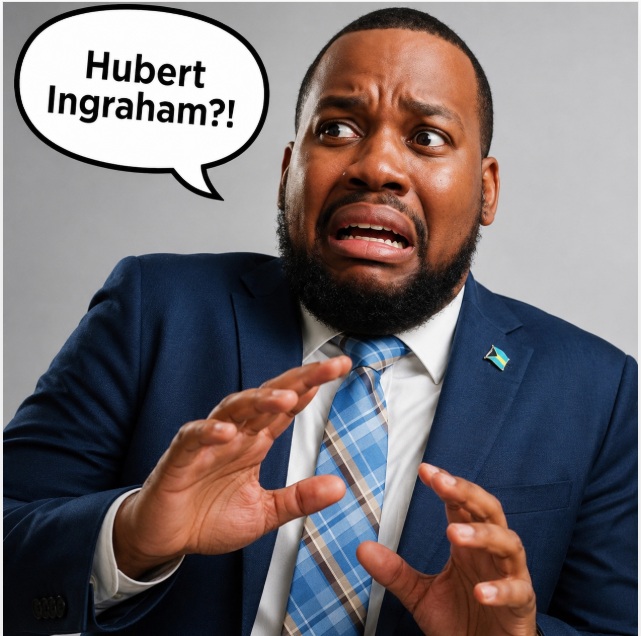
Rahming accused the FNM of “using” Hubert Ingraham to “hide the weak leadership” of Michael Pintard. But that argument raises an obvious question: if Mr. Ingraham is supposedly irrelevant and disconnected from modern politics, why does his mere appearance require an official political counterattack from the Office of the Prime Minister?

That is a lot of energy to spend fighting a man they claim nobody is listening to.
The statement itself was loaded with the familiar PLP campaign trilogy: “lies, confusion and chaos.” Ironically, critics of the PLP would argue that this is rich coming from a party that faced heavy criticism during previous election cycles over accusations of exaggeration and political fearmongering related to the handling of the COVID-19 pandemic and the aftermath of Hurricane Dorian. Those debates remain politically contentious to this day.

Latrae and the PLP also challenged the FNM for supposedly not speaking about plans for governance, which the FNM has done but out of political convenience it appears that the PLP just glossed over. Yet Bahamians may reasonably ask whether the government itself has clearly articulated a consistent long-term direction beyond campaign slogans and glossy branding exercises like the “Blueprint for Progress.”

Because somewhere between the ribbon cuttings, press conferences, billboards, and dramatic speeches, many ordinary Bahamians are still waiting to feel this so-called “progress” in their grocery bills, electricity costs, rent, and day-to-day quality of life.

And then there is the comedy hidden in the PLP’s repeated reference to Hubert Ingraham as “the former chairman of the PLP.” One almost gets the sense they are trying to remind voters that Mr. Ingraham once belonged to the PLP before becoming one of the most electorally successful leaders in FNM history.

But that line of attack creates another uncomfortable contradiction.

If the PLP keeps invoking Ingraham’s former ties to the PLP as some sort of political stain, what exactly are they saying about their own party?

After all, you cannot simultaneously claim:

  • Hubert Ingraham is politically irrelevant,
  • Hubert Ingraham is dangerously influential,
  • Hubert Ingraham is “out of touch,”
  • and Hubert Ingraham is secretly propping up Michael Pintard’s momentum.

At some point, the script starts contradicting itself.

And perhaps the funniest part of all is this: the PLP’s statement may have unintentionally elevated the very appearance they were trying to diminish. What could have simply been another rally speech suddenly became headline material because the government responded with the urgency of a five-alarm political fire.

For a party insisting that Michael Pintard is weak and Hubert Ingraham is irrelevant, they certainly seem deeply concerned whenever the two appear in the same sentence.

The Progressive Liberal Party (PLP) fails for one reason; it is their nature.

END
My Morning Paper – 06th March 2026 – From Reset to ‘Cancel Everything’: The PLP’s Creative Translation

What we are witnessing from the Progressive Liberal Party (PLP) is less “interpretive framing” and more Olympic-level mental gymnastics—with a straight face and a political ad.

Let’s start with the first trick.

Turning a metaphor into a manifesto
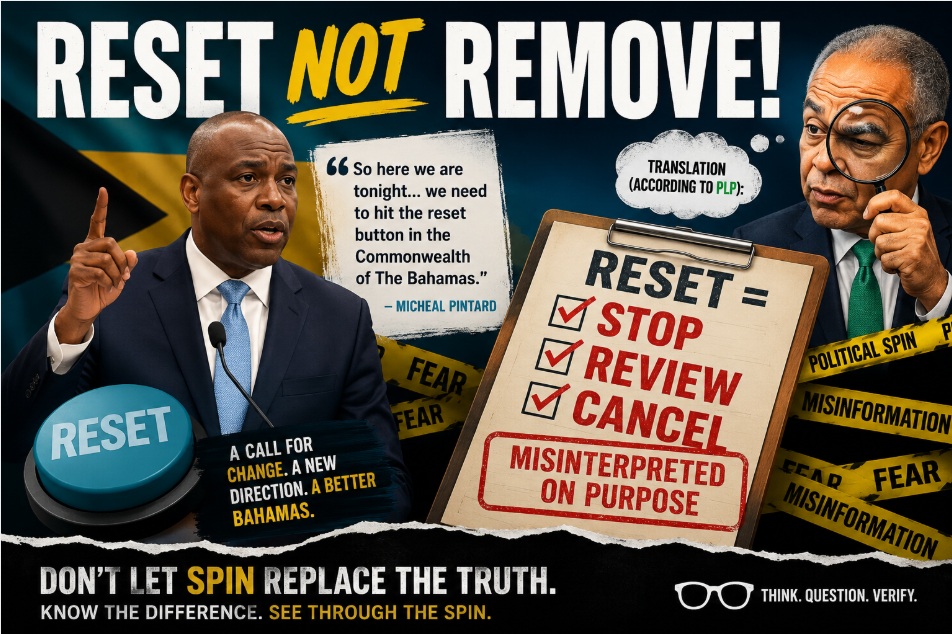
Apparently, in PLP translation services, “reset” doesn’t mean recalibrate, refocus, or rethink—it means grab the scissors, unplug the system, and cancel everything in sight.
When Michael Pintard said the country needs a reset, he was speaking in the broad, almost cliché language politicians have used for decades. But somehow, the PLP heard: “Ladies and gentlemen, we will now begin deleting government programs one by one.”
That’s not interpretation—that’s creative writing. And when presented as fact, it crosses the line from politics into pure misdirection.

Speculation dressed up as certainty
Then comes the second act: bold predictions with absolutely no receipt.
The Free National Movement has not laid out any documented plan to cancel specific programs in that statement. Yet the PLP speaks with the confidence of someone reading from a script that doesn’t exist.
If guessing were governance, we’d all be in excellent hands. But in reality, presenting speculation as settled fact is exactly the kind of behavior the PLP has become known for—especially when election season rolls around and imagination starts working overtime.

Fear for dramatic effect
And of course, no political performance is complete without a little suspense.
By tying this so-called “reset” to the idea that programs will disappear overnight, the PLP conveniently introduces a sense of panic: “Vote wrong, and everything you rely on vanishes.”
It’s a well-worn tactic—take a vague phrase, attach the worst possible outcome, and hope fear does the rest. Effective? Sometimes. Honest? That’s another matter entirely.

Let’s deal with reality for a moment
What can actually be said—without the theatrics—is simple:

  • Pintard’s statement points to a desire for change, not a demolition exercise.
  • It does not outline cuts, cancellations, or reviews—full stop. Suggesting otherwise requires a leap of imagination that would make a novelist proud.
  • The PLP’s version of events is political framing, not a quotation, not a policy, and certainly not confirmed fact.

So, what’s really going on?
The issue isn’t that the PLP responded—politics would be boring if they didn’t. The issue is that they’ve taken an opinion, polished it up, and are now trying to pass it off as gospel truth.

And that’s the real problem:
You can spin, you can interpret, you can even exaggerate—but at some point, you have to stop pretending your opinion is the same thing as reality.

The Progressive Liberal Party (PLP) fails for one reason; it is their nature.

END
My Morning Paper – 5th May 2026 – Strengthening Relations… Just in Time for Election Day

It’s getting harder to tell whether this is governance or a last-minute campaign episode of “Scandal: Nassau Edition.” Because when a government signs off on a reported $250,000-a-month lobbying contract weeks before an election, the public is entitled to raise an eyebrow… and maybe the other one too.

Let’s deal with the facts first.

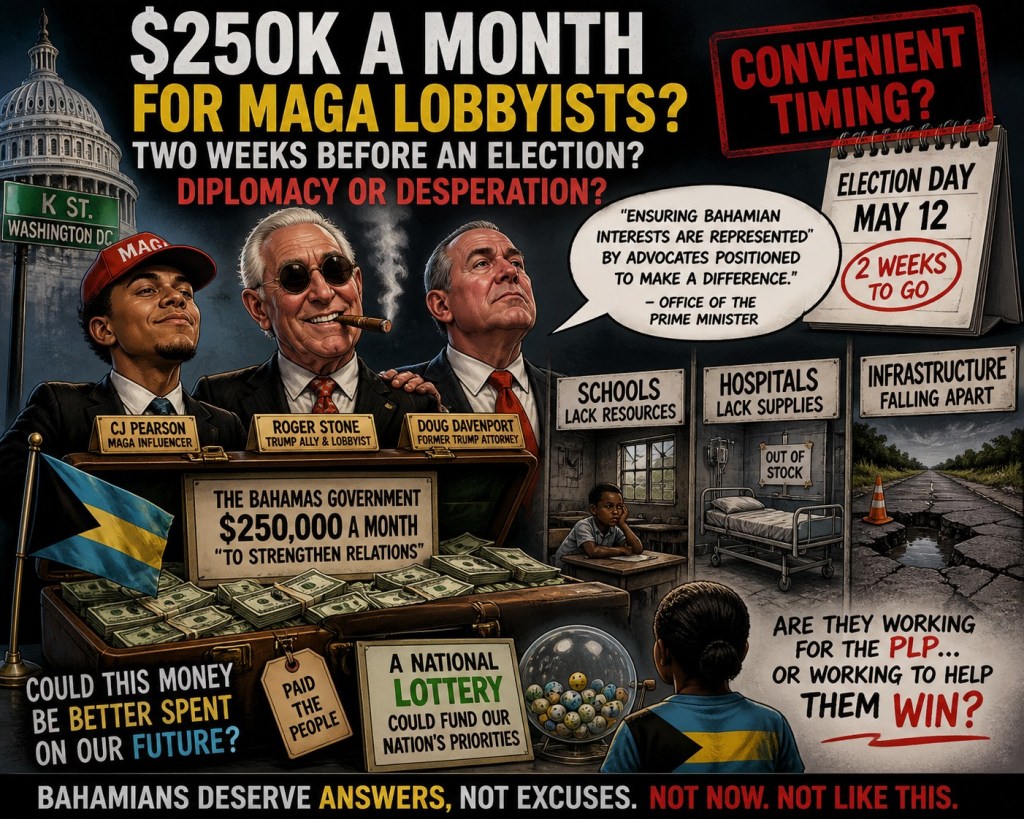
According to reporting by The Nassau Guardian, the administration of Prime Minister Philip Davis entered into a contract with U.S.-based firm DCI Group AZ to “strengthen relations” with the United States. Filings under the U.S. Foreign Agents Registration Act (FARA) reportedly list figures such as Coreco “CJ” Pearson, Roger Stone, and Doug Davenport as part of the lobbying effort.

So yes—the contract appears real. The price tag appears real. And the timing? Also, very real.

Now comes the part where the public is expected to nod politely and accept that this is all just routine business in “the best interest of the country.”

That’s a tough sell.

Because if “strengthening relations” with the United States is so critical, why does that urgency suddenly materialize two weeks before a general election? Were relations perfectly fine for the last four and a half years? Or did diplomacy, like roadworks and ribbon cuttings, just happen to peak right before voters head to the polls?

Even more puzzling is when these lobbyists weren’t hired.

When The Bahamas was pushing for action on climate vulnerability and access to green financing—particularly around carbon credit frameworks—there was no high-powered Washington lobby blitz.

When tensions arose over Cuban medical professionals and U.S. scrutiny complicated healthcare staffing, there was no emergency deployment of politically connected intermediaries to “uncomplicate” matters.

But now, suddenly, the cavalry has arrived—complete with American political operatives tied to the orbit of Donald Trump.

So naturally, people are asking: advocating for what, exactly?

Because at $250,000 per month, Bahamians are not unreasonable for expecting more than vague phrases like “strengthening relations.” That’s not a policy—that’s a brochure tagline.

And then there’s the opportunity cost.

At a time when:

  • Schools face resource gaps
  • Hospitals reportedly struggle with basic supplies
  • Infrastructure projects are being rushed to completion before election day

…we’re told that a quarter-million dollars per month for foreign lobbyists is the best use of public funds?

That’s not just questionable—it borders on theatrical.

One might even ask—purely as a thought exercise, of course—whether this contract is about national interest or political interest. Because the timing, the personalities involved, and the proximity to an election create a rather inconvenient perception problem.

And perception matters in politics. Sometimes more than reality.

This is where the opposition, led by Michael Pintard and the Free National Movement, has floated alternatives like a regulated national lottery as a revenue stream for public services. Whether one agrees or disagrees with that idea, it at least raises a broader question: should the country be exploring sustainable domestic revenue solutions instead of writing sizable monthly checks abroad under unclear circumstances?

Because if the goal is truly to strengthen The Bahamas, then investments in education, healthcare, and infrastructure tend to deliver far more visible returns than political consultants in Washington.

Unless, of course, the return being sought isn’t entirely national.

And that’s the question lingering in the background—quiet, persistent, and increasingly difficult to ignore:

Is this contract about improving The Bahamas’ standing internationally…
or improving someone’s standing electorally?

Because right now, the line between the two looks… conveniently blurred.

The Progressive Liberal Party (PLP) fails for one reason; it is their nature.

END

My Morning Paper 4th March 2026 – The  Billboard That Ate The Campaign

It seems Fred Mitchell and the ever-dramatic Progressive Liberal Party have found their latest blockbuster storyline — “The Billboard That Ate The Campaign.”

Apparently, in a country facing real issues, this sign has now been promoted to public enemy number one… complete with a full theatrical performance from the Bimini stage.

Mitchell would have you believe that the Free National Movement (FNM) is masterminding some grand, villainous billboard conspiracy. No evidence, no proof — just vibes, outrage, and a microphone. One might think CSI: Nassau has already wrapped the case.

But here’s where things get… interesting.

When accusations are flying this wildly, it’s usually worth asking a simple question: who actually benefits? Because while fingers are being pointed outward, the timing feels almost too convenient. Right as uncomfortable headlines begin to bubble up — like that eyebrow-raising chatter about hefty payments to a MAGA-linked lobbyist — suddenly, the nation must drop everything and focus on… a sign.

Coincidence? Maybe.

Or maybe this “offensive billboard” is less of an attack and more of a distraction — a shiny object tossed into the road to pull attention away from something far more politically inconvenient.

And let’s not ignore the possibility that the call may be coming from inside the house. Politics, after all, is not just a battle between parties — sometimes it’s a wrestling match within them. When a narrative emerges that paints the leadership as a victim while simultaneously stirring chaos, you have to wonder: is this about winning an election… or positioning for what comes after losing one?

Because if someone wanted to weaken the standing of the current leadership, embarrass them publicly, and create internal instability — all while blaming the opposition — this would be a rather creative way to do it.

But of course, that would require a level of political chess that goes beyond roadside signage… wouldn’t it?

Meanwhile, Mitchell spent what sounded like an entire rally not outlining solutions, not presenting vision, but shadowboxing with a billboard like it personally insulted him at breakfast. If this is the centrepiece of the campaign, one has to ask: where are the ideas?

It is rather interesting that Mitchell would even bring up Beaches and Parks, given the controversy of unanswered questions that they are caught up in but it appears that Mitchell has become desperate.

In the end, the Bahamian people are left watching a production where outrage replaces evidence, deflection replaces accountability, and suspicion hangs in the air thicker than the accusations themselves.

One thing is certain:

If this is the strategy, then the real message on display isn’t on any billboard — it’s the lengths some will go to control the narrative.

And that, more than anything, should have people asking questions.

The Progressive Liberal Party (PLP) fails for one reason; it is their nature.

END