
This morning, in his now familiar Monday voice note, the Chairman of the Progressive Liberal Party (PLP) once again attempted to persuade right-thinking Bahamians that demanding transparency and accountability from his PLP government somehow damages the image of The Bahamas.
Apparently, in the PLP’s world, the real threat to the country’s reputation is not questionable government conduct, unanswered questions, or the appearance of political favouritism. No, the real problem is the citizens who dare ask about it.
While that argument continues to stagger along like a three-legged donkey, another matter remains in desperate need of clarification.
The headline from The Nassau Guardian read:
“Halkitis claims transparency around building voucher process.”
According to reports from both The Nassau Guardian and The Tribune, more than $200,000 worth of building vouchers distributed in Abaco before the May 12 General Election were funded by the Ministry of Finance as part of the government’s Hurricane Dorian relief initiatives. The controversy stems from the fact that vouchers reportedly carried the name of Bradley Fox, then the PLP candidate for Central and South Abaco and now the Member of Parliament for the constituency.
The Minister of Finance, Michael Halkitis, has maintained that the vouchers went through the proper procurement process and formed part of a longstanding government assistance program in Abaco and Grand Bahama.
That explanation, however, raises almost as many questions as it answers.
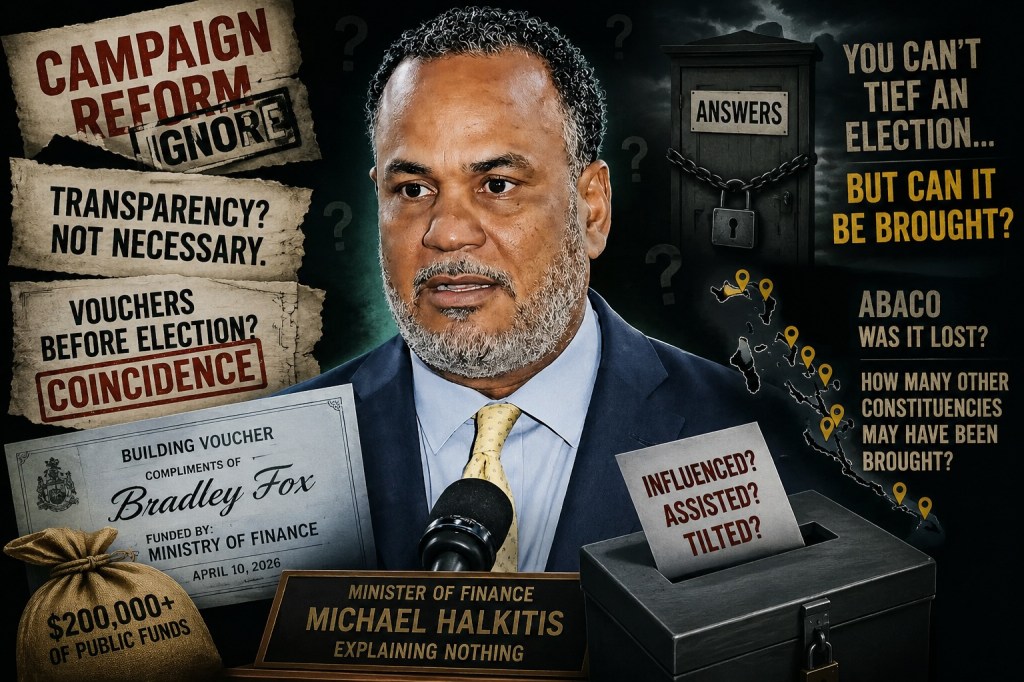
If this was simply part of a longstanding relief initiative, why did vouchers carrying the name of a political candidate appear just weeks before a general election? Why were government-funded vouchers branded in a manner that could reasonably give recipients the impression that assistance was being provided by an individual candidate? And perhaps most importantly, is this consistent with the spirit of campaign reform and the separation between public resources and political campaigns that modern democracies are supposed to uphold?
The government would have us believe this was all one giant coincidence.
A happy coincidence.
An election-season coincidence.
A candidate-name-on-government-funded-vouchers coincidence.
One of those coincidences that seem to happen with remarkable frequency whenever an election is approaching.
The Minister’s most curious defense may have been his suggestion that the fact the media discovered the issue somehow demonstrates transparency.
“The point to make is that the issue was raised I think because the leader of the opposition says he saw a report in a newspaper, and so that speaks to the transparency of the process.”
That is a fascinating definition of transparency.
Under this interpretation, transparency apparently occurs when journalists uncover something and publish it.
Traditionally, transparency has meant government officials proactively disclosing information, answering questions promptly, and providing documentation before concerns become public controversies. It has never been widely understood to mean “the newspaper found out first.”
In fact, if the media’s discovery of an issue is now the government’s preferred measurement of transparency, then Bahamians may wish to ask a few uncomfortable follow-up questions.
How exactly did the media find out?
Was the government planning to publicly disclose these vouchers before election day?
Would the public have ever known about them had journalists not obtained copies?
And why did the Minister promise to address the matter during the Budget Debate only to leave those questions unanswered?
These questions matter because campaign reform has always been based upon a simple principle: public resources belong to the public, not to political parties, candidates, or election campaigns.
The issue is not whether hurricane relief should be provided. It absolutely should.
The issue is whether government-funded assistance was presented in a manner that could provide political benefit to a candidate during an election period.
That is a question deserving of clear answers, not semantic gymnastics.
Former Prime Minister Hubert Ingraham once remarked that “You can’t tief an election in The Bahamas.”
Most Bahamians would agree.
But another question now hangs in the air.
Can an election be influenced, assisted, or tilted through the use of publicly funded programs that appear to be connected to political candidates?
If the outcome in Abaco was decided by a relatively small margin, voters are entitled to ask whether these vouchers had any impact whatsoever.
And if they did, then another uncomfortable question follows:
If it happened in Abaco, where else might similar practices have occurred?
The government’s response so far seems less focused on answering those questions and more focused on criticizing those who ask them.
Unfortunately, accountability does not disappear because it is politically inconvenient.
Nor does transparency become real simply because a newspaper uncovers a story.
If anything, the fact that journalists had to uncover the issue is precisely why the questions remain.
The Bahamian people deserve better.
END

