
Back in April 2025, Prime Minister Philip Davis raised more than a few eyebrows when he publicly expressed concern over a major U.S. drug trafficking indictment and suggested that aspects of the operation appeared, “on the face of it,” to resemble entrapment.
Now, that was an interesting moment. Not because governments should not be concerned about due process—they absolutely should—but because many Bahamians were left wondering why the Prime Minister suddenly sounded less like the head of government and more like counsel preparing a pretrial argument. The question naturally arose: why move so quickly toward discussing possible entrapment before the public even knew the full scope of who may have been involved?
At the time, the indictment involved allegations against senior Bahamian law enforcement figures and referenced an unnamed politician. Importantly, no public identification of that politician had been made.
Then came what appears to be another layer to an already troubling story.
Recent reporting cited a U.S. criminal complaint alleging that a Bahamian politician met in Parliament in 2024 with individuals connected to an alleged drug trafficking operation. The complaint further alleged links involving government contracts and protection from high-ranking officials. These remain allegations in U.S. court documents and are not convictions.
But here is where the political theatre becomes especially fascinating.
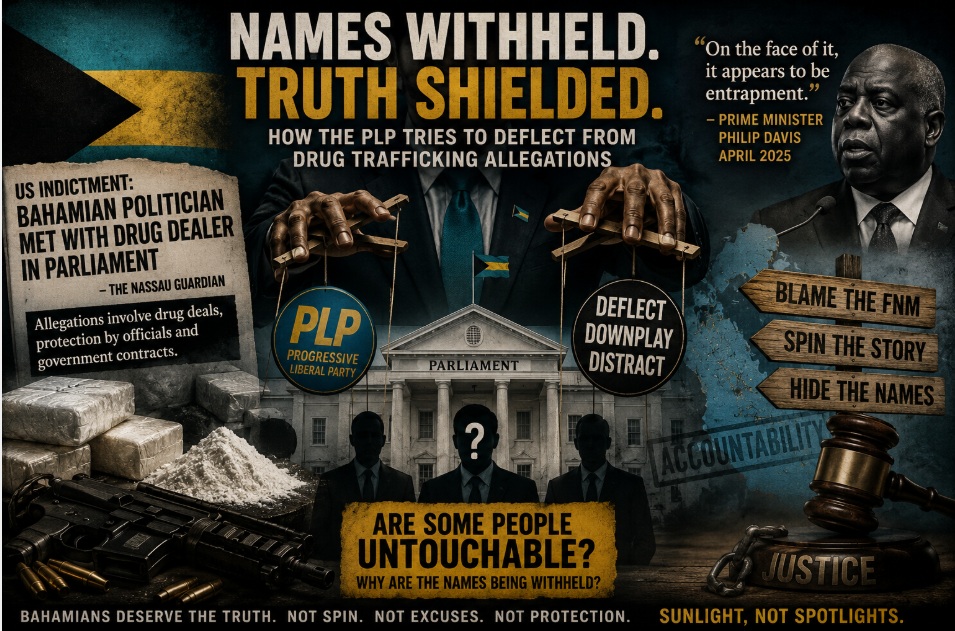
When the earlier allegations surfaced, many observers recall efforts by PLP voices and supporters to steer public conversation toward suggestions involving the previous administration or figures connected to the opposition. Political smoke machines suddenly went into overdrive. One almost expected a narrator to emerge saying: “Pay no attention to the allegations behind the curtain—look over there instead!”
Yet if these cases are in fact connected through overlapping names, allegations, or investigative threads—as reporting suggests may be possible—the attempt to politically redirect the conversation begins looking less like strategy and more like a magician whose audience noticed where the rabbit actually went.
And then comes the question that continues hanging over the entire matter like a tropical storm cloud refusing to move offshore: the names.
Not convictions. Not guilt. Names.
Because when references are made to unnamed politicians and unnamed government figures, and the public is told little else, a vacuum forms. Nature hates a vacuum, and politics hates one even more. Vacuums get filled with speculation.
The unfortunate reality is that withholding identities—whether for legitimate investigative reasons or otherwise—creates an atmosphere where citizens begin asking uncomfortable questions. Is there a procedural reason? Is there an ongoing investigation? Or does the public begin wondering whether there are people so politically connected that accountability somehow moves at island time while ordinary citizens face express delivery?
That perception alone is damaging.
The larger issue here is not whether one party gains points over another. Drug trafficking allegations touching law enforcement and political circles represent something far bigger than campaign warfare. If politicians—of any stripe, PLP, FNM, or otherwise—are implicated, the public deserves transparency and a serious response, not a national game of political hot potato.
Because when allegations of corruption emerge, governments are supposed to lead with transparency and accountability.

