My Morning Paper 7th August 2026 – WHEN POLITICS BECOMES MORE IMPORTANT THAN THINKING

It appears that Bahamian politics has entered a realm that can only be described as deeply troubling — and, at times, downright absurd.

And before anyone gets offended, this is not an accusation that Bahamians are uniquely incapable of rational thought. Political tribalism, blind loyalty and the rejection of inconvenient facts are hardly exclusive to The Bahamas. They exist in democracies around the world.

What should concern us, however, is the extent to which our political loyalties increasingly appear to determine what we are willing to believe.

That is a dangerous place for any society to find itself.

The German theologian Dietrich Bonhoeffer, writing during the rise of Nazi Germany, reflected deeply on what he called stupidity. Importantly, Bonhoeffer was not simply talking about a lack of intelligence. He was describing something far more dangerous: the surrender of independent judgment.

His argument was essentially that a person can be perfectly capable of thinking, yet surrender that ability to a political movement, leader, ideology or group. At that point, slogans can replace thought, loyalty can replace judgment, and facts that contradict one’s beliefs can simply be dismissed.

And perhaps that is where we should pause and look at ourselves.

FIRST: OUTSOURCING OUR THINKING

When we allow a political party, politician or political tribe to tell us what to think about every issue, we have stopped exercising independent judgment.

If the party says it is good, we say it is good.

If the party says it is bad, we say it is bad.

If our political opponents make the identical argument, suddenly it becomes unacceptable.

That is not political conviction.

That is intellectual dependence.

And the irony is that some of the people who behave this way today would have fiercely condemned the very same behaviour when their political opponents were doing it.

SECOND: WILLFUL IGNORANCE

Ignorance is not necessarily stupidity.

None of us knows everything. That is perfectly normal.

The problem begins when we encounter information that challenges what we believe and deliberately refuse to investigate it.

We don’t read the report.

We don’t check the numbers.

We don’t examine the evidence.

We simply repeat what our political side has told us.

And when presented with facts that contradict our position, we dismiss them because they came from “the other side.”

That isn’t knowledge.

It is wilful ignorance dressed up as political loyalty.
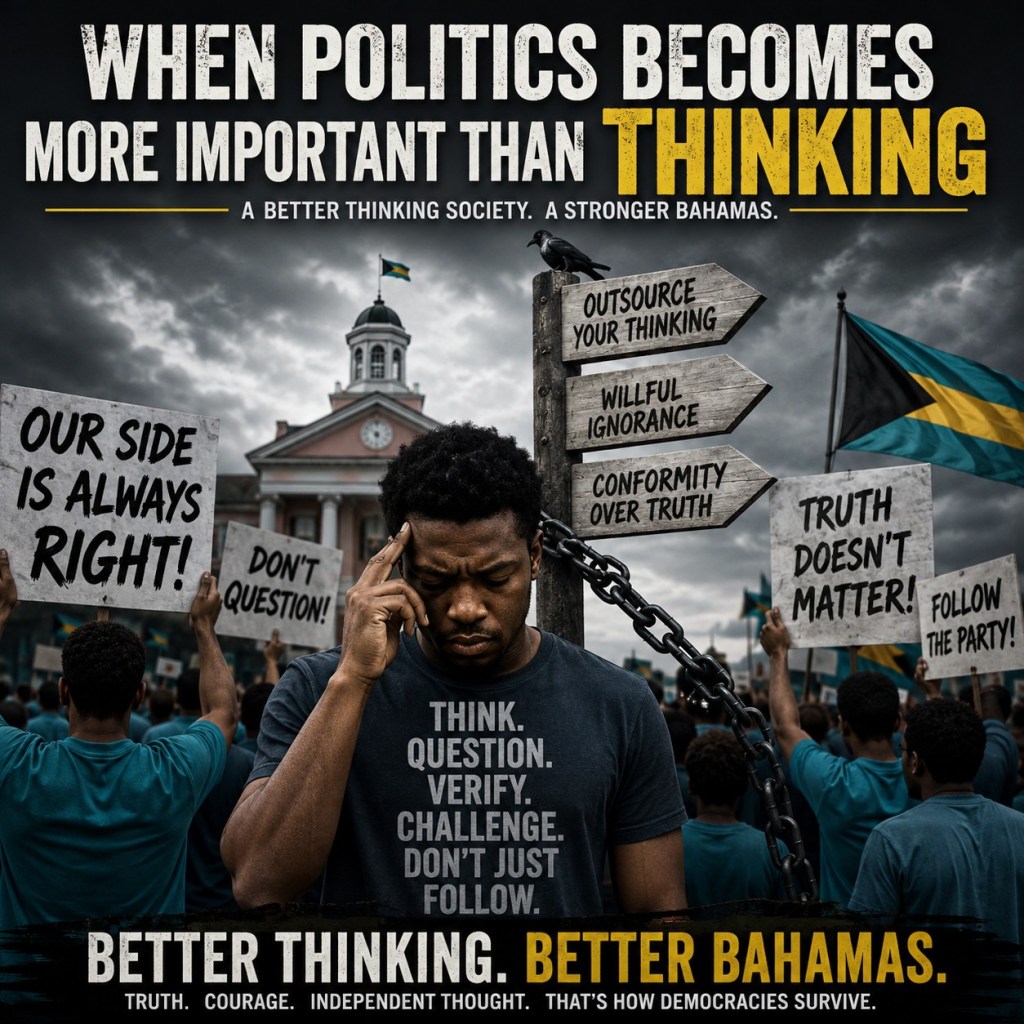
THIRD: CONFORMITY

Then there is the pressure to belong.

We see what everyone around us is saying, so we say it too.

We repeat the same slogans.

We defend the same people.

We condemn the same people.

We laugh at the same political jokes.

We attack anyone who dares to question the accepted position.

Eventually, being part of the crowd becomes more important than determining whether the crowd is actually right.

And that is where conformity becomes particularly dangerous: truth becomes secondary to belonging.

Bonhoeffer’s warning was not that every person is inherently stupid. In fact, his reflections specifically caution against treating the majority of people as stupid in every circumstance. His concern was what happens when people surrender their inner independence to the power and influence surrounding them.

SO, WHERE DOES THAT LEAVE US?

I believe we need to ask ourselves some uncomfortable questions.

Can we criticize our own political party?

Can we acknowledge when our preferred politician is wrong?

Can we accept a fact even when it benefits our political opponent?

Can we change our position when the evidence changes?

Can we disagree with someone politically without assuming that they are stupid, evil or unpatriotic?

And most importantly:

Are we thinking for ourselves — or are we simply repeating what our political tribe has instructed us to think?

A healthy democracy does not require everyone to agree.

It requires people to think.

It requires citizens willing to question their own side.

It requires the courage to say, “I was wrong.”

It requires us to value truth over tribalism, evidence over emotion and principle over party.

Because political parties are temporary.

Politicians come and go.

Governments change.

But the habits of thought we allow to take root in our society can remain for generations.

We cannot continue down a road where political loyalty becomes more important than intellectual honesty and still expect to build a mature, civilized democracy.

The Bahamas does not need more people who simply know which side they are on.

We need more people willing to ask whether their side is right.

Think.

Question.

Verify.

Challenge.

And when the facts prove us wrong, have the courage to change our minds.

That is not weakness.

That is citizenship.

END
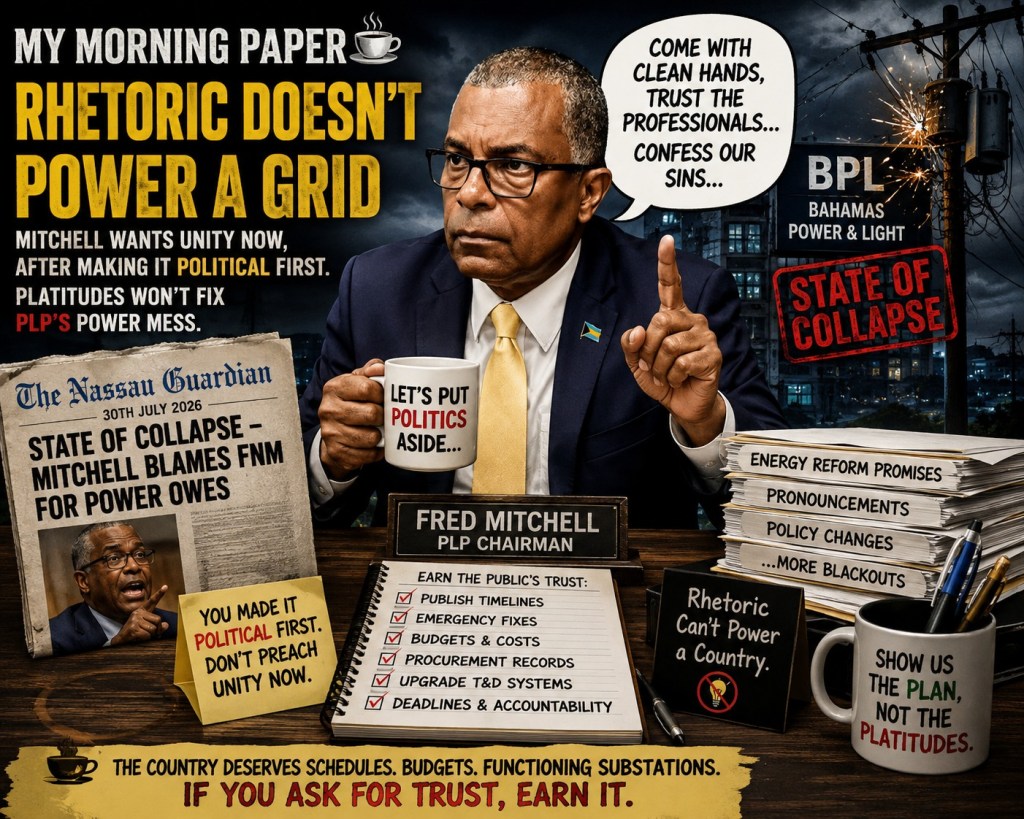
My Morning Paper – August 6th 2026 – Rhetoric Doesn’t Power the Grid: The Blackout Between Promises and Performance

I sat down to read the latest from Fred Mitchell — a press statement urging calm, praising “the professionals,” and scolding the opposition for “creating anxiety” over the Bahamas Power and Light mess. Charming. If only rhetoric powered a grid. 

It is simply amazing that now the PLP’s chairman would like “all hands of deck” and would like for persons to put politics aside on this matter when he was the first one to make it political and creating unnecessary anxiety; “State of collapse – Mitchell blames FNM for power owes” – The Nassau Guardian 30th July 2026.

Let’s cut to the chase: asking everyone to put politics aside while absolving your own party of responsibility is rich. Mitchell now wants “all hands-on deck” and for people to trust the experts — after the PLP’s loud energy-reform promises, after the pronouncements, after the changes that, by all appearances, left the system more fragile, not less. And no one is blaming the experts; the ones being blamed are those whose failed policies took us this far back.

And yet the chairman’s statement reads like a moral sermon: “come with clean hands,” “confess our sins,” “let us give the professionals an honest opportunity.” Fine. Start by putting the facts on the table. Publish the timelines, the emergency fixes, the budgets, the procurement records. Show the public the concrete steps being taken to finish transmission and distribution upgrades that everyone agrees are needed. Until then, pious calls for unity sound suspiciously like finger-pointing in a slow-motion collapse and we can all agree that the PLP’s hands are always “clean”, now this may be because they have never done anything wrong – that they would like you to believe or it is more likely because they really do not do any “heavy lifting”.

If Mitchell truly wanted bipartisanship, he’d show leadership by owning what his administration can fix immediately, admitting what it inherited, and committing to a clear, accountable plan with deadlines and costs. Instead, we get the rhetorical equivalent of a beach recommendation while the lights go out.

Final brew thought: if you ask for trust, earn it. Otherwise “leave it to the professionals” is just polite shorthand for “let us avoid responsibility.” The country deserves better than platitudes. It deserves schedules, budgets, and functioning substations.

END

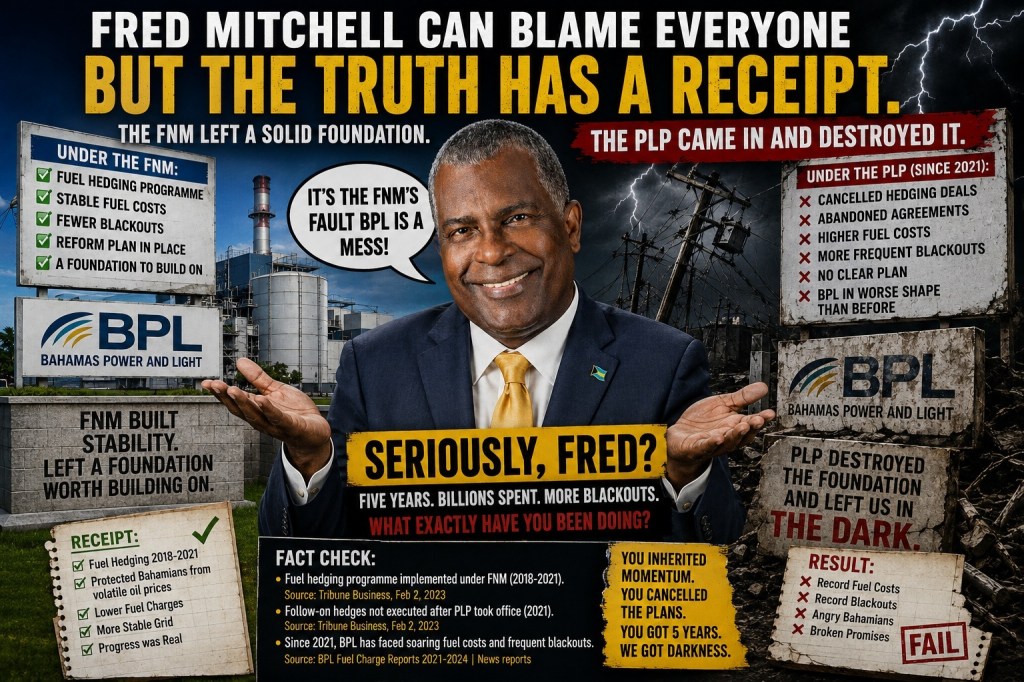
My Morning Paper 4th August 2026 – Fred Mitchell Wants to Rewrite History. Bahamians Remember the Blackouts.

One would have thought that, out of respect for Emancipation Day, Fred Mitchell might have taken a day off from his now familiar pastime of political revisionism.

Apparently not.

Instead, Bahamians were treated to yet another broadside from the Chairman of the Progressive Liberal Party (PLP), this time directed at the Free National Movement (FNM), its leadership, and even the staff of The Nassau Guardian. Their apparent crime? Reporting and scrutinizing Mr. Mitchell’s own public comments on the continuing Bahamas Power and Light (BPL) crisis.

Imagine attacking the messenger because the message was your own.

What is truly astonishing is Mr. Mitchell’s latest attempt to convince Bahamians that today’s electricity crisis is somehow the FNM’s fault, despite the PLP having been in office since September 2021. Governments inherit challenges—that is true. But governments also inherit opportunities. The question is what they do with them.

When the Davis administration took office, BPL certainly was not a perfect utility. Decades of underinvestment under successive governments had left major structural issues. However, the FNM administration had begun implementing a broader reform strategy that included fuel hedging, refinancing efforts, and plans for new generation intended to stabilize electricity costs and improve reliability.

The fuel hedging programme, negotiated with support from the Inter-American Development Bank (IDB), had already provided consumers with unusually stable fuel charges during a period of volatile oil prices. Planned follow-on hedge transactions scheduled after the 2021 general election were not executed by the incoming administration—a decision the Davis administration has defended but one that has remained highly controversial because critics argue it contributed to significantly higher fuel costs.

Whether one agrees with that decision or not, one fact is difficult to escape: the PLP did not continue every major element of the strategy it inherited. It chose a different course.

Five years later, Bahamians are asking a very simple question.

Has that course produced a better BPL?

The answer is written every time another island experiences widespread outages, every time businesses lose revenue because the power disappears, and every time families wonder whether the next thunderstorm will once again leave them sitting in darkness.

Mr. Mitchell insists the FNM “tried and failed.”

Perhaps.

But what exactly should we call five years of PLP management?

Because if the FNM supposedly failed after beginning a reform programme, what word describes an administration that dismantled significant parts of that programme and has still not delivered the reliable electricity system Bahamians were promised?

Mr. Mitchell also declared:

“The PLP does not stick its finger in the wind and pander…”

Indeed.

At this point it seems less like finger-in-the-wind politics and more like reading tea leaves—or perhaps consulting bones—hoping that political spin will somehow generate electricity where sound policy has not.

One has to wonder whether this statement is intended to justify not only the continuing problems at BPL, but also the government’s handling of other major national projects that have attracted public criticism over the past five years.

The irony is almost too rich.

Mr. Mitchell now complains that newspapers and political opponents have twisted his words.

No, Mr. Mitchell.

They quoted them.

There is a significant difference.

If your own words produce headlines you dislike, perhaps the problem is not the headlines.

Perhaps it is the words.

Political leadership requires accountability, especially after five years in office. The public is entitled to ask difficult questions, and the media is entitled to report the answers—or the absence of them.

Instead of blaming the FNM, blaming the newspapers, or blaming anyone else who dares point out the obvious, perhaps the PLP Chairman should answer the question Bahamians continue to ask:

After nearly five years in government, if the PLP inherited a foundation it believed was flawed, where is the stronger one it promised to build?

Because blaming yesterday’s government does not keep today’s lights on especially when that government is one administration removed.

The Bahamian people deserve better.

END

My Morning Paper- 1st August 2026 – An Energy Crisis Five Years Later

After receiving my $8.45 Bahamas Power and Light (BPL) credit, I was almost overcome with gratitude. I briefly considered sending Prime Minister Philip Davis a thank-you card. But sarcasm aside, that isn’t today’s issue.

Today’s issue is a statement by Progressive Liberal Party (PLP) Chairman Fred Mitchell, who has once again attempted to convince Bahamians that the current electricity crisis should be laid at the feet of the previous Free National Movement (FNM) administration.

According to reports, Mitchell said New Providence’s electrical grid is now “in a state of collapse” because the FNM “did nothing” to fix it, and therefore FNM Chairman Dr. Duane Sands has no standing to criticize the current administration.

It is a clever piece of political wordplay.

The implication is not merely that the FNM left behind problems. Every government inherits problems. The implication is that five years into the Davis administration, the PLP bears little responsibility for the condition of the very system it has controlled, managed and repeatedly promised to transform.

That is where the argument begins to collapse.

Five Years Is a Long Time

The Davis administration has been in office since September 2021.

During that period, energy reform has been one of the government’s flagship initiatives. The administration has repeatedly announced that it was rebuilding BPL, modernizing the transmission and distribution (T&D) network, and putting the country on a path toward a more reliable electricity supply.

Indeed, the government’s own position has consistently been that the transmission and distribution grid required major investment and that this work was being undertaken through the Bahamas Grid Company and its partnership with Island Grid/Pike.

So, Mr. Mitchell cannot simultaneously argue that:

  • the PLP has spent five years fixing the grid; and
  • every major failure today remains solely the fault of the FNM.

Both statements cannot be true.

What the FNM Actually Left Behind

There is also important context.

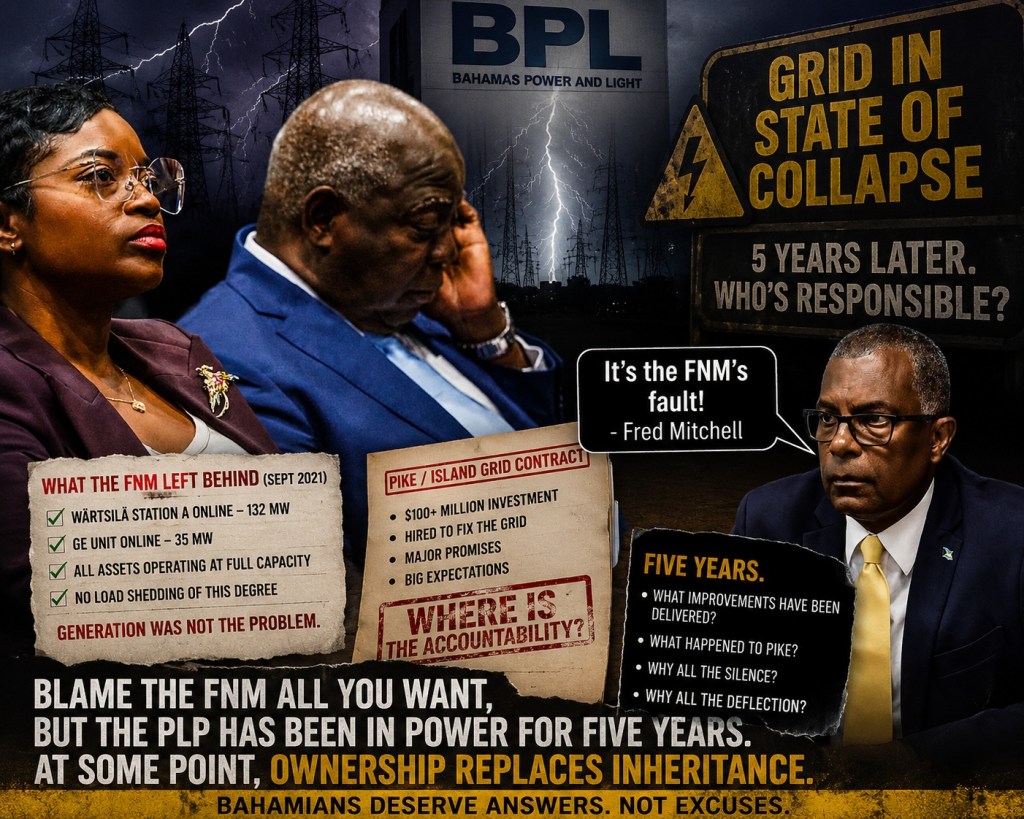
By the time the Minnis administration left office in September 2021, the new Wärtsilä Station A plant had already been commissioned, providing approximately 132 MW of generation capacity under its operating agreement.

Whether one agrees with every aspect of the FNM’s energy policy is a legitimate political debate. The Davis administration itself has heavily criticized the Wärtsilä project, alleging deficiencies in its execution and maintenance.

But that debate concerns generation.

Fred Mitchell’s latest comments concern the transmission and distribution grid—the poles, substations and lines that actually deliver electricity.

That is precisely the area the Davis administration said it intended to overhaul.

Whatever Happened to Pike?

This is where the unanswered questions begin.

The PLP introduced one of the largest energy reform initiatives in modern Bahamian history by entering into a long-term arrangement involving Pike Corporation, operating through Island Grid, to modernize New Providence’s transmission and distribution system. The agreement was promoted as a transformational solution to the grid’s long-standing weaknesses.

Yet in 2026, reports emerged that Island Grid had withdrawn from its management role, senior executives including Eric Pike stepped down, and questions immediately arose about the future of the project. Government officials insisted that investment would continue but offered limited public detail on why the management arrangement ended.

Those developments raise legitimate questions.

  • What exactly happened with the Pike arrangement?
  • Why did the management relationship end so abruptly?
  • What obligations remain under the agreement?
  • What measurable improvements have been achieved after millions of dollars in investment?
  • Why has the government been reluctant to provide comprehensive public answers regarding the contract?
  • What was the state of grid with Pikes sudden departure?

These are questions of accountability—not politics.

Transparency becomes even more important given that controversy has already surrounded whether the full Pike agreement had been tabled in Parliament, with public statements by senior government officials creating confusion over its status.

Responsibility Cannot Be Deferred Forever

Governments frequently remind us that “government is continuous” when taking credit for projects begun by previous administrations.

If that principle applies to successes, it must also apply to responsibility.

After nearly five years in office, the condition of BPL’s transmission and distribution system can no longer be explained solely by decisions made before September 2021.

At some point, ownership replaces inheritance.

At some point, execution replaces promises.

At some point, voters stop asking what was inherited and start asking what was accomplished.

The Real Question

Instead of another voice note blaming an administration that left office five years ago, Bahamians deserve a straightforward accounting.

What measurable improvements has the Davis administration delivered to New Providence’s electrical grid?

What became of the Pike strategy that was supposed to modernize it?

Why has transparency surrounding that agreement remained a recurring issue?

And if the grid is, as Mr. Mitchell now claims, truly “in a state of collapse,” after five years of PLP stewardship, isn’t the first place to look not the Opposition benches—but the Cabinet table?

Political blame may generate headlines.

Reliable electricity powers a country.

The Bahamian people deserve more of the latter and considerably less of the former.

The Progressive Liberal Party (PLP) government fails for one reason; it is their nature.

END