
It appears that Bahamian politics has entered a realm that can only be described as deeply troubling — and, at times, downright absurd.
And before anyone gets offended, this is not an accusation that Bahamians are uniquely incapable of rational thought. Political tribalism, blind loyalty and the rejection of inconvenient facts are hardly exclusive to The Bahamas. They exist in democracies around the world.
What should concern us, however, is the extent to which our political loyalties increasingly appear to determine what we are willing to believe.
That is a dangerous place for any society to find itself.
The German theologian Dietrich Bonhoeffer, writing during the rise of Nazi Germany, reflected deeply on what he called stupidity. Importantly, Bonhoeffer was not simply talking about a lack of intelligence. He was describing something far more dangerous: the surrender of independent judgment.
His argument was essentially that a person can be perfectly capable of thinking, yet surrender that ability to a political movement, leader, ideology or group. At that point, slogans can replace thought, loyalty can replace judgment, and facts that contradict one’s beliefs can simply be dismissed.
And perhaps that is where we should pause and look at ourselves.
FIRST: OUTSOURCING OUR THINKING
When we allow a political party, politician or political tribe to tell us what to think about every issue, we have stopped exercising independent judgment.
If the party says it is good, we say it is good.
If the party says it is bad, we say it is bad.
If our political opponents make the identical argument, suddenly it becomes unacceptable.
That is not political conviction.
That is intellectual dependence.
And the irony is that some of the people who behave this way today would have fiercely condemned the very same behaviour when their political opponents were doing it.
SECOND: WILLFUL IGNORANCE
Ignorance is not necessarily stupidity.
None of us knows everything. That is perfectly normal.
The problem begins when we encounter information that challenges what we believe and deliberately refuse to investigate it.
We don’t read the report.
We don’t check the numbers.
We don’t examine the evidence.
We simply repeat what our political side has told us.
And when presented with facts that contradict our position, we dismiss them because they came from “the other side.”
That isn’t knowledge.
It is wilful ignorance dressed up as political loyalty.
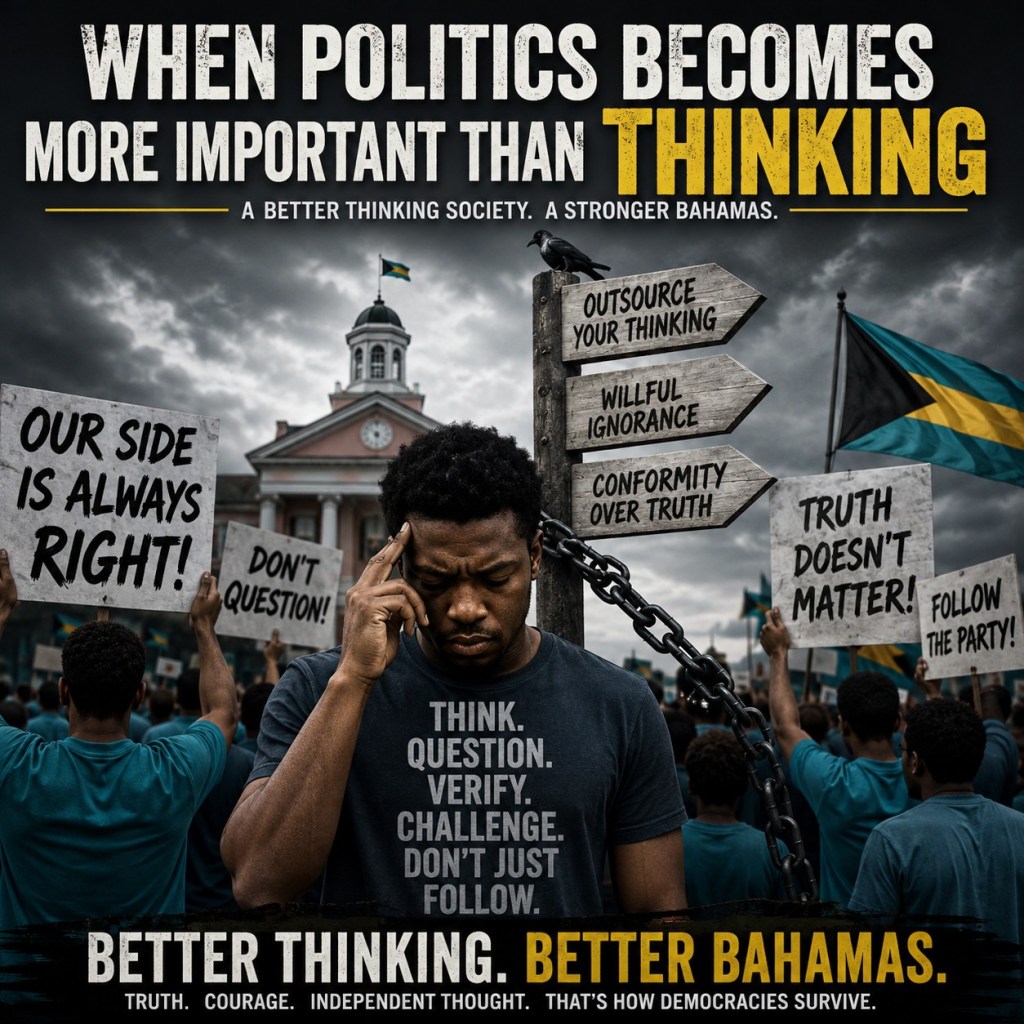
THIRD: CONFORMITY
Then there is the pressure to belong.
We see what everyone around us is saying, so we say it too.
We repeat the same slogans.
We defend the same people.
We condemn the same people.
We laugh at the same political jokes.
We attack anyone who dares to question the accepted position.
Eventually, being part of the crowd becomes more important than determining whether the crowd is actually right.
And that is where conformity becomes particularly dangerous: truth becomes secondary to belonging.
Bonhoeffer’s warning was not that every person is inherently stupid. In fact, his reflections specifically caution against treating the majority of people as stupid in every circumstance. His concern was what happens when people surrender their inner independence to the power and influence surrounding them.
SO, WHERE DOES THAT LEAVE US?
I believe we need to ask ourselves some uncomfortable questions.
Can we criticize our own political party?
Can we acknowledge when our preferred politician is wrong?
Can we accept a fact even when it benefits our political opponent?
Can we change our position when the evidence changes?
Can we disagree with someone politically without assuming that they are stupid, evil or unpatriotic?
And most importantly:
Are we thinking for ourselves — or are we simply repeating what our political tribe has instructed us to think?
A healthy democracy does not require everyone to agree.
It requires people to think.
It requires citizens willing to question their own side.
It requires the courage to say, “I was wrong.”
It requires us to value truth over tribalism, evidence over emotion and principle over party.
Because political parties are temporary.
Politicians come and go.
Governments change.
But the habits of thought we allow to take root in our society can remain for generations.
We cannot continue down a road where political loyalty becomes more important than intellectual honesty and still expect to build a mature, civilized democracy.
The Bahamas does not need more people who simply know which side they are on.
We need more people willing to ask whether their side is right.
Think.
Question.
Verify.
Challenge.
And when the facts prove us wrong, have the courage to change our minds.
That is not weakness.
That is citizenship.
END

