
There are moments in politics when you almost must admire the sheer creativity of an experienced politician.
After five years in office, the Chairman of the Progressive Liberal Party (PLP), Fred Mitchell, appears to have made a remarkable discovery:
The Bahamas needs money to do things.
Who knew?
According to remarks attributed to Mitchell, the country is facing enormous demands for capital — nearly $500 million for water and sewage, approximately $800 million for roads, and hundreds of millions more for bridges, seawalls, environmental projects, public buildings and healthcare facilities.
And, of course, there is the small matter of keeping the lights on.
Mitchell describes it as a “lack of capital” in a “dynamic economy” and says the country needs both capital and labour.
Well, after five years of a PLP government, one is tempted to ask the most impolite question of all:
When exactly did the government discover that all of this was going to cost money?
Because this is the same Progressive Liberal Party (PLP) that went to the Bahamian people in 2021 with a Blueprint for Change containing 387 commitments and promising to “recover, rebuild and revolutionize” the country.
The PLP’s own recently published tracker now acknowledges that some commitments have been delivered, others remain in progress, and some have been delayed, revised, replaced or discontinued. In other words, even the government’s own scorecard does not suggest that every promise made on the campaign trail magically became reality.
And this is where Mr. Mitchell’s newfound fascination with capital becomes rather interesting.
The “Dynamic Economy” Excuse
When the PLP was campaigning, the message was not:
“Vote for us, but please understand that we may subsequently discover that there isn’t enough money to do what we promised.”
No.
The message was transformational.
The 2021 Blueprint promised major changes, including increased public investment through government expenditure and public-private partnerships. In its first budget after taking office, the Davis administration itself said it intended to increase public investment and described its programme as “bold,” “aggressive,” “reasonable,” “responsible” and “realistic.”
So, what happened?
Five years later, we are apparently being introduced to The New New Day:
The government has discovered that roads cost money.
Water systems cost money.
Bridges cost money.
Healthcare facilities cost money.
Power infrastructure costs money.
And — hold on to your chairs — workers cost money too.
This would all be perfectly understandable if this were a government that had just walked into office yesterday.
But it isn’t.
The PLP has had five years to govern, plan, prioritize, finance and execute.
And Mr. Mitchell is not some bewildered backbencher who accidentally wandered into Cabinet. He is a senior Cabinet minister and the Chairman of the governing party.
So, when he tells Bahamians that there is a shortage of capital, the obvious question is:
What happened to the grand financial strategy that was supposed to make all those promises possible?
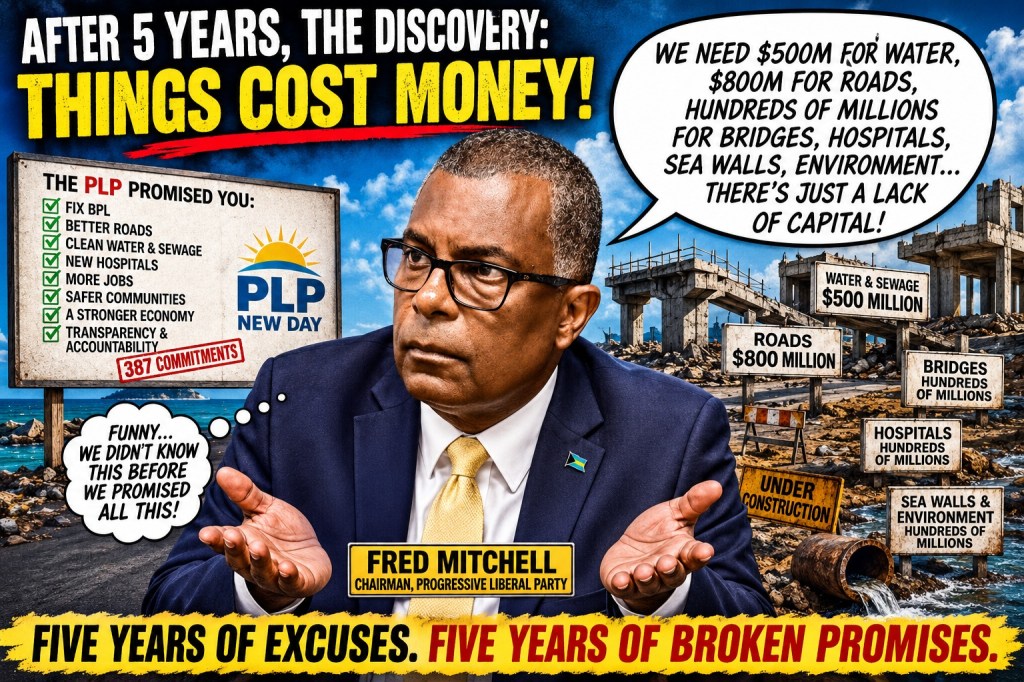
Nobody Said Government Was Cheap
To be fair, there is a legitimate point buried somewhere underneath Mr. Mitchell’s argument.
The Bahamas is a small country with a population of roughly 400,000 people. It has an enormous infrastructure bill relative to its population, a narrow domestic tax base, high import dependence and significant exposure to external economic shocks.
And yes, infrastructure is expensive.
But that isn’t a revelation.
It is precisely the sort of thing political parties are supposed to understand before they write their manifestos.
The government’s own fiscal numbers show that the fiscal position has improved considerably from the depths of the COVID-era crisis. Government debt fell from about 88.7% of GDP in FY2020/21 to a projected 71.4% in FY2024/25, according to the Ministry of Finance’s 2025 budget documents. The government also moved from a primary deficit to primary surpluses.
So, the argument cannot simply be that the cupboard is bare.
The more appropriate question is:
How has the government chosen to allocate the resources available to it, and why haven’t the promised investments been delivered at the pace Bahamians were led to expect?
That’s a very different question.
And Then There Is the Little Matter of the Promises
This is where the political mathematics becomes particularly amusing.
You cannot spend five years telling people that you have a plan to fix the country and then, near the end of the political cycle, discover that fixing the country is rather expensive.
The PLP’s own 2021 budget rhetoric was extraordinarily confident. The government said it was going to stabilize the nation’s finances, increase revenue, grow the economy and increase public investment.
It even criticized the previous administration’s fiscal management and declared that the era of “mismanagement, shoddy fiscal discipline and indecisive governance” was over.
That was quite a statement.
Because once you assume the mantle of government, eventually the speeches must become projects.
Eventually the announcements must become contracts.
Eventually the contracts must become construction.
Eventually the construction must become something Bahamians can actually use.
And eventually somebody must pay the bill.
The Immigration Argument Is Another Matter
Mitchell’s comments about businesses struggling to find workers while some Bahamians say they cannot find jobs touch on a genuine economic problem: the mismatch between available skills and the labour demanded by employers.
That is a legitimate policy debate.
A government can reasonably argue that carefully managed immigration is necessary where local labour supply does not meet demand, while simultaneously investing in Bahamian training and employment.
But that debate should not be used as a substitute for confronting the government’s own failures in workforce development.
If contractors have been complaining for years that they cannot find skilled Bahamian labour, and Bahamians have been complaining that they cannot find suitable employment, then perhaps the country doesn’t merely have an immigration problem.
Perhaps it has a planning problem.
And after five years, that planning problem belongs to the government.
The Capital Problem Is Not an Excuse for Broken Promises
Here is the inconvenient truth for the PLP:
Governments inherit problems. Governments are elected to solve them.
They don’t get to campaign promising transformation and then, five years later, announce that transformation has turned out to be rather costly.
Imagine a contractor telling a client:
“Good news! I have completed the first five years of the project. Bad news: I have just discovered that concrete, steel, labour and plumbing cost money.”
The client might reasonably ask:
“Didn’t you prepare a budget?”
That is precisely what Bahamians should be asking.
Because the PLP didn’t simply promise to govern.
It promised a New Day.
It promised to “Recover, Rebuild and Revolutionize.”
It published 387 commitments.
And now, near the end of the five-year period, the party chairman is explaining that the country has a tremendous amount to do and — surprise, surprise — there isn’t unlimited capital available to do it.
Well, Mr. Chairman, welcome to government.
There never was unlimited money.
There never was unlimited labour.
There never was unlimited time.
There was, however, a campaign trail.
And on that trail, the PLP made a great many promises.
The question now isn’t whether The Bahamas needs $500 million for water, $800 million for roads, or hundreds of millions more for everything else.
Of course it does.
The question is much simpler:
Why did the people have to wait five years for the people making the promises to discover the price tag?
Perhaps the next election should come with a new campaign slogan:
“Vote PLP — Now With An Actual Budget.”
Because apparently the first five years were merely the trial period.
And if this is what happens when the New Day arrives, perhaps somebody should check whether the receipt comes with a return policy.
The people of The Bahamas deserve better.
END

