
Anyone following Fred Mitchell’s latest commentary on the Public Accounts Committee (PAC) investigation might reasonably wonder whether the Chairman of the Progressive Liberal Party (PLP) understands the difference between parliamentary accountability and political damage control.
Mitchell, who also serves as Minister of Foreign Affairs, appears particularly offended that the Opposition-controlled PAC has actually undertaken the responsibility Parliament entrusted to it: examining how the Government spends the Bahamian people’s money.
Imagine that! A parliamentary committee investigating public expenditure and asking questions about where taxpayers’ money went. What an extraordinary inconvenience!
In his latest response, Mitchell has dismissed the PAC report, accused the Opposition of attempting to relitigate the 2026 general election and questioned the credibility of the committee’s findings. He has even told Opposition Leader Michael Pintard to “go jump in a lake.”
Apparently, when the questions become uncomfortable, parliamentary scrutiny suddenly becomes political persecution.
But perhaps Mitchell should spend less time insulting the Opposition and more time explaining the findings that prompted this investigation.
THE QUESTION WAS NEVER SIMPLY WHETHER MONEY WAS STOLEN!
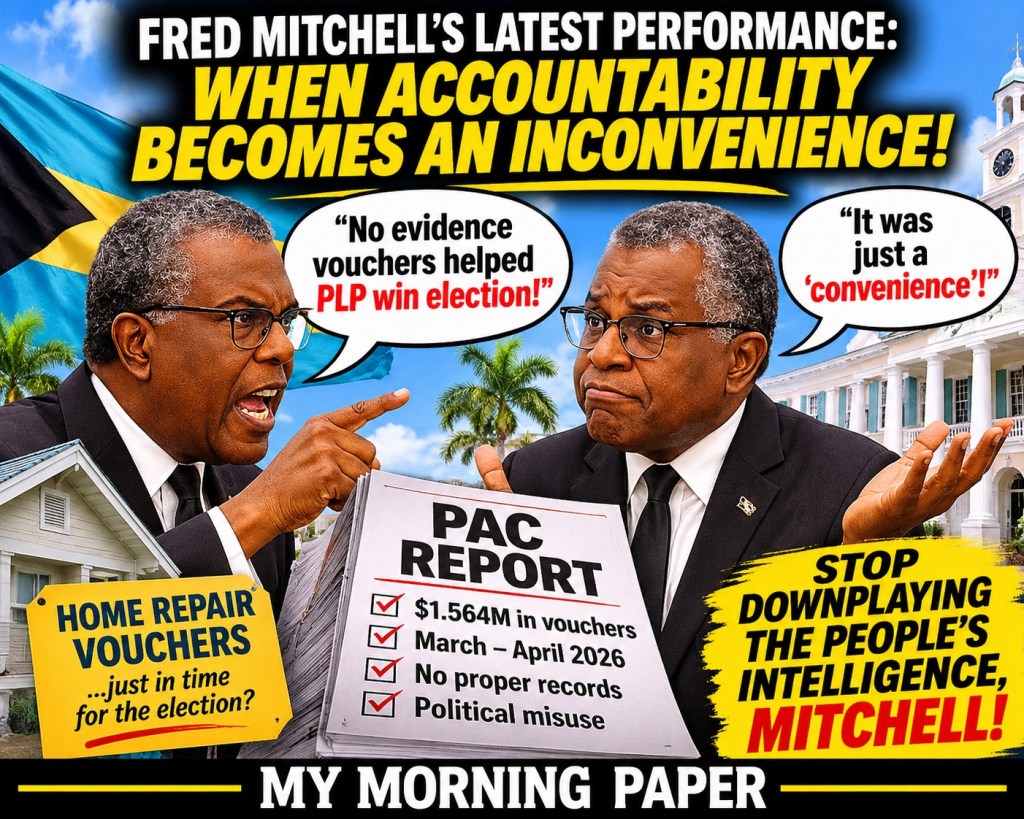
One of the more convenient arguments coming from Mitchell is that there is no evidence that the voucher programme helped the PLP win the May 12 general election because, according to him, no money was stolen and the services were delivered.
But who, exactly, said the PAC had to prove that the election result was stolen before it could question the administration of public funds?
That is a rather extraordinary standard of accountability, and we are quite ware that when it comes to accountability, Fred Mitchell and the PLP always seems to get a tad bit testy.
The PAC’s report identified approximately $1.564 million in government-funded vouchers purchased during March and April 2026, immediately before the May 12 general election.
The committee’s concerns were not limited to whether building materials were supplied or whether some houses received repairs. It examined the circumstances under which the money was approved, distributed, controlled and accounted for.
Among its findings were:
- No complete register identifying the ultimate voucher beneficiaries.
- No signed acknowledgements from recipients.
- No adequate end-to-end system connecting public expenditure to eligible beneficiaries and completed work.
- No proper assessment process establishing that the individuals ultimately receiving assistance were those assessed.
- Significant involvement in voucher distribution by Jerome Fitzgerald, who simultaneously served as the Prime Minister’s senior policy adviser and the PLP’s national election coordinator.
- A government-funded $150,000 account at Pinder Enterprises divided into constituency allocations involving PLP MPs and an unsuccessful PLP candidate.
These are not allegations that can be brushed aside simply by announcing that somebody’s roof was repaired.
Indeed, the committee acknowledged that genuine repairs took place. Its concern was that the Government could not adequately establish who ultimately benefited, whether the assistance was properly authorised and whether taxpayers received value for their money.
In other words, the existence of some legitimate repairs does not automatically legitimise the administrative arrangements surrounding the entire programme.
And that is precisely the point Mitchell seems determined to avoid.
THE CONVENIENCE OF AN ELECTION-YEAR HOME REPAIR PROGRAMME
Now, let us examine the timing.
The Ministry of Finance approved and funded approximately $1.564 million in voucher purchases during March and April 2026. The general election took place on May 12.
That is a rather interesting coincidence, particularly when the programme involved assistance with home repairs and building materials, something that directly affects the everyday lives of ordinary Bahamian households.
Nobody needs to manufacture a conspiracy to recognise the political significance of distributing substantial amounts of government-funded assistance in the weeks immediately preceding a general election.
Consider the circumstances.
People struggling with deteriorating roofs, damaged windows and unfinished home repairs suddenly had access to building-material assistance. Such assistance can be enormously valuable to a struggling household. It can also generate considerable goodwill among the people receiving it.
That is why the timing, administration and political association of the programme deserved serious scrutiny.
The issue is not whether a homeowner appreciated receiving assistance. Of course they did.
The issue is whether taxpayers’ money was distributed through a transparent, properly administered government programme or through arrangements that allowed political figures and party-connected individuals to exercise influence over the distribution.
The PAC report identified precisely those concerns.
And when the committee examined the arrangements, it found that public money had moved through channels without the basic records and safeguards necessary to establish accountability.
Mitchell would apparently prefer Bahamians to concentrate exclusively on the repaired roofs while ignoring the unanswered questions about who selected the beneficiaries, who controlled the vouchers and why the programme was being administered in this manner so close to an election.
Unfortunately, accountability does not work that way.
THE PAC IS NOT A PLP PUBLIC RELATIONS DEPARTMENT
Mitchell also appears troubled that the report was not endorsed or signed by the PLP members of the committee.
That may be a legitimate procedural issue to discuss. However, disagreement by committee members does not, by itself, invalidate the documentary evidence, testimony or financial records examined during an investigation.
The PAC is a parliamentary oversight body. Its responsibility is to examine public expenditure, not to protect the political reputation of whichever party happens to be in government.
If the FNM members have misrepresented evidence, let the PLP produce the documentation and demonstrate precisely where the report is wrong.
If the financial records are accurate, explain them.
If the vouchers were properly administered, produce the recipient registers, signed acknowledgements, assessments and records showing where the money went.
That would be considerably more useful than telling the Opposition to go jump in a lake.
Mitchell has also complained that certain PLP parliamentarians were named without being afforded an opportunity to appear before the committee. That is an issue of procedural fairness that deserves consideration. Anyone facing adverse findings should have an appropriate opportunity to respond.
But procedural objections do not make the underlying questions about public expenditure disappear.
And they certainly do not explain the missing records.
THE ELECTION RESULT IS NOT THE SAME THING AS THE ACCOUNTABILITY QUESTION!
Perhaps the most revealing aspect of Mitchell’s argument is his insistence that there is no credible demonstration that the voucher programme determined the outcome of the general election.
But that is not what the PAC needed to establish.
There is a considerable difference between proving that a particular government programme changed an election result and establishing that public resources were administered in a manner that created opportunities for political misuse.
The first is a question of electoral causation.
The second is a question of public administration, financial controls and accountability.
The PAC’s report addressed the second.
Whether the programme influenced individual voters is a separate question, and the available findings do not establish that it changed the overall election result.
But does that mean the timing and distribution arrangements should escape scrutiny?
Absolutely not.
If the Government spent $1.564 million in public funds immediately before an election, and its own records cannot adequately establish who received the assistance, who authorised its distribution and whether the programme operated according to proper procedures, then Bahamians are entitled to answers.
That is not relitigating an election. That is examining how their money was spent.
And if Mitchell believes the report is inaccurate, he has every opportunity to challenge its specific findings with evidence.
BAHAMIANS DESERVE MORE THAN POLITICAL DEFLECTION!
The PAC has recommended that the evidence be referred to the relevant investigative authorities, including the Royal Bahamas Police Force, for further examination. Importantly, the report does not itself establish criminal guilt.
That distinction matters. Nobody should be declared guilty simply because their name appears in a parliamentary report.
But neither should the seriousness of the findings be diminished because they are politically inconvenient.
Fred Mitchell cannot have it both ways. He cannot demand that the Opposition respect parliamentary institutions while simultaneously suggesting that the PAC has no credibility simply because its findings are uncomfortable for his party.
The committee was not established to provide the PLP with a certificate of good political conduct.
It was established to examine public expenditure.
And perhaps that is the real source of this controversy: the PAC has asked questions that cannot be answered by political slogans, personal insults or declarations that everything was perfectly legitimate.
The Bahamian people are not asking whether Fred Mitchell believes the FNM would have won or lost the election without the vouchers.
They are asking why $1.564 million in public money was spent on a programme immediately before the election under arrangements that the PAC says lacked essential financial controls and proper accountability.
They are asking who received the assistance, who controlled its distribution and why the Government cannot adequately account for it.
Those are perfectly reasonable questions.
And until they are answered, telling Michael Pintard to “jump in a lake” is not an explanation.
It is simply another contribution to the growing collection of political noise surrounding a very serious question of public accountability.
Because here in The Bahamas, a repaired roof may be a welcome election-season gift, but the taxpayer still deserves to know who paid for it, who authorised it, who distributed it and why the records are missing.
The Bahamian deserves better.
END

