
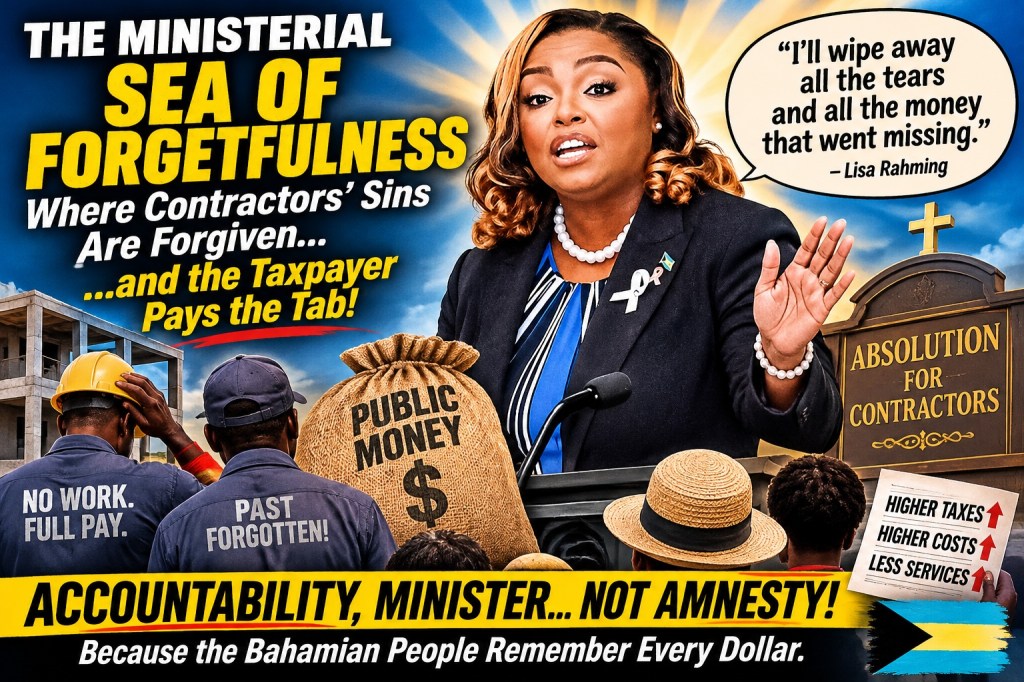
It would appear that we are witnessing a rather interesting new development in Bahamian governance: a religious-political revival in which contractors accused of taking public money without completing the work are being offered something resembling divine forgiveness, courtesy of the Minister of Urban Renewal and Community Relations, Lisa Rahming.
While the Opposition is demanding accountability for public funds paid to contractors for work reportedly left incomplete, improperly executed or not done at all, the Minister seems to have taken a different approach. Rather than explaining how the money will be recovered, who will be held responsible and what safeguards will prevent a repeat performance, she appears to have taken to the political pulpit to offer absolution.
“FNM demands accountability on Small Home Repairs Program funds” – The Nassau Guardian
According to the newspaper’s report, Minister Rahming acknowledged that some contractors hired under the government’s Small Home Repairs Programme pocketed funds without fulfilling their contractual obligations.
Yet, at a press briefing at the Office of the Prime Minister, she revealed that although contractors had been warned they could be blacklisted, not one had actually been blacklisted.
Then came the remarkable declaration.
Referring to a meeting with contractors in August, Rahming reportedly told them that she would “wipe away all the tears and all the money that went missing.”
She went even further:
“I forgot it in a sea of forgetfulness.”
Well, isn’t that convenient!
Apparently, we have moved beyond contract management, financial oversight and public accountability and entered the realm of ministerial absolution. A contractor can allegedly receive public funds, fail to deliver the promised work, and then find himself standing before a minister who is prepared to wash away the past and offer him a fresh start.
One wonders whether the Minister has confused the Ministry of Urban Renewal with a church altar.
Because, if this is how public administration is supposed to work, perhaps we should dispense with contracts altogether. Why bother with performance guarantees, inspections, audits, financial controls or recovery procedures? Just invite the contractors to a meeting, have a little prayer, declare the past forgotten and send everybody home with a clean slate.
Apparently, the only thing missing is a collection plate.
Deputy FNM Leader Shanendon Cartwright was right to challenge this extraordinary approach, reminding the government that public money is not personal money and cannot simply be forgotten when questions arise about its expenditure.
And that is precisely the point.
Minister Rahming may be prepared to forgive, but she does not own the money she is forgiving.
It belongs to the Bahamian people.
The taxpayers who funded this programme did not give the government a blank cheque to distribute public money and then exercise ministerial discretion over which financial transgressions deserve forgiveness and which deserve investigation.
More importantly, this is happening at a time when Bahamians are already struggling with the cost of living and facing increased demands on their pockets through taxation and other government charges.
Think about the extraordinary contradiction.
The ordinary Bahamian is expected to pay VAT, property taxes, business licence fees and every other government obligation on time. Miss a payment, and the machinery of government can be remarkably efficient in finding you, calculating penalties and demanding compliance.
But when contractors allegedly receive public money and fail to deliver the work, suddenly we discover the virtues of mercy, compassion and a rather expansive sea of forgetfulness.
How wonderfully accommodating!
Perhaps the Minister could explain whether the same philosophy applies to the ordinary taxpayer. If a homeowner falls behind on property taxes, can he simply inform the Ministry that he has forgotten the outstanding balance in a sea of forgetfulness? If a business owes VAT, can the proprietor request a fresh start on the basis of a promise to do better next time?
I suspect the answer would be considerably less spiritual.
And let us be clear: this is not about denying contractors an opportunity to correct mistakes or fulfil their obligations. It is about distinguishing between an honest contractual dispute and the serious allegation that public money was received without the corresponding work being delivered.
There must be consequences where wrongdoing is established.
There must be an accounting of every dollar. There must be recovery of funds where appropriate, proper investigations where warranted, and disciplinary or legal action where the evidence justifies it.
A warning about possible blacklisting is not accountability. A promise to behave better in the future is not restitution. And a ministerial declaration that yesterday’s financial problems have been forgotten is certainly not an acceptable substitute for public financial management.
Perhaps what the Bahamas needs is not another ministerial sermon, but an independent regulatory and oversight framework with the authority to monitor contractors, verify completed work, investigate complaints, recover public funds and prevent repeat offenders from simply moving from one government programme to another.
Because contractors entrusted with public money should be answerable for their performance, not dependent upon the generosity of a minister’s memory.
And here is the question Minister Rahming ought to answer:
Who authorised the payments? Who verified the work? How much money is missing? Has any of it been recovered? And why has nobody been blacklisted?
These are not unreasonable political questions. They are elementary questions of public accountability.
At the end of the day, the Minister is not being asked to forgive a personal debt or overlook a private disagreement. She is dealing with money belonging to the Bahamian people.
So, while Minister Rahming may wish to consign the contractors’ alleged transgressions to her proverbial sea of forgetfulness, I would respectfully suggest that the Bahamian taxpayer has no such luxury.
The taxpayer remembers every dollar because he is the one who has to earn it, pay it, and ultimately replace it.
Minister Rahming may have found a sea in which to forget the money, but the Bahamian people are still looking for the money itself.
And before anyone starts preaching about second chances, perhaps they should first explain what happened to the first payment.
After all, forgiveness may be a virtue. But when it comes to public funds, accountability is an obligation.
END

