
There is something quite extraordinary about the Davis administration’s understanding of transparency and accountability. Apparently, transparency is something the Government enthusiastically supports, provided that nobody becomes too enthusiastic about actually investigating it.
On September 16, 2026, Minister of Finance Michael Halkitis stood in the House of Assembly and addressed the growing controversy surrounding the National Investment Fund (NIF).
His assurances were reassuringly straightforward.
He told Parliament:
“It’s their job to ask these questions. It’s our job to answer them.”
He also pledged that the Government would fully cooperate with the Public Accounts Committee (PAC) as it investigated the administration of the Fund.
Wonderful!
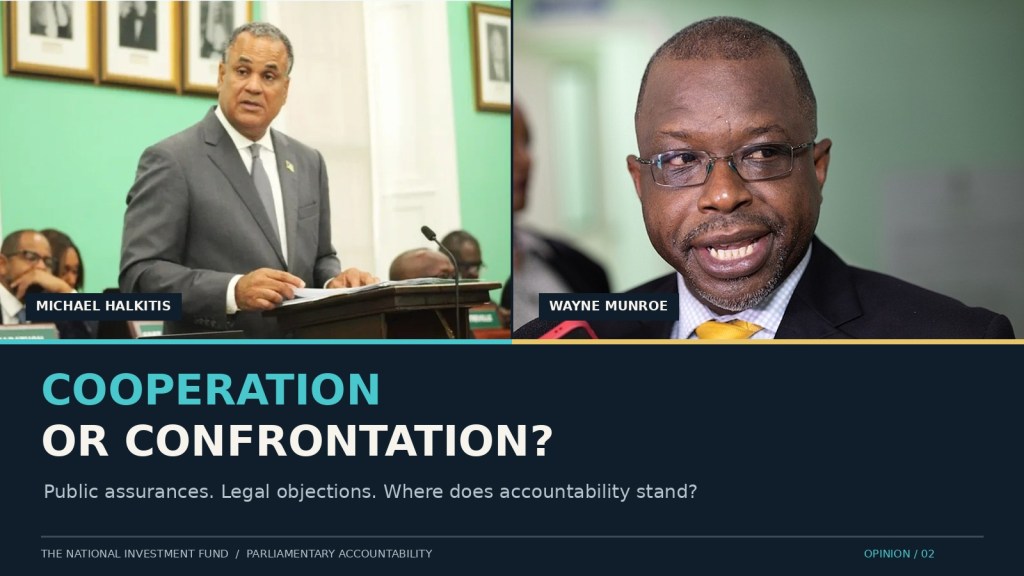
One could almost hear the trumpets of accountability playing in the background. At last, a government prepared to open its books, answer questions and allow Parliament to do what Parliament is supposed to do: hold the Executive accountable for the expenditure of public money.
Unfortunately, the enthusiasm for transparency appears to have encountered a rather inconvenient obstacle: the actual investigation.
According to today’s report in The Tribune, “Pintard accuses Gov’t of obstruction amid ‘imbroglio’ fear over $700m NIF probe, the Attorney General, Wayne Munroe KC, is now contemplating taking the PAC to the Supreme Court if it continues with its decision to summon former Attorney General Ryan Pinder KC.
And who delivered this rather interesting warning to Parliament?
None other than Kingsley Smith, the PLP Member of Parliament for West Grand Bahama, who warned the House that the PAC could find itself facing adverse judicial declarations and sanctions if it continued with what the Attorney General considers an unlawful exercise of its powers.
In other words, while one member of the Government was promising the Bahamian people that the administration was prepared to cooperate with the investigation, another was standing in Parliament explaining the potential legal consequences of the committee attempting to investigate.
How wonderfully coordinated!
One minister says, “Ask the questions. We will answer them.”
The Attorney General’s message, as communicated to Parliament, is effectively: “Ask those particular questions, and we may see you in court.”
Perhaps the Government should arrange a meeting between its public relations department and its legal department. They appear to be operating from two entirely different transparency manuals.
A familiar PLP tradition: Advising people not to appear before the PAC
What makes this latest development particularly interesting is that it is not the first time a Davis administration Attorney General has advised someone against appearing before the Public Accounts Committee.
Let us rewind to February 21, 2023.
Michael Pintard, then Chairman of the PAC and Leader of the Opposition, had summoned Permanent Secretary Luther Smith to appear before the Committee on February 21 to answer questions concerning government contracts and procurement.
However, instead of appearing before the Committee, Mr Smith stayed away after receiving advice from the then Attorney General, Ryan Pinder KC.
On February 21, 2023, Mr Pinder wrote to the PAC chairman arguing that the Committee’s general request for contracts exceeded its authority under Section 17 of the House of Assembly’s Rules of Procedure.
His position was that the request for documents and interviews of public servants was therefore denied.
The following day, February 22, 2023, the story was reported under the rather revealing headline:
“WHY THE NO-SHOW AT PUBLIC ACCOUNTS COMMITTEE? Pintard wants answers as Attorney General advises PS to stay away.”
Mr Smith subsequently confirmed that he had relied on the Attorney General’s advice.
So, here we are again.
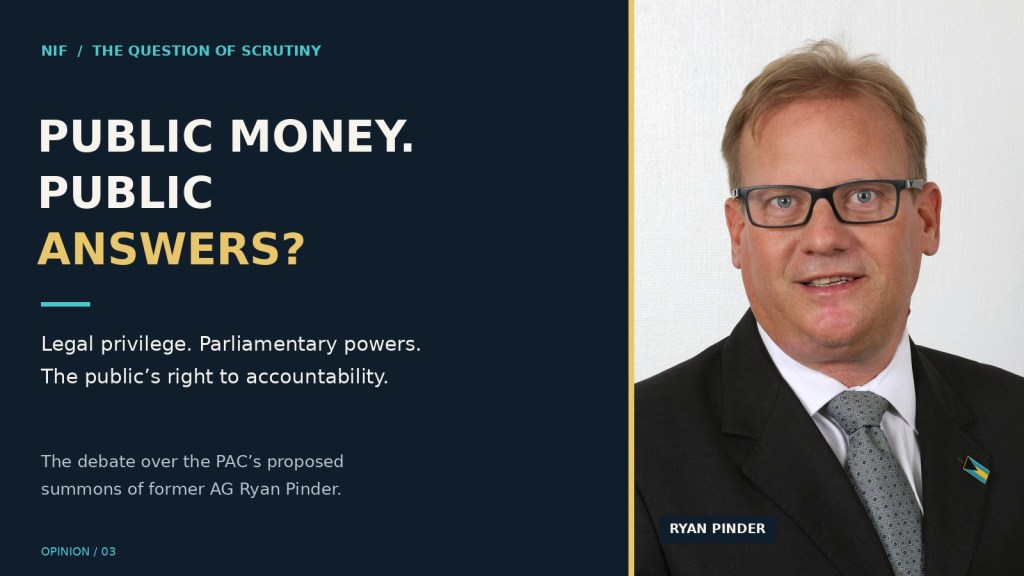
Three years later, another Attorney General is raising legal objections to the PAC’s investigative efforts, this time concerning the former Attorney General himself.
One could be forgiven for thinking that somewhere inside the Davis administration there is a standing instruction that whenever the Public Accounts Committee starts asking uncomfortable questions, somebody in the Attorney General’s Office should be placed on standby.
Of course, the legal arguments in the two cases are not identical. In 2023, the dispute concerned the scope of the PAC’s requests under its rules. In 2026, the dispute concerns the proposed summons of a former Attorney General, legal professional privilege, Cabinet confidentiality and the statutory authority required to summon witnesses.
But the recurring question remains: why does the Government seem so uncomfortable with the prospect of its officials answering questions before Parliament?
The $700 million question
Let us remember what this investigation is actually about.
It is not a dispute over somebody’s private bank account, a family disagreement or an academic discussion about parliamentary procedure.
It concerns the administration of hundreds of millions of dollars belonging to the Bahamian people.
On September 16, 2026, Michael Halkitis confirmed that approximately $310.9 million had been utilised for infrastructure and other public investments through arrangements associated with the National Investment Fund.
He also acknowledged that important governance arrangements, including regulations, mandates, committee structures and financial reporting and audit processes, were still being completed.
The controversy is not simply whether the money was spent on roads, airports, buildings or other worthwhile projects.
The question is whether the money was transferred, administered and spent in accordance with the laws governing the Fund.
That distinction seems to be getting lost in the Government’s increasingly elaborate explanations.
The fact that a road was constructed does not answer the question of whether the money used to construct it was lawfully authorised.
The fact that an airport was improved does not eliminate the requirement for proper financial controls.
And the fact that the Government received legal advice does not automatically make that advice immune from parliamentary scrutiny.
Indeed, if the Government relied upon legal advice to justify its handling of hundreds of millions of dollars, it is entirely reasonable for Parliament to want to understand the legal foundation upon which those decisions were made.
That is precisely why the PAC wants to hear from Ryan Pinder, who was Attorney General when the relevant legal advice was provided.
Exactly whom are they protecting?
This brings us to the question that the Government seems increasingly reluctant to answer.
Why is there such resistance to allowing the PAC to examine the circumstances surrounding the establishment and operation of these accounts?
Why is the Government promising full cooperation while its Attorney General is warning that legal proceedings may be necessary to stop the Committee from pursuing a particular line of inquiry?
Why are we hearing arguments about privilege, confidentiality and parliamentary authority before the public has received a satisfactory explanation of the legal authority under which these transactions took place?
If the Government is confident that everything was done properly, surely the investigation presents an opportunity to demonstrate precisely that.
If the legal advice was sound, let the facts be established.
If the transactions were lawful, explain the legal authority.
If the money was properly administered, produce the records.
And if the Government believes the PAC is exceeding its authority, let that question be resolved through the proper constitutional and parliamentary processes without using procedural disputes to frustrate legitimate accountability.
There is a difference between defending the rule of law and using the law as a shield against scrutiny.
The Government cannot reasonably expect the Bahamian people to accept that distinction without explanation.
Transparency is not a campaign slogan
Perhaps the most remarkable aspect of this entire affair is that the Government appears to believe that saying it supports transparency is somehow equivalent to practising it.
It is not.
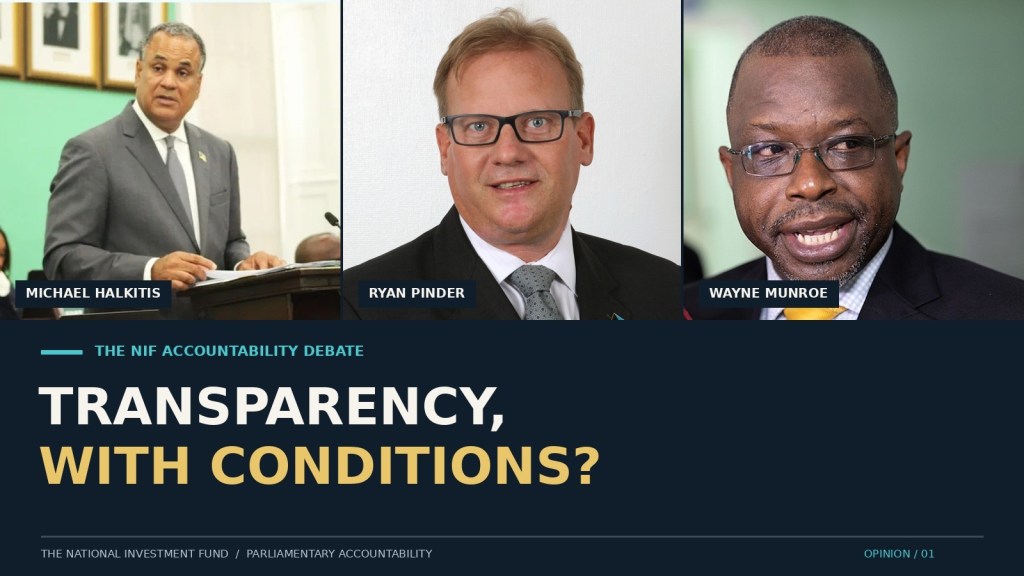
Transparency is not a ministerial statement. It is not a carefully prepared press release. It is not a promise delivered in Parliament when the questions are still comfortably hypothetical.
Transparency is demonstrated when the questions become uncomfortable, when the documents are requested, when witnesses are summoned and when those responsible for public decisions are required to explain themselves.
Michael Halkitis told the country that it was the PAC’s job to ask questions and the Government’s job to answer them.
Well, Minister, the PAC is doing precisely what you said it should do.
Perhaps somebody should remind the rest of the Government.
Because at the moment, the Bahamian people are witnessing an administration that appears perfectly comfortable with an investigation right up until the investigation begins asking questions about the people who authorised the transactions.
And that, ladies and gentlemen, is quite a performance.
One minister promises cooperation. An Attorney General contemplates court action. A government MP warns of an impending legal imbroglio. And the Bahamian taxpayer is left wondering why obtaining answers about hundreds of millions of dollars has become such a complicated exercise.
The Public Accounts Committee is not asking the Government for a favour. It is performing its responsibility on behalf of the Bahamian people.
The money belongs to the public. The obligation to account for it belongs to the Government.
And if the Government has nothing to hide, it should have nothing to fear from an investigation.
Unless, of course, the problem is not the questions being asked, but the answers that might eventually have to be given.
Because accountability should not require a court order, a parliamentary drama and three different interpretations of transparency.
The Bahamian people deserve better.
END

