
There is something reassuringly predictable about the promise of transparency at the Bahamas Public Parks and Public Beaches Authority. The audit is completed. It will be made public. The public must wait.
Then the question is asked again, and the announcement begins afresh.
Americans observe Groundhog Day every February 2. According to the tradition, a groundhog that sees its shadow foretells six more weeks of winter. In the Bahamas, the appearance of another promise about the Beaches and Parks audit seems to forecast another season of “in due course”.
The comparison owes something to the 1993 film Groundhog Day, in which Bill Murray plays “Phil Connors”, a television weatherman condemned to relive the same day. Bahamian taxpayers may recognise the arrangement. We keep waking up to the same assurance, delivered with the expectation that we should receive it as news.
On June 29, 2026, The Tribune reported that Executive Chairman Jamahl Strachan had confirmed the authority’s financial audit was completed and would be tabled in the House of Assembly. His explanation was straightforward:
“Well, the audit is completed and it will be laid in due course.”
He added that it should be made public “soon or at the appropriate time”.
By October 30, The Nassau Guardian was reporting another assurance under the headline, “Audit for Beaches and Parks will be made public soon”.
“The audit is completed, as I stated, and we will lay it in its entirety just so no one is blindsided or anything,” Strachan said.
“We are definitely eager and excited to lay them in due course.”
The eagerness is duly noted. A date would be more useful.
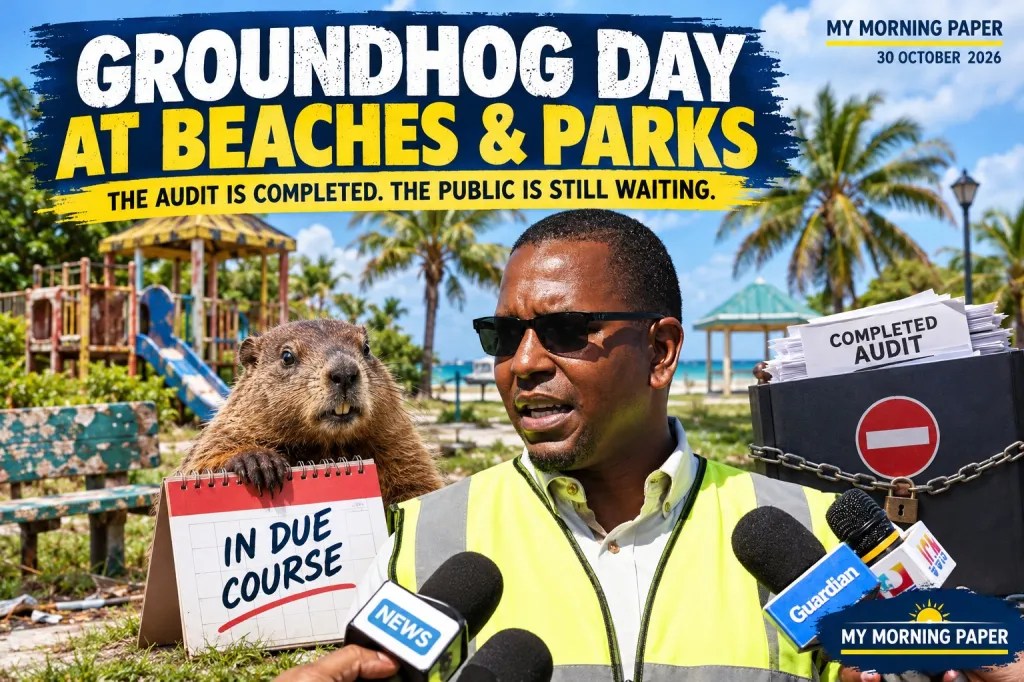
This is a matter of public expenditure. According to The Guardian, the authority spent $147.6 million between July 2021 and March 2026 under former Executive Chairman McKell Bonaby. That figure represents total spending over the period; it should not be confused with the amount by which the authority exceeded its budget. Nevertheless, the newspaper reported spending significantly above government allocations, alongside the poor condition of nearly a dozen public parks.
The Tribune also reported in June that the authority had already exceeded its $29 million subsidy for the entire 2025–2026 fiscal year within the first nine months.
Those figures warrant an explanation supported by records. Taxpayers are entitled to know what was authorised, what was spent, why allocations were exceeded and what controls will govern future expenditure.
Strachan did not chair the authority during the period in question. Responsibility for those spending decisions must be established through the evidence. His own responsibility is clear enough: he has promised transparency and repeatedly confirmed that an audit is ready. The public can reasonably judge him on whether he releases it.
Instead, when asked about delivering his promised new era, he pointed to park restoration. Five parks had been completed, he said, and another five would bring the number to ten.
The arithmetic is sound. The accounting remains outstanding.
Restored parks are welcome. Safe playgrounds, usable bathrooms and properly maintained public spaces are precisely what taxpayers should expect. Their improvement, however, does not explain earlier expenditure or answer questions about budget overruns. A newly repaired swing cannot tell us whether procurement procedures were followed.
Asked how much had been spent beautifying the five parks, Strachan referred to the overall $31 million allocation. That identifies the broader budget. It does not tell the public what those five projects cost.
There is nothing unreasonable about asking for that distinction. Public accountability depends on being able to connect expenditure to specific work, assess its value and understand departures from the approved budget. General assurances provide little help with any of those tasks.
Strachan has pledged a culture of transparency and accountability. Such a culture requires a publication date, access to the completed audit and a clear response to its findings. Describing the administration’s enthusiasm does not advance the matter very far.
Nor does “in due course” become more precise through repetition.
If a completed audit cannot yet be released, the chairman should explain the outstanding step and give a firm timetable. If it is ready for publication, he should publish it. Either course would give taxpayers something they can assess.
Until then, the promise remains suspended in that comfortable political interval between “soon” and “the appropriate time”.
In Groundhog Day, Phil Connors eventually learns enough to move beyond the repetition. At Beaches and Parks, we await the corresponding development.
The audit, we are assured, is completed.
Perhaps the next announcement could be its release.
The Bahama deserves better.
END

