
There is a concept in economics and public policy known as the Cobra Effect. It describes what happens when an attempted solution to a problem produces consequences that make the original problem even worse.
It is a lesson in unintended consequences: sometimes the response to a problem becomes a problem of its own.
Grand Bahama now finds itself at the centre of a debate that raises precisely this question.
For years, the people of Freeport have been promised economic revival, renewed investment and a return to prosperity. Yet, after five years in office, the Davis administration is still presenting plans for projects and developments that many residents expected would already be well advanced.
And what is the latest response?
A new framework, accompanied by an increasingly confrontational approach towards the Grand Bahama Port Authority (GBPA) and the Hawksbill Creek Agreement (HCA).
The Prime Minister’s recently presented New Framework for Grand Bahama may contain proposals worthy of consideration. Grand Bahama undoubtedly needs investment, development and economic renewal. But the manner in which the Government approaches the existing contractual and commercial arrangements deserves careful scrutiny.
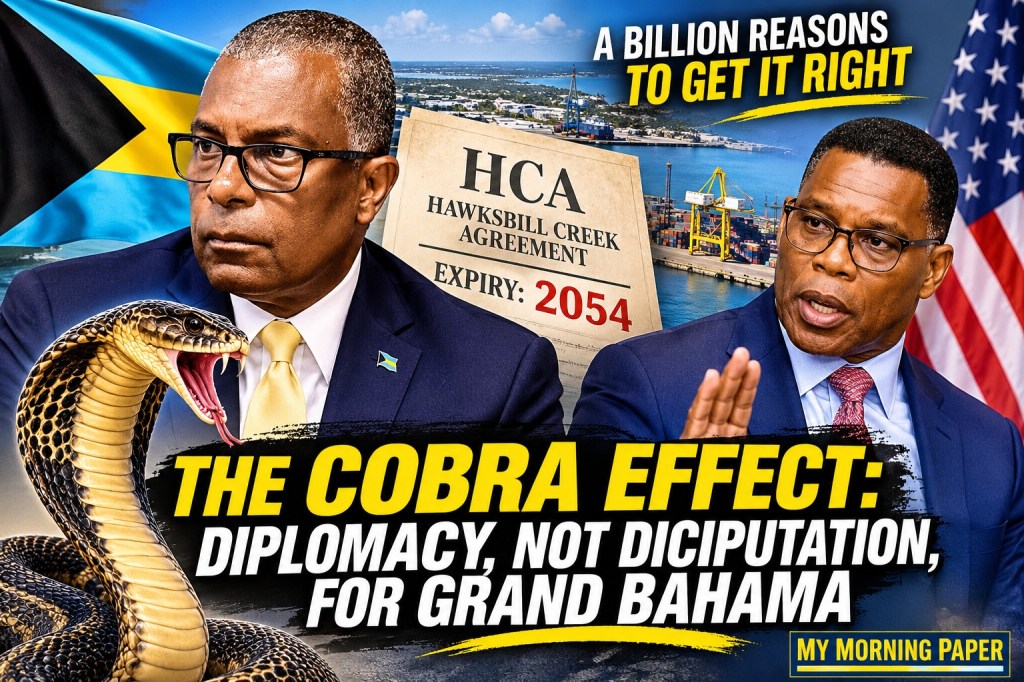
The Hawksbill Creek Agreement is not simply an inconvenient historical document that can be dismissed because the Government has become dissatisfied with the present state of Freeport. It is a legally significant agreement with provisions extending to 2054.
Any proposal to alter that arrangement must be approached through law, negotiation and a clear understanding of the economic consequences.
When a government begins suggesting that it may dismantle or fundamentally alter an established agreement, investors are entitled to ask a straightforward question: If an agreement can be changed when a government becomes dissatisfied with it, how secure is the next investment?
That is not an unreasonable question. It is a fundamental question of commercial confidence.
And it is against this background that the comments of United States Ambassador Herschel Walker have become part of the discussion, as he says that the United States has a billion reason to pay attention
In a Nassau Guardian article titled “Walker hits back – Defends US interest in Freeport debate”, the American Ambassador responded to Foreign Affairs Minister Fred Mitchell’s suggestion that outsiders should mind their own business.
Walker made it clear that the future of Freeport is not exclusively a domestic concern when American commercial interests are involved.
He stated:
“There’s more than one billion reasons that the future of Freeport is not only a ‘domestic’ matter for The Bahamas.”
He went on to explain:
“Those are more than $1 billion invested in less than a decade by United States companies in Freeport. That represents thousands of jobs for Bahamians and Americans alike.”
Walker also explained that his responsibility as American Ambassador includes looking after those investments and the families whose livelihoods depend on their success.
These are significant remarks.
The Ambassador was not claiming that the United States owns Freeport, nor was he suggesting that The Bahamas has surrendered its sovereignty. He was identifying the legitimate economic interests of American companies and the people whose livelihoods depend on those investments.
There is a distinction between respecting national sovereignty and recognising the importance of international commercial relationships.
The two are not mutually exclusive.
It amazes me that after all these years as Foreign Affairs Minister that the Hon. Fred Mitchell does not seem to know that sovereignty does not require diplomatic confrontation.’
Minister Mitchell’s response, telling outsiders to stay out of Freeport’s business, raises a question about the Government’s understanding of diplomacy.
Yes, The Bahamas is a sovereign nation.
Yes, decisions concerning the country’s laws, development and economic future ultimately belong to Bahamians and their elected representatives.
But sovereignty does not require unnecessary confrontation with international partners.
Diplomacy is not the surrender of national interests. It is the art of protecting those interests while maintaining relationships that are economically and strategically important.
The United States is one of The Bahamas’ most important trading and investment partners. Our economies are interconnected through tourism, trade, financial services, investment and employment.
When an American ambassador raises concerns about investments exceeding $1 billion, the appropriate response should be to establish the facts, explain the Government’s position and engage constructively.
There is nothing undignified about diplomatic engagement.
Nor is there anything particularly statesmanlike about turning a legitimate investment concern into a public exchange of competing declarations about who should mind their own business.
A government can be firm without being needlessly confrontational.
It can defend its sovereignty without creating the impression that international investors are unwelcome when they raise questions about the security of their investments.
Also, the government must concede it very own role in Grand Bahama’s economic difficulties because I honestly and truly believe that this New Day Progressive Liberal Party (PLP) government feels that they are faultless in this regard
There is another part of this discussion that should not be overlooked.
The Davis administration cannot discuss Grand Bahama’s economic difficulties without being questioned about its own decisions.
When the PLP came to office in 2021, there were development arrangements involving the Grand Bahama International Airport and the Grand Lucayan Resort that had been advanced under the previous FNM administration.
The Davis administration subsequently cancelled those arrangements.
The Government may have had reasons for doing so, and those reasons deserve to be examined on their merits. But cancellation came with consequences, including the loss of development opportunities that were expected to contribute to Grand Bahama’s economic recovery.
The question that remains is straightforward:
Where would Grand Bahama be today if those arrangements had been allowed to proceed, or if the Government had successfully negotiated alternatives capable of delivering comparable investment and employment?
That is not a question the Government can answer simply by pointing towards the GBPA.
The Port Authority has responsibilities. Its performance and contribution to Freeport’s development are legitimate subjects of public scrutiny. But accountability cannot operate in only one direction.
The Government must also account for its own decisions, particularly those involving projects that were presented as important to Grand Bahama’s economic future.
It is entirely possible for the GBPA to have responsibilities for Freeport’s present difficulties while the Government also bears responsibility for decisions that affected the island’s development trajectory.
One does not cancel out the other.
This brings us back to the Cobra Effect.
The Government says it wants to resolve Grand Bahama’s economic problems. It says it wants a new framework, renewed investment and a better future for Freeport.
But if the pursuit of that objective produces greater uncertainty over existing agreements, strains relationships with major investors and creates unnecessary diplomatic friction, then the consequences must be considered alongside the original intentions.
The Government’s responsibility is not simply to announce that it intends to fix Freeport.
It must demonstrate that its approach will produce the investment, employment and economic activity that Grand Bahama needs.
There is a difference between reforming an arrangement through negotiation and creating uncertainty by appearing to challenge the security of an existing contractual framework.
There is also a difference between defending Bahamian sovereignty and treating every expression of concern from an international partner as an intrusion into domestic affairs.
The latter approach risks turning a discussion about economic development into a dispute about diplomacy and contractual security.
And that is precisely the danger of the Cobra Effect: an attempted solution can introduce consequences that make the original challenge more difficult to resolve.
Currently Grand Bahama needs development, not an endless exchange of accusations.
The people of Grand Bahama have waited long enough for economic renewal.
They need a functioning airport, a viable tourism industry, employment opportunities, infrastructure investment and a credible development strategy.
They need the Government and the GBPA to resolve their differences through serious negotiations, within the law and with the interests of Grand Bahamians at the centre of the discussion.
They do not need a continuing public argument between the Government, the Port Authority and the American Ambassador.
Nor should the people of Grand Bahama be expected to accept another collection of promises without asking what happened to the previous ones.
The Prime Minister has every right to pursue a different vision for Grand Bahama. But that vision must be accompanied by sound legal reasoning, economic realism and diplomatic judgement.
Sovereignty is the right to make our own decisions. It is not an exemption from the economic and diplomatic consequences of those decisions.
Ultimately, the measure of the Davis administration’s New Framework will not be the strength of its rhetoric against the GBPA or the firmness of its response to an American ambassador.
It will be whether Grand Bahama receives the investment, employment and economic opportunities it has been promised.
Until then, perhaps the Government should give some thought to the Cobra Effect.
Because in attempting to solve Grand Bahama’s problems, it must be careful not to create another one.
The people of The Commonwealth of The Bahamas deserve better.
END

