
I cannot decide whether this is sad or simply funny. Perhaps it is that special category of political entertainment where the public supplies the money but is expected to remain politely outside the room when the explanations begin.
According to The Nassau Guardian’s November 6 report, “Munroe fires back,” Attorney General Wayne Munroe defended his position on the Public Accounts Committee’s (PAC’s) efforts to question him and former Attorney General Ryan Pinder about $700 million reportedly transferred to an account held in the name of the National Investment Fund (NIF).
PAC Chairman Michael Pintard says Munroe told Pinder not to appear because the evidence he might give would breach legal professional privilege. Munroe, for his part, says he supplied “pages of evidence” and rejects the suggestion that protecting confidential ministerial advice amounts to refusing to cooperate.
Fair enough. Pages of evidence should not be dismissed. But neither should the public mistake the thickness of a submission for the completeness of an explanation.
Legal professional privilege is real. It protects confidential legal advice; invoking it is not proof that anyone has done anything improper. The question is whether the government is protecting genuinely privileged advice while providing a full account of the underlying financial transactions—or treating the entire subject as though it arrived in an envelope marked “None of the taxpayers’ business.”
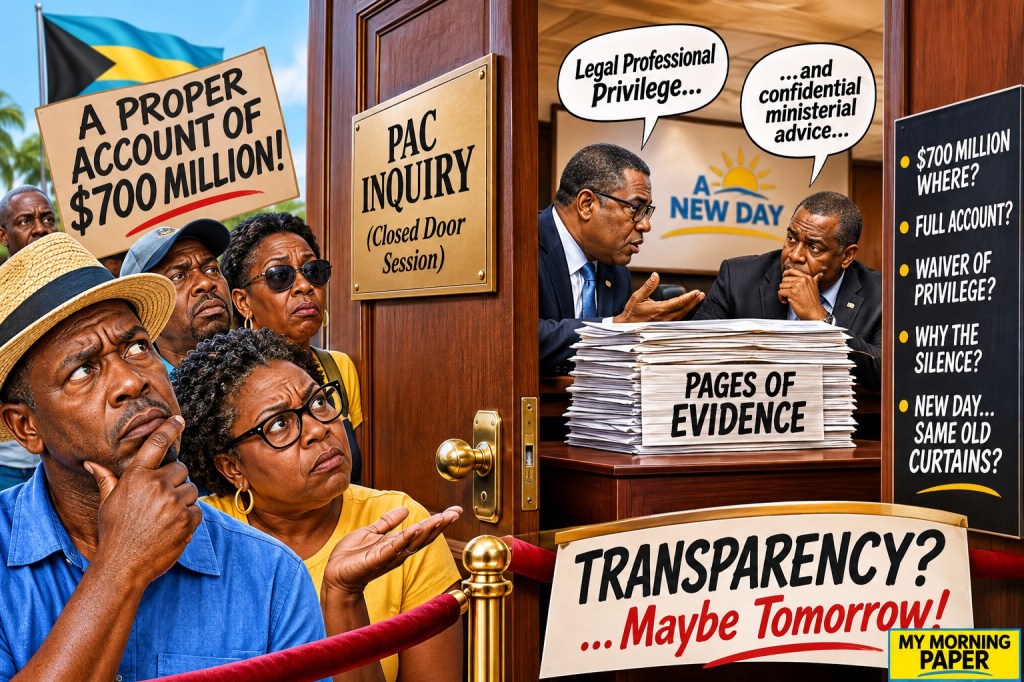
There is also a rather inconvenient detail for the government: Pintard has requested a waiver of privilege and applicable confidentiality protections so that both attorneys general can give full and frank evidence. That deserves a substantive response, not merely another reminder that oaths exist.
The reported warning that Pinder could be held to account for breaching his oath or privilege, and that the matter could reach the Supreme Court, adds an interesting flourish. The public might reasonably wish to see the same determination applied to producing a clear account of the money.
None of this establishes that Pinder is incompetent or that the government has something unlawful to hide. Those would be conclusions beyond the evidence. But discouraging his appearance, rather than explaining what he can properly answer and precisely what must remain protected, hardly inspires confidence.
For an administration that arrived under the banner of a “New Day,” this is an oddly familiar spectacle: accountability warmly endorsed in principle, then introduced to an impressive collection of qualifications when the questions become uncomfortable.
The public is not entitled to every confidential legal conversation. It is entitled to a proper account of public money. A government confident in its handling of that money should be eager to explain the distinction—not leave taxpayers wondering whether “New Day” comes with the curtains permanently drawn.
The Progressive Liberal Party (PLP) fails for one reason; it is their nature.
END

