My Morning Paper- 7th May 2026 – If Hubert Ingraham Is So Irrelevant… Why The Panic?

The New Day Progressive Liberal Party (PLP) seems to have found itself in a rather awkward political balancing act when it comes to former Prime Minister Hubert Ingraham.

On one hand, they insist he is “out of touch,” “irrelevant,” and politically retired somewhere between memory lane and the history books. On the other hand, the moment he appears on a campaign stage for the Free National Movement (FNM), the PLP reacts like somebody just announced the return of a final boss in a video game.

While the Hon. Michael Pintard was reportedly travelling from a political rally in the Berry Islands back to New Providence, Mr. Ingraham addressed supporters at an FNM rally. Apparently, what he had to say struck such a nerve within the PLP that an official statement quickly emerged from Latre Rahming, who now appears to be serving in the dual role of government communications director and emergency campaign firefighter for the PLP.

Rahming accused the FNM of “using” Hubert Ingraham to “hide the weak leadership” of Michael Pintard. But that argument raises an obvious question: if Mr. Ingraham is supposedly irrelevant and disconnected from modern politics, why does his mere appearance require an official political counterattack from the Office of the Prime Minister?

That is a lot of energy to spend fighting a man they claim nobody is listening to.

The statement itself was loaded with the familiar PLP campaign trilogy: “lies, confusion and chaos.” Ironically, critics of the PLP would argue that this is rich coming from a party that faced heavy criticism during previous election cycles over accusations of exaggeration and political fearmongering related to the handling of the COVID-19 pandemic and the aftermath of Hurricane Dorian. Those debates remain politically contentious to this day.

Latrae and the PLP also challenged the FNM for supposedly not speaking about plans for governance, which the FNM has done but out of political convenience it appears that the PLP just glossed over. Yet Bahamians may reasonably ask whether the government itself has clearly articulated a consistent long-term direction beyond campaign slogans and glossy branding exercises like the “Blueprint for Progress.”

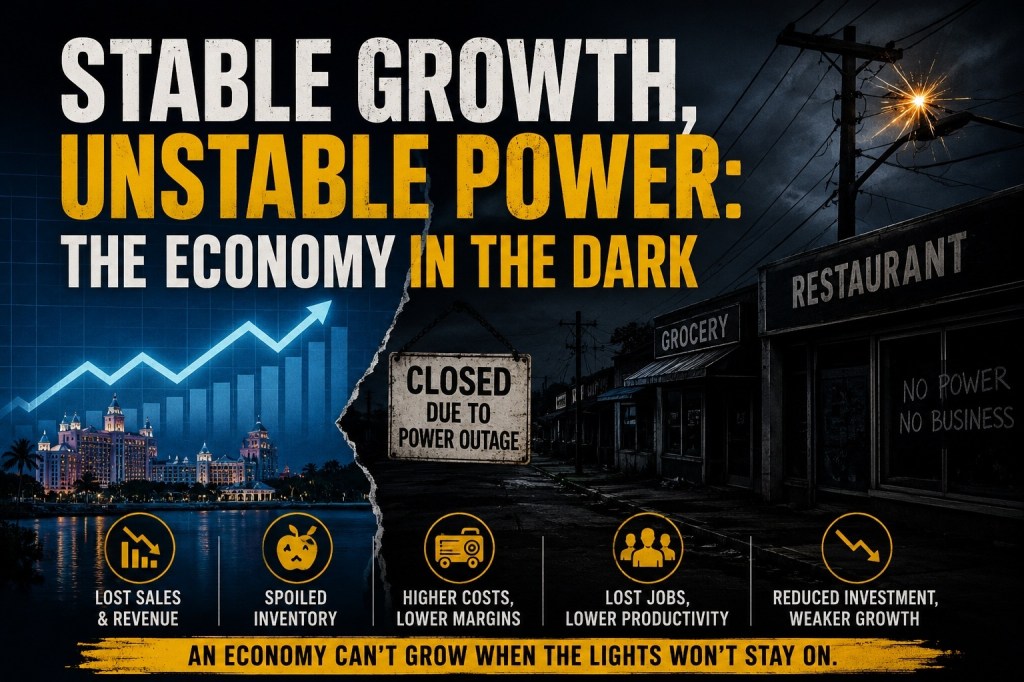
Because somewhere between the ribbon cuttings, press conferences, billboards, and dramatic speeches, many ordinary Bahamians are still waiting to feel this so-called “progress” in their grocery bills, electricity costs, rent, and day-to-day quality of life.

And then there is the comedy hidden in the PLP’s repeated reference to Hubert Ingraham as “the former chairman of the PLP.” One almost gets the sense they are trying to remind voters that Mr. Ingraham once belonged to the PLP before becoming one of the most electorally successful leaders in FNM history.

But that line of attack creates another uncomfortable contradiction.

If the PLP keeps invoking Ingraham’s former ties to the PLP as some sort of political stain, what exactly are they saying about their own party?

After all, you cannot simultaneously claim:

  • Hubert Ingraham is politically irrelevant,
  • Hubert Ingraham is dangerously influential,
  • Hubert Ingraham is “out of touch,”
  • and Hubert Ingraham is secretly propping up Michael Pintard’s momentum.

At some point, the script starts contradicting itself.

And perhaps the funniest part of all is this: the PLP’s statement may have unintentionally elevated the very appearance they were trying to diminish. What could have simply been another rally speech suddenly became headline material because the government responded with the urgency of a five-alarm political fire.

For a party insisting that Michael Pintard is weak and Hubert Ingraham is irrelevant, they certainly seem deeply concerned whenever the two appear in the same sentence.

The Progressive Liberal Party (PLP) fails for one reason; it is their nature.

END

My Morning Paper – 06th March 2026 – From Reset to ‘Cancel Everything’: The PLP’s Creative Translation

What we are witnessing from the Progressive Liberal Party (PLP) is less “interpretive framing” and more Olympic-level mental gymnastics—with a straight face and a political ad.

Let’s start with the first trick.

Turning a metaphor into a manifesto
Apparently, in PLP translation services, “reset” doesn’t mean recalibrate, refocus, or rethink—it means grab the scissors, unplug the system, and cancel everything in sight.
When Michael Pintard said the country needs a reset, he was speaking in the broad, almost cliché language politicians have used for decades. But somehow, the PLP heard: “Ladies and gentlemen, we will now begin deleting government programs one by one.”
That’s not interpretation—that’s creative writing. And when presented as fact, it crosses the line from politics into pure misdirection.

Speculation dressed up as certainty
Then comes the second act: bold predictions with absolutely no receipt.
The Free National Movement has not laid out any documented plan to cancel specific programs in that statement. Yet the PLP speaks with the confidence of someone reading from a script that doesn’t exist.
If guessing were governance, we’d all be in excellent hands. But in reality, presenting speculation as settled fact is exactly the kind of behavior the PLP has become known for—especially when election season rolls around and imagination starts working overtime.

Fear for dramatic effect
And of course, no political performance is complete without a little suspense.
By tying this so-called “reset” to the idea that programs will disappear overnight, the PLP conveniently introduces a sense of panic: “Vote wrong, and everything you rely on vanishes.”
It’s a well-worn tactic—take a vague phrase, attach the worst possible outcome, and hope fear does the rest. Effective? Sometimes. Honest? That’s another matter entirely.

Let’s deal with reality for a moment
What can actually be said—without the theatrics—is simple:

  • Pintard’s statement points to a desire for change, not a demolition exercise.
  • It does not outline cuts, cancellations, or reviews—full stop. Suggesting otherwise requires a leap of imagination that would make a novelist proud.
  • The PLP’s version of events is political framing, not a quotation, not a policy, and certainly not confirmed fact.

So, what’s really going on?
The issue isn’t that the PLP responded—politics would be boring if they didn’t. The issue is that they’ve taken an opinion, polished it up, and are now trying to pass it off as gospel truth.

And that’s the real problem:
You can spin, you can interpret, you can even exaggerate—but at some point, you have to stop pretending your opinion is the same thing as reality.

The Progressive Liberal Party (PLP) fails for one reason; it is their nature.

END

My Morning Paper – 5th May 2026 – Strengthening Relations… Just in Time for Election Day

It’s getting harder to tell whether this is governance or a last-minute campaign episode of “Scandal: Nassau Edition.” Because when a government signs off on a reported $250,000-a-month lobbying contract weeks before an election, the public is entitled to raise an eyebrow… and maybe the other one too.

Let’s deal with the facts first.

According to reporting by The Nassau Guardian, the administration of Prime Minister Philip Davis entered into a contract with U.S.-based firm DCI Group AZ to “strengthen relations” with the United States. Filings under the U.S. Foreign Agents Registration Act (FARA) reportedly list figures such as Coreco “CJ” Pearson, Roger Stone, and Doug Davenport as part of the lobbying effort.

So yes—the contract appears real. The price tag appears real. And the timing? Also, very real.

Now comes the part where the public is expected to nod politely and accept that this is all just routine business in “the best interest of the country.”

That’s a tough sell.

Because if “strengthening relations” with the United States is so critical, why does that urgency suddenly materialize two weeks before a general election? Were relations perfectly fine for the last four and a half years? Or did diplomacy, like roadworks and ribbon cuttings, just happen to peak right before voters head to the polls?

Even more puzzling is when these lobbyists weren’t hired.

When The Bahamas was pushing for action on climate vulnerability and access to green financing—particularly around carbon credit frameworks—there was no high-powered Washington lobby blitz.

When tensions arose over Cuban medical professionals and U.S. scrutiny complicated healthcare staffing, there was no emergency deployment of politically connected intermediaries to “uncomplicate” matters.

But now, suddenly, the cavalry has arrived—complete with American political operatives tied to the orbit of Donald Trump.

So naturally, people are asking: advocating for what, exactly?

Because at $250,000 per month, Bahamians are not unreasonable for expecting more than vague phrases like “strengthening relations.” That’s not a policy—that’s a brochure tagline.

And then there’s the opportunity cost.

At a time when:

  • Schools face resource gaps
  • Hospitals reportedly struggle with basic supplies
  • Infrastructure projects are being rushed to completion before election day

…we’re told that a quarter-million dollars per month for foreign lobbyists is the best use of public funds?

That’s not just questionable—it borders on theatrical.

One might even ask—purely as a thought exercise, of course—whether this contract is about national interest or political interest. Because the timing, the personalities involved, and the proximity to an election create a rather inconvenient perception problem.

And perception matters in politics. Sometimes more than reality.

This is where the opposition, led by Michael Pintard and the Free National Movement, has floated alternatives like a regulated national lottery as a revenue stream for public services. Whether one agrees or disagrees with that idea, it at least raises a broader question: should the country be exploring sustainable domestic revenue solutions instead of writing sizable monthly checks abroad under unclear circumstances?

Because if the goal is truly to strengthen The Bahamas, then investments in education, healthcare, and infrastructure tend to deliver far more visible returns than political consultants in Washington.

Unless, of course, the return being sought isn’t entirely national.

And that’s the question lingering in the background—quiet, persistent, and increasingly difficult to ignore:

Is this contract about improving The Bahamas’ standing internationally…
or improving someone’s standing electorally?

Because right now, the line between the two looks… conveniently blurred.

The Progressive Liberal Party (PLP) fails for one reason; it is their nature.

END

My Morning Paper 4th March 2026 – The  Billboard That Ate The Campaign

It seems Fred Mitchell and the ever-dramatic Progressive Liberal Party have found their latest blockbuster storyline — “The Billboard That Ate The Campaign.”

Apparently, in a country facing real issues, this sign has now been promoted to public enemy number one… complete with a full theatrical performance from the Bimini stage.

Mitchell would have you believe that the Free National Movement (FNM) is masterminding some grand, villainous billboard conspiracy. No evidence, no proof — just vibes, outrage, and a microphone. One might think CSI: Nassau has already wrapped the case.

But here’s where things get… interesting.

When accusations are flying this wildly, it’s usually worth asking a simple question: who actually benefits? Because while fingers are being pointed outward, the timing feels almost too convenient. Right as uncomfortable headlines begin to bubble up — like that eyebrow-raising chatter about hefty payments to a MAGA-linked lobbyist — suddenly, the nation must drop everything and focus on… a sign.

Coincidence? Maybe.

Or maybe this “offensive billboard” is less of an attack and more of a distraction — a shiny object tossed into the road to pull attention away from something far more politically inconvenient.

And let’s not ignore the possibility that the call may be coming from inside the house. Politics, after all, is not just a battle between parties — sometimes it’s a wrestling match within them. When a narrative emerges that paints the leadership as a victim while simultaneously stirring chaos, you have to wonder: is this about winning an election… or positioning for what comes after losing one?

Because if someone wanted to weaken the standing of the current leadership, embarrass them publicly, and create internal instability — all while blaming the opposition — this would be a rather creative way to do it.

But of course, that would require a level of political chess that goes beyond roadside signage… wouldn’t it?

Meanwhile, Mitchell spent what sounded like an entire rally not outlining solutions, not presenting vision, but shadowboxing with a billboard like it personally insulted him at breakfast. If this is the centrepiece of the campaign, one has to ask: where are the ideas?

It is rather interesting that Mitchell would even bring up Beaches and Parks, given the controversy of unanswered questions that they are caught up in but it appears that Mitchell has become desperate.

In the end, the Bahamian people are left watching a production where outrage replaces evidence, deflection replaces accountability, and suspicion hangs in the air thicker than the accusations themselves.

One thing is certain:

If this is the strategy, then the real message on display isn’t on any billboard — it’s the lengths some will go to control the narrative.

And that, more than anything, should have people asking questions.

The Progressive Liberal Party (PLP) fails for one reason; it is their nature.

END

My Morning Paper – 27 Apr. 2026 – Crying Foul in a Game He Perfected

It seems the Chairman has suddenly discovered a most tragic affliction: selective outrage. One minute he’s cruising to the airport, the next he’s clutching his pearls over FNM billboards like they’ve committed some unprecedented crime against humanity. Apparently, in his world, political messaging only becomes “nasty” when someone else does it better.

His lament reads less like a statesman’s concern and more like a man shocked—shocked!—to find mudslinging happening in a game his own team practically invented. After all, this is the same PLP playbook that gave us years of relentless attacks in opposition, followed by an encore performance while in government. But now, suddenly, the tone is too harsh? The irony could power the entire national grid.

And let’s not pretend this is about “desperation.” If the FNM is leaning into negative campaigning, then by the Chairman’s own standard, they’re simply excelling at a craft the PLP has spent years perfecting. The only difference now is that the criticisms hitting the New Day PLP are landing a little too close to home—less fiction, more uncomfortable fact.

The Chairman’s call for a “vigorous and punchy defense” is particularly amusing. Translation: when they attack, it’s righteous; when others respond, it’s reckless. One might even admire the consistency—if not for the complete lack of self-awareness.

Take Abaco, for example. The recent rally wasn’t so much a presentation of achievements as it was a nostalgic tour of alleged FNM failures—many of which were generously seasoned with exaggeration, if not outright fiction. It worked once, and now the hope is lightning will strike twice, even as the island waits for tangible progress that never quite seems to arrive.

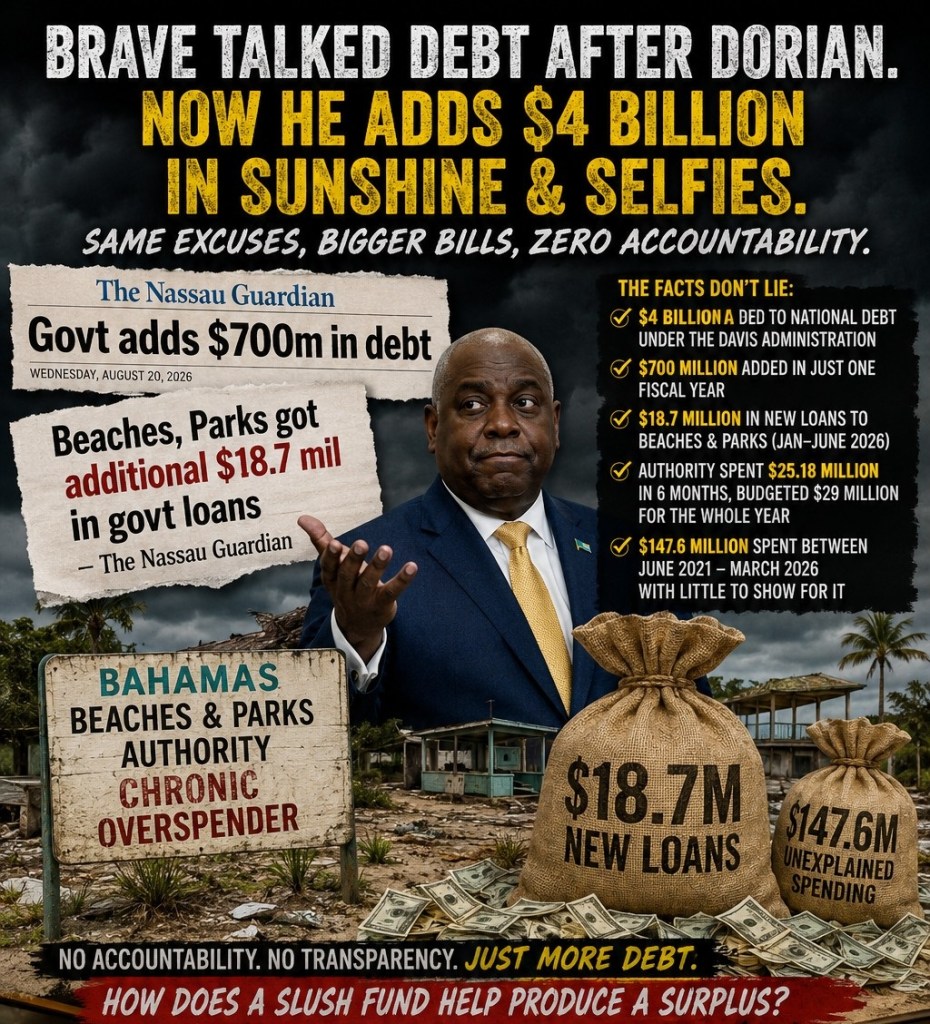
And then we arrive at the pièce de résistance: the claim of transparency. According to the Chairman, everything is “in plain sight.” Indeed—so plain, in fact, that the numbers themselves appear to be staging a quiet protest. If transparency were truly the hallmark of this administration, then the leadership at Beaches and Parks would be subjected to the same forensic-level scrutiny applied to others. Funny how accountability always seems to be a one-way street.

In the end, the Chairman crying foul over “nasty campaigning” feels less like a genuine concern and more like a seasoned boxer complaining about punches mid-fight—after years of throwing the first and hardest blows.

If nothing else, it’s a reminder: in politics, the loudest cries of victimhood often come from those most fluent in the art of attack.

The Progressive Liberal Party (PLP) fails for one reason, it is their nature.

END

My Morning Paper – 24th April 2026 – Accountability Deferred, Transparency Denied

From the very moment JoBeth Coleby-Davis told Opposition Leader Michael Pintard that she would only answer his parliamentary questions if he first survived an internal leadership contest within the Free National Movement (FNM), the tone was set—not for accountability, but for deflection. It was a remark that revealed more about the government’s posture than any formal statement ever could. Years later, those questions remain unanswered, and the pattern has only deepened.

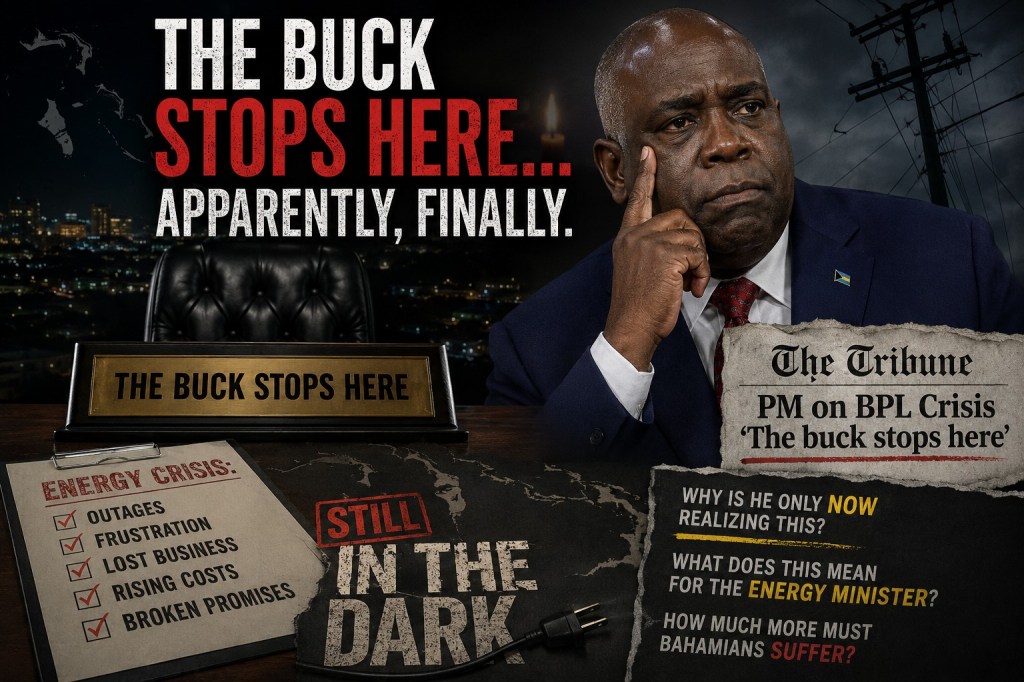
Now we arrive at the latest episode involving Bahamas Power and Light (BPL), Bahamas Grid Company, and the much-touted energy reform arrangement tied to U.S. executive Eric Pike. According to reporting from The Tribune, a deal described as central to modernizing New Providence’s grid has effectively unravelled less than two years into what was supposed to be a 25-year agreement. When pressed, Minister Coleby-Davis offered little more than a rehearsed line — “a statement went out”—before cutting off further inquiry.

That is not transparency. That is choreography.

The government’s attempt to rebrand what appears to be a breakdown as a “transition” follows a now-familiar script. Bahamians have seen this before, most notably with the Our Lucayan situation in Grand Bahama, where optimistic framing was used to soften hard realities. In this case, the public is again being asked to accept reassurance in place of explanation, confidence in place of clarity.

But the facts, as presented, raise legitimate concerns. A key partner has exited. A flagship agreement has faltered prematurely. Millions in financing are under scrutiny. Yet, the level of detail provided to the public remains minimal, controlled, and carefully filtered.

This is where the broader criticism of the Progressive Liberal Party (PLP) finds its footing—not in partisan rhetoric, but in observable governing habits. The administration campaigned heavily on accountability and transparency, presenting these as cornerstones of its mandate. However, instances like this BPL matter, alongside others such as the Beaches and Parks controversy, suggest a governing style that prefers managed messaging over open scrutiny.

Even when responses are eventually given, they often generate more questions than answers—sometimes contradicting earlier positions or introducing new ambiguities. Press engagements become limited. Questions are deflected. And substantive engagement is replaced with carefully staged communication.

It creates the impression of a government more comfortable speaking at the public than to it.

The irony is hard to ignore. The same administration that once championed a “Blueprint for Change” now promotes a “Blueprint to Progress.” But progress, by any reasonable standard, requires measurable outcomes, clear communication, and public trust built on transparency—not semantics.

So, the question naturally follows: what exactly constitutes this “progress”?

Because for many observers, the list of unanswered questions—from Parliament to press briefings to national projects—continues to grow. And until those questions are met with direct, consistent, and verifiable answers, the gap between promise and practice will remain impossible to ignore.

The Progressive Liberal Party (PLP) fails for one reason; it is their nature.

END

My Morning Paper- 22 April 2026 – A Desperate Plea from a Desperate Man – Midweek Edition

On Monday night, Philip Davis took to the national stage—not to clarify policy, not to account for governance, but to mount what can only be described as a carefully dressed act of political desperation. This came, of course, after sidestepping growing public concern over issues like reported overspending within Beaches and Parks—matters that demand transparency but instead receive theatrical deflection.

Prime Minister Davis ran the full gamut of what Bahamians have come to recognize as “politicks”: a blend of insinuation, selective outrage, and a not-so-subtle pivot into fearmongering. The irony is almost too neat. While referencing the satirical book Politricks – “A Confidential Handbook for Politicians and Aspiring Politicians and Political Squirrels”, the Prime Minister and his Progressive Liberal Party seem less amused by its humour and more committed to turning its caricature into governing strategy—weaponizing satire against Michael Pintard while embodying its very lessons.

A headline from The Tribune reads: “Davis: Lottery would benefit private operators rather than public.” It is a striking claim—serious, consequential, and notably unsupported by any publicly presented evidence. The Prime Minister asserts that the Free National Movement’s (FNM’s) proposal for a national lottery would enrich unnamed “private operators” at the expense of the Bahamian people. But who are these operators? Where is the documentation? What contractual framework is being referenced?

In the absence of specifics, the accusation reads less like policy critique and more like a calculated attempt to seed suspicion and fear. If such a claim were grounded in fact, it would demand immediate disclosure and national scrutiny. Instead, Bahamians are left with an allegation suspended in midair—heavy enough to alarm, but too vague to verify.

Equally concerning is the Prime Minister’s pivot into familiar territory: fear. The suggestion that a future FNM administration would dismantle social initiatives such as the National School Breakfast Programme or the National Youth Guard is a serious charge. Yet, again, no direct policy statements, manifesto excerpts, or verifiable commitments have been cited to substantiate this claim. Political debate is expected; unsubstantiated warnings presented as inevitabilities are something else entirely.

This raises an uncomfortable question: who, exactly, is being “desperate” here?

The Davis administration has been quick to label the Opposition as such. Yet the pattern on display tells a different story—one where allegations are made without evidence, and hypothetical rollbacks are presented as certainties. That is not the language of confidence; it is the language of a campaign searching for traction.

The Prime Minister also took aim at Michael Pintard’s leadership, suggesting he is unable to command his party. This line of attack appears rooted in internal political shifts—members who have chosen to depart. But political parties, by their nature, evolve. Individuals make decisions, alliances shift, and leadership is ultimately measured not by unanimity but by the confidence of those who remain. By that standard, the FNM’s base continues to signal its support.

What remains unanswered, however, is perhaps more telling than what was said. If the government opposes a national lottery so vigorously, whose interests are being protected? The Bahamas already operates within a legalized gaming environment—one in which domestic “number houses” function openly. The question is not whether gaming exists, but how it is structured, regulated, and who ultimately benefits. Opposition to reform, without clarity, invites scrutiny.

As PLP supporters hung on the Prime Minister’s every word at the rally, the scene may have felt energizing in the moment. But beyond the applause, beyond the rhetoric, the substance was thin. What emerged was not a roadmap for governance, but a portrait of a government leaning heavily on accusation and apprehension—hoping, perhaps, that one will compensate for the absence of the other.

In the end, the “wave” the Prime Minister referenced may indeed be real—but not in the way he intended. It is a wave of public frustration, built not on opposition slogans, but on unanswered questions, unmet expectations, and a growing impatience with politics that substitutes clarity with conjecture.

And if that wave is now turning, it is not because of what the Opposition has done—but because of what the government has failed to convincingly explain.

The Progressive Liberal Party (PLP) government fails for one reason; it is their nature.

END

My Morning Paper – April 21st, 2026 – Deflection and Desperation: The PLP’s Failure to Address Real Issues

Only a leader desperate for to remain in power takes to a national stage and chooses to engage in political propaganda instead of addressing meaningful ways to deal with real issues that affect the lives of the average working person. This type of leader amounts to nothing more than a political entertainer and cannot and should not be taken seriously.

Now, what stands out most from that rally is not simply that the Progressive Liberal Party (PLP) chose to criticize the opposition—that’s expected in politics—but that it did so while sidestepping the very issues it is constitutionally responsible for addressing. When a governing party devotes significant time to attacking opponents instead of accounting for its own record, it invites scrutiny about what it is avoiding.

Philip Davis framed the Free National Movement (FNM) and its leader the Hon. Michael Pintard as unserious and desperate. But that line of attack cuts both ways. If the government believes the opposition’s proposals are weak, the most effective rebuttal would be to clearly present stronger alternatives and demonstrate measurable progress on national priorities—economic growth, cost of living, public services, and fiscal discipline. Instead, the emphasis appeared to be on character attacks and political framing rather than substance.

That absence becomes even more glaring when considering unresolved matters of public concern. The issue surrounding overspending within Beaches and Parks is not a trivial administrative detail—it speaks directly to fiscal management and accountability. McKell Bonaby had an opportunity, both at the rally and previously during the Budget Debate, to provide clarity: What caused the overruns? Were there procurement failures, poor forecasting, or mismanagement? What corrective measures are in place? Those are straightforward questions that taxpayers reasonably expect answers to.

Instead, the decision to pivot toward attacking the opposition—both at the rally and during the Budget Debate—creates the impression of deflection. Criticism of the opposition is politically convenient; explaining budget overruns is politically difficult. But governance demands the latter. When a sitting member of parliament repeatedly avoids addressing a documented financial concern while engaging in partisan attacks, it raises legitimate doubts about transparency and accountability.

Prime Minister Davis’s remarks on global instability—referencing geopolitical tensions, regional challenges, climate change, and economic shifts—introduce an even deeper contradiction. He suggests these are “serious times” requiring “serious people,” yet does not clearly articulate his administration’s concrete policy responses to those very challenges. If these are indeed the defining issues of the moment, then where are the detailed strategies? Where is the roadmap for economic resilience, climate adaptation, or regional competitiveness?
His critique of the national lottery proposal hinges on the argument that it is insufficient in the face of global crises. But that argument only holds weight if it is paired with a clear articulation of what is sufficient. Simply dismissing an opposition idea without presenting a robust alternative leaves a vacuum. The obvious question follows: what are the administration’s priority solutions, and why were they not the focus of the address?
There is also an internal inconsistency in the rhetoric. On one hand, the Prime Minister claims the opposition is engaging in negativity and desperation. On the other, a significant portion of his own platform at the rally is dedicated to questioning the opposition leader’s competence and unity. If the stated standard is to avoid “getting in the mud,” then the messaging should reflect a higher level of policy-driven engagement.
Ultimately, political rallies are opportunities—not just to energize supporters—but to demonstrate leadership through clarity, accountability, and vision. When those opportunities are used primarily for partisan attacks, it weakens public confidence in the seriousness of governance. The electorate is left not with a clearer understanding of how their challenges will be addressed, but with unanswered questions:
• Why has overspending in key departments not been fully explained?
• What specific policies are being implemented to address the global and regional challenges cited?
• If a national lottery is dismissed as inadequate, what are the administration’s primary economic solutions?
Those are not opposition talking points—they are governance obligations. Until they are answered directly and transparently, criticisms of the opposition risk sounding less like leadership and more like distraction.
The Progressive Liberal Party (PLP) fails for one reason; it is their nature.

END

My Morning Paper- 15th April 2026 – Running on Fear, Governing on Empty: Davis in Grand Bahama

In what can only be described as a thinly veiled exercise in political desperation, Prime Minister Philip Davis’ recent remarks in Grand Bahama leaned heavily on alarmism rather than substance. Framed as a warning to voters, his speech instead revealed a troubling reliance on fearmongering—particularly the attempt to resurrect the long-dead Oban proposal as a cautionary tale of what a Free National Movement (FNM) government might bring.

The Oban project, announced in 2018 under the Minnis administration, did indeed collapse amid scrutiny over the developers’ credibility and the lack of proper environmental approvals. That much is factual. However, to suggest that this single failed proposal represents the entirety of what an FNM government would offer today is not just misleading—it is politically convenient. It allows Davis to avoid a far more pressing question: what, exactly, has his own administration delivered for Grand Bahama after four and a half years in office?

The answer, by most measurable standards, is very little of substance. Despite inheriting a global economic rebound following the COVID-19 pandemic—particularly in tourism—Grand Bahama has not experienced the same level of recovery or targeted investment as New Providence. The most glaring failures remain the government’s inability to finalize and execute a viable deal for the Grand Lucayan Resort and the continued stagnation surrounding the redevelopment of the Grand Bahama International Airport. Both are critical pillars for the island’s economic revival, and yet both remain unresolved despite repeated announcements and shifting negotiations.

Against this backdrop, Davis’ appeal to voters to “choose the PLP” rings hollow. Political rhetoric about “standing up” to the Grand Bahama Port Authority may generate applause on a rally stage, but it does not create jobs, attract investment, or restore economic confidence. Even the arbitration outcome—where the government secured regulatory authority—has yet to translate into a clear, actionable development plan. Grand Bahamians are still waiting.

Equally concerning is the Prime Minister’s invocation of a “colonial mindset” as a political attack line. Such language is not only inflammatory but distracts from the absence of a coherent vision for the island. If anything, it raises the question of why, after nearly a full term in office, the Davis administration has yet to articulate a detailed and credible roadmap for Grand Bahama’s long-term growth. Accusations of colonial thinking may stir emotion, but they do not substitute for leadership or policy clarity.

Then there is the matter of the national lottery. Davis’ dismissal of the proposal as a “gimmick” is, at best, inconsistent. The record shows that the Progressive Liberal Party (PLP), during the Christie administration—with Davis serving as Deputy Prime Minister—oversaw the legalization and regulation of web shop gaming, despite a 2013 referendum in which voters rejected both web shops and a national lottery. To now deride a lottery as turning the country into a “numbers house” ignores the reality that such gaming operations are already a normalized and significant part of the Bahamian economy.

In the end, what was presented in Grand Bahama was less a vision for the future and more an attempt to revive fears of the past. But voters are not only looking backward—they are assessing the present. And on that measure, the Davis administration’s record in Grand Bahama leaves far more questions than answers.

The Progressive Liberal Party (PLP) government fails for one reason; it is their nature.

END

My Morning Paper 13th April 2026 – Lottery vs. Number Houses: What Is the PLP Really Protecting?

It is a remarkable bit of political theatre when the Progressive Liberal Party (PLP) suddenly discovers moral outrage over a national lottery—an idea it once flirted with, entertained, and in broader terms, helped normalize through the legalization and expansion of domestic gaming.

The statement attacking Michael Pintard and the Free National Movement is less a principled objection and more a convenient reinvention of history. To hear the PLP now, one would think they have always stood as guardians against the social ills of gaming. Yet Bahamians have not forgotten that it was under PLP governance that the gaming landscape was fundamentally altered—particularly following the 2013 referendum on web shop gaming, which the government at the time dismissed as “non-binding,” effectively treating it as an opinion poll before proceeding in a direction many voters had rejected.

That decision did not eliminate gaming—it consolidated it. A small number of operators were legitimized and empowered, creating a structured but limited industry. So, the question now becomes unavoidable: why is a government that enabled and regulates “number houses” suddenly opposed to a broader, more transparent national lottery model?

The PLP’s critique that a lottery is a “gimmick” rings hollow when placed against this backdrop. If anything, the distinction they are trying to draw—between a regulated lottery and existing gaming operations—feels artificial. Both rely on games of chance. Both generate revenue from participation. The only meaningful difference is scale, transparency, and who ultimately benefits.

Their argument leans heavily on cautionary tales from abroad, particularly referencing scandals in the Dominican Republic. Certainly, corruption risks exist in any system lacking proper oversight. But to suggest that the mere existence of a lottery inevitably leads corruption is intellectually lazy. By that logic, any public institution—from procurement to infrastructure—could be dismissed outright due to corruption risks elsewhere. The real issue is governance, not the mechanism itself.

And this is where the tone of the PLP’s response becomes almost ironic. A party that has often bristled at being labelled obstructionist now finds itself reflexively opposing a proposal that could, if properly structured, provide a dedicated revenue stream for education, healthcare, and social programs. Instead, their response leans on dismissiveness rather than substantive counter-policy.

Their defense—that they prefer to invest in programs like BTVI, BAMSI, and entrepreneurial support—is not inherently wrong. These are worthwhile initiatives. But investment requires funding, and funding requires either taxation, borrowing, or alternative revenue streams. If the objection to a lottery is principled, then the PLP owes the public a clear explanation of how they intend to sustainably finance these ambitions without increasing the national debt or tax burden.

Which leads to the more uncomfortable question—one the PLP carefully avoids: who benefits from maintaining the current gaming structure?

It is not unreasonable to observe that the existing “number houses” operate within a controlled environment with established stakeholders. A national lottery, particularly one with transparent oversight and public accountability, could disrupt that balance. It could redistribute market share, introduce competition, and alter revenue flows. So when resistance emerges, it is fair—indeed necessary—to ask whether this is about public policy or private interests.

To be clear, this is not an accusation, but an observation rooted in political pattern. Governments rarely resist revenue-generating mechanisms without reason. And when that resistance contradicts their own historical posture on similar issues, scrutiny is warranted.

Ultimately, the debate over a national lottery should not be reduced to slogans like “gimmick” or “slush fund.” It deserves a serious, fact-based discussion about regulation, transparency, economic impact, and social responsibility. What Bahamians are getting instead is a selective memory from the Progressive Liberal Party and a response that feels less like leadership and more like deflection.

And that, perhaps, is the most telling point of all.

The Progressive Liberal Party (PLP) fails for one reason; it is their nature.

END