My Morning Paper 19th August 2026 – FNM GAVE FRED MITCHELL A SEAT — NOW HE WANTS TO ERASE THEIR ANNIVERSARY

There are few things quite as entertaining in our Bahamian politics as Fred Mitchell lecturing the country about the evils of the Free National Movement (FNM) while standing on a piece of political history that the FNM itself helped create.

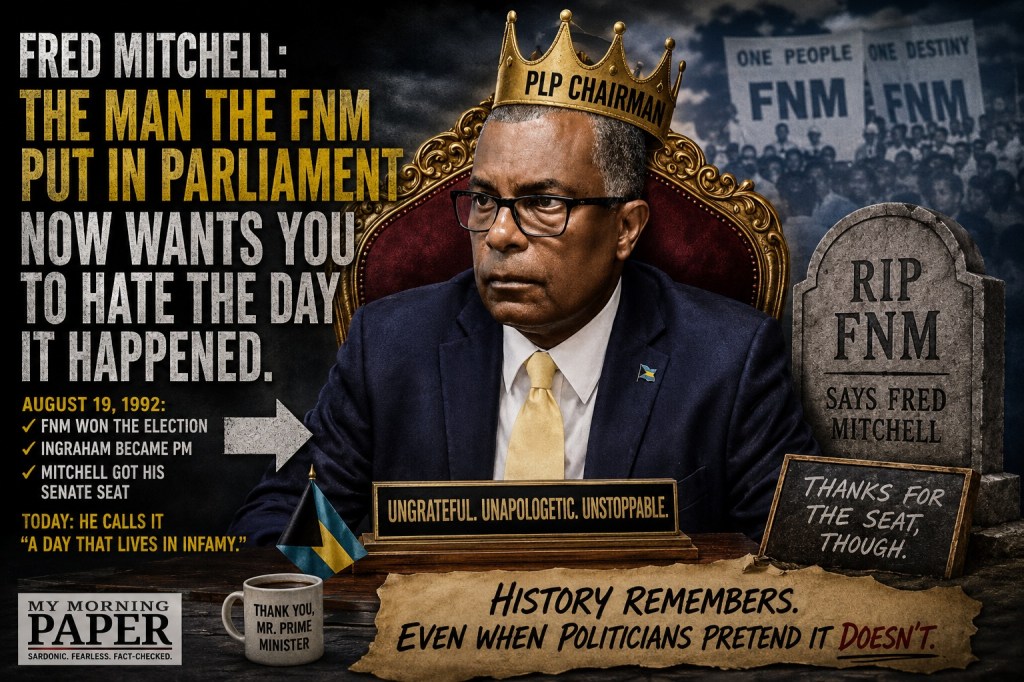
Today, August 19, Fred Mitchell would apparently like right-thinking Bahamians to regard the election of the FNM government in 1992 as some sort of “National Day of Infamy”.

That is quite a performance.

Especially from a man who, although never an FNM member, entered Parliament in 1992 because FNM Prime Minister Hubert Ingraham appointed him to an independent Senate seat. Mitchell served in the Senate from 1992 until 1996/97 before eventually joining the PLP and winning election to the House.

So here we are, three decades later, watching the Chairman of the PLP attempting to turn August 19 into something resembling a national crime scene.

Apparently the FNM’s greatest historical offence is that it won.

And apparently Mr. Mitchell’s first parliamentary appointment is to be treated as an unfortunate clerical error because without it he would probably still outside of parliament burning constitutions.

Mitchell describes the FNM’s 1992 victory as a day that “lives in infamy.”

One almost expects the next sentence to begin:

“Previously, on Days of Our Political Lives…”

But before we allow the Chairman to rewrite the history books, perhaps we should read a few of the pages he would rather have us skip.

Yes, the FNM changed the direction of the country in 1992.

Yes, reasonable Bahamians can debate the merits and consequences of individual FNM policies.

Yes, the International Persons Landholding framework remains a legitimate subject for criticism and debate.

But here is the inconvenient part for Mr. Mitchell’s historical sermon:
The PLP has had ample time to change policies it believes were disastrous.

The FNM did not remain in office for the next thirty years.

The PLP has governed for substantial periods since 1992, including the present administration.

So, if the land policy is responsible for today’s problems, the obvious question is not merely:

“Why did Ingraham do it?”

It is:

“Why hasn’t the PLP fixed it?”

At some point, blaming a government from the last century becomes less an explanation and more a substitute for governing.

Then comes BTC.

Mitchell presents the privatization of BTC as though Hubert Ingraham wandered into the Cabinet one morning, spotted the national telephone company and announced:

“Let’s sell that.”

History is slightly less theatrical.

The Ingraham government completed the privatization of BTC in April 2011, selling 51% to Cable & Wireless for US$210 million.

And, rather inconveniently for today’s political mythology, the government’s stated plan included offering shares to Bahamians so that the public could participate in ownership. Ingraham told Parliament that the government intended to sell approximately 9% of the shares to the Bahamian public.

That does not mean everyone must agree with the BTC sale.

It does mean that honest political debate requires something more than selecting the portions of history that fit neatly into a press statement.

And there is another little historical wrinkle.

The privatization process did not originate in a political vacuum. Ingraham said the government had concluded that privatization and liberalization were necessary to improve telecommunications, after years of considering different arrangements.

So, by all means criticize the transaction.

But criticize it with the facts.

Mitchell also invokes the destruction of Bahamian agriculture.

Fair enough.

Agriculture deserves serious discussion.

But if the PLP wants to present itself as the permanent guardian of Bahamian farmers, perhaps the public is entitled to ask a wonderfully simple question:

After all these years, where is the agricultural revolution?

Where is the dramatic reduction in the nation’s dependence on imported food?

Where is the corresponding reduction in grocery prices?

Where is the transformation that ordinary Bahamians can actually see when they walk into a supermarket?

BAMSI can be discussed.

Government expenditure can be discussed.

Programs can be discussed.

But eventually the conversation has to leave the conference room and arrive at the grocery counter.

Because the Bahamian consumer doesn’t eat press releases.

And then we arrive at the port.

According to Mitchell’s argument, the FNM’s legacy includes handing the country’s principal seaport over to a handful of families and contributing to monopoly pricing.

Yet when the cruise industry generates record or increased passenger numbers, governments are perfectly happy to celebrate the economic benefits.

One begins to wonder whether the port is a national disaster or an economic triumph depending upon which microphone is switched on.

Perhaps it can be both.

But again, political honesty requires acknowledging the complexity rather than converting history into a morality play with the FNM permanently cast as the villain.

The really delicious irony in Mitchell’s speech is that he wants Bahamians to believe that August 19, 1992, should be remembered principally as the beginning of everything that is wrong with The Bahamas.

Except that August 19, 1992, was also the beginning of Fred Mitchell’s parliamentary career.

That is not an opinion.

That is history.

The FNM won.

Hubert Ingraham became Prime Minister.

And Fred Mitchell received an independent Senate appointment from the government he now describes with such extraordinary contempt.

Politics can produce some remarkable transformations.

Apparently one of them is the ability to receive a parliamentary appointment from a government and, three decades later, describe the election that produced that government as a day that “lives in infamy.”

That is some Olympic-level political gymnastics.

Mr. Mitchell concludes:

“Let the FNM rest in peace. Amen.”

But that may be the one part of his speech that requires correction.

The FNM is not dead.

It is a political party.

It has won elections.

It has lost elections.

It has made mistakes.

It has accomplished things.

It has been criticized.

It has been praised.

And, most importantly, it remains part of Bahamian democratic history.

August 19, 1992, cannot be erased because Fred Mitchell finds the anniversary inconvenient.

The FNM’s victory ended 25 consecutive years of PLP government under Lynden Pindling. That fact alone makes the date historically significant.

One does not have to support the FNM to acknowledge that.

And one certainly does not have to pretend that everything the FNM did was perfect.

But neither should we allow politicians to turn their version of history into a political weapon by demanding that the public forget the inconvenient parts.

So perhaps, before Fred Mitchell asks Bahamians to remember August 19 as a day of infamy, he might take a moment to remember something else:

The FNM government he now wants the country to despise was the same government that opened the door to his first seat in Parliament.

That little historical footnote doesn’t quite fit the sermon.

But then again, inconvenient facts rarely do.

And if the Chairman wants to bury August 19, he might want to be careful about digging the grave too deep.

He may discover that his own political biography is buried in there with it.

The Commonwealth of The Bahamas deserves better.

END
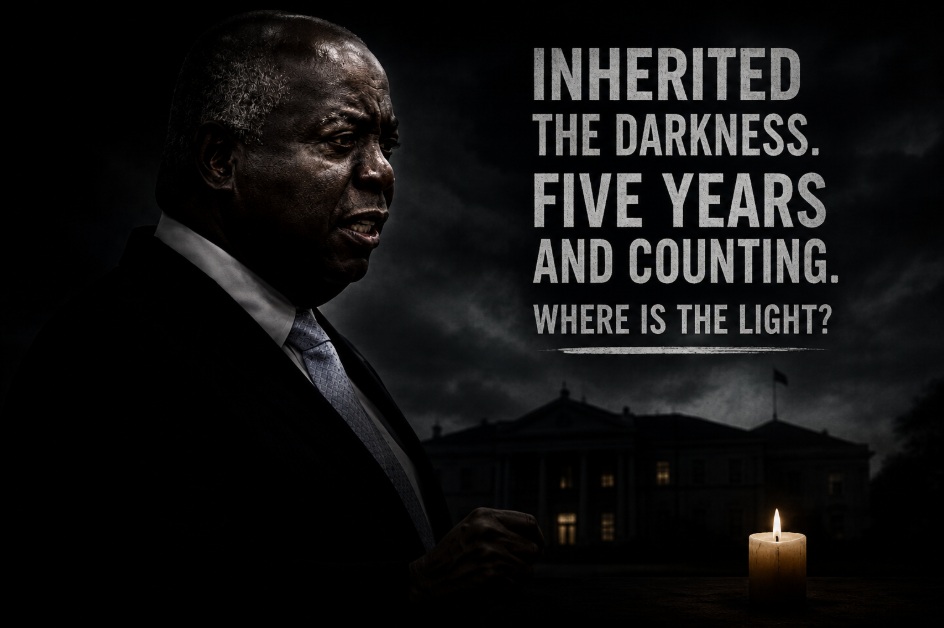
My Morning Paper 18th August 2026 – Dear Mr. Prime Minister: A Most Curious Case of Inherited Infrastructure

My Dear Mr. Prime Minister,

How exquisitely appropriate.

There you were last night, addressing the nation about the darkness enveloping The Bahamas — explaining, reassuring, diagnosing, promising.

And, almost as if the electrical grid itself had developed a rather refined sense of political irony, a large portion of New Providence was plunged into darkness as you began speaking.

One almost hates to interrupt such a perfectly staged moment.

But let us examine your explanation, shall we?

You told Bahamians that the electrical system you inherited was effectively “on life support.” You described ageing infrastructure, failed equipment, decades of temporary fixes and a system that was never properly modernised. You said more than 60 percent of New Providence’s generation equipment needed replacement when your administration took office, with the figure even higher in the Family Islands.

Quite a dreadful condition, pure doom and gloom.

One question, however, keeps scratching at the door:

Who, exactly, was supposed to have noticed?

Because, Mr. Prime Minister, this is where your little tale becomes rather interesting.

You were not some unsuspecting gentlemen who wandered into the Ministry of Works one morning and discovered, to his horror, that BEC had been neglected.

From 2012 to 2017, you were Deputy Prime Minister and Minister of Works and Urban Development, with responsibility that included BEC and the country’s physical infrastructure.

And it was your own Christie administration, under your ministerial responsibility, that formally confronted the miserable state of BEC.

In 2015, you announced PowerSecure as the preferred bidder to manage the corporation. In 2016, under your watch as Minister of Works, the government entered into a five-year management agreement giving PowerSecure responsibility for generation, transmission and distribution.

Indeed, your own government’s presentation of the problem was remarkably familiar.

BEC, you said at the time, was unsustainable, debt-ridden and suffering from inadequate generation assets. The government identified the need for at least $450 million in capital investment over five years to address the problems confronting the system.

So, forgive the question, Prime Minister:

When did the infrastructure become old?

Was it sometime after you left the Ministry of Works in 2017?

Or was it already old when you were sitting in the ministerial chair?

And if it was already sufficiently decrepit in 2016 to require hundreds of millions of dollars of investment, why are we sitting here in August 2026 listening to essentially the same diagnosis?

Perhaps the infrastructure did not age.

Perhaps the explanation did.

Because now, after five years as Prime Minister, we are being invited to contemplate the fascinating proposition that the principal problem confronting your government is the condition of a system that you have known about for years.

You became Prime Minister in September 2021.

You were subsequently returned to office in May 2026 for a second consecutive term.

That means the word “inherited” has now had rather a long life in your administration.

Five years.

Then another mandate.

And yet the electrical system is still being presented to the Bahamian people as though it were a recently discovered crime scene.

My dear Prime Minister, you have had five years to investigate the body.

You have had another five-year mandate to repair the morgue.

At some point, one must stop asking who killed the patient and start asking who has been holding the clipboard.

The Overtime Mystery

Now, to be fair, you raised a legitimate issue last night.

The Tribune reports that BPL spent approximately $20 million on overtime last year. Three employees in the Fuel and Performance Department reportedly received a combined $601,295.16 in overtime between May 2025 and April 2026. One employee’s records reportedly showed 18 hours claimed on Christmas Day followed by 24 hours on each of the next three days — 90 hours over four days.

You quite properly called that a management and oversight problem.

Quite right.

But management and oversight, Mr. Prime Minister, have a rather nasty habit of eventually finding their way upstairs.

If there has been a failure of management, controls and oversight “across administrations,” as you said, then perhaps the country is entitled to ask:

When does “across administrations” become “this administration”?

Because those three employees did not apparently collect that $601,295 in 2016.

They collected it between May 2025 and April 2026.

That is your administration.

The policy you are now defending is your government’s policy.

The management structure is operating under your government.

And the company was spending the money while you were Prime Minister.

So yes, investigate the overtime.

But please don’t mistake investigation for absolution.

And Then There Is the Fuel

There is another little detail history has inconveniently preserved.

When your administration came to office in 2021, BPL’s fuel-hedging programme was already producing significant savings.

An October 2021 letter from then-BPL CEO Whitney Heastie to Works Minister Alfred Sears said the programme had produced approximately $30 million in fuel-cost savings through September 2021, with estimated savings of $55 million by January 2022.

The subsequent argument over whether the Davis administration received and acted upon specific advice regarding additional hedging trades remains politically contested.

So, I would not present the matter as the simple fairy tale that “Davis cancelled the hedge and therefore electricity bills exploded.”

That would be too convenient.

But this much is beyond dispute:

Your government inherited a fuel-hedging mechanism designed to stabilise costs, and your government subsequently had to confront rapidly rising electricity charges.

That deserves examination.

Especially because governments cannot simultaneously claim credit for everything that works and blame everybody else for everything that doesn’t.

That is not governance.

That is accounting by séance.

What Went Wrong?

You told Bahamians last night that you could have simply rented another engine and patched another cable — as governments had allegedly done for decades.

But, Mr. Prime Minister, you were one of the people who occupied the room when those decisions were being made.

Your government in 2016 understood the system needed massive investment.

Your government established PowerSecure to manage the utility.

The succeeding FNM administration ended that management agreement in 2017.

Then you returned as Prime Minister in 2021.

Five years later, you are telling us that the system is still old, still fragile, still requiring massive investment, still dependent upon temporary generation and still vulnerable to catastrophic outages.

And now you tell us:

“I am not here to manage this. I am here to fix it.”

Beautiful.

Absolutely beautiful.

Except, Mr. Prime Minister, that was the job description five years ago.

The Curious Case of Responsibility

You also said something else rather revealing.

You said:

“The responsibility to act is ours.”

There we agree.

Entirely.

It is yours.

It has been yours.

And, before that, you personally had direct ministerial responsibility for BEC.

That is precisely why the constant invocation of the word “inherited” is becoming less persuasive with every passing blackout.

A government can inherit a problem.

It cannot reasonably inherit the same problem for five years, repeatedly diagnose it, announce reforms, make promises, spend money, change ministers, create companies, launch initiatives and then return to the electorate saying:

“Look what we inherited.”

At some point, Prime Minister, the inheritance becomes an estate you have been administering.

And the beneficiaries are beginning to wonder where the money went.

And What of Minister Coleby-Davis?

Which brings us, rather delicately, to the question of the Minister responsible for Energy.

JoBeth Coleby-Davis has been one of the public faces of the government’s energy agenda. Yet last night’s address had the unmistakable character of a Prime Minister stepping directly into the centre of a crisis that has become too large to leave at ministerial level.

That raises an uncomfortable question.

Is the Prime Minister merely taking charge during an extraordinary national emergency?

Or has the BPL crisis become so politically radioactive that the Prime Minister now has to personally explain what the responsible ministry has been unable to explain convincingly?

Either way, the optics are not particularly comforting.

Because if the minister has the authority, why must the Prime Minister rescue the portfolio?

And if the Prime Minister must rescue the portfolio, why have we been paying for the portfolio?

One begins to suspect that somewhere inside the machinery of government there is a very lonely switch marked:

“ACCOUNTABILITY.”

Perhaps someone should turn it on.

Assuming, of course, BPL permits it.

The Final Question

Mr. Prime Minister, nobody seriously expects you to manufacture electricity with a wave of your hand.

Nobody expects you to prevent every mechanical failure.

Nobody expects an ageing utility to become modern overnight.

And nobody should pretend that the FNM bears no responsibility for the decisions it made while in office.

But political accountability has a rather simple principle:

You inherit circumstances. You own decisions.

And after five years in government — followed by a successful campaign for another five years — your administration cannot forever occupy the comfortable territory between “we inherited it” and “give us credit for fixing it.”

You cannot have both.

If the infrastructure was already in crisis when you arrived, tell us precisely what your government did about it.

If you spent five years rebuilding it, show us the results.

If you say the system is finally being transformed, show us the contracts, the timelines, the expenditure, the milestones and the measurable improvements.

And if there were failures in management, controls and oversight under your government, investigate them without using the word “inherited” as a diplomatic fog machine.

Because last night, while you were telling Bahamians that you were going to bring light to the darkness, the lights went out.

Some might call that coincidence.

Others might call it irony.

And somewhere, I suspect, the electrical grid itself was quietly smiling.

Yours rather darkly,

My Morning Paper

P.S. Prime Minister, when you said “What we inherited is not what we will leave behind,” the country heard the promise. After five years, however, Bahamians are entitled to ask whether the next inheritance will be another explanation — or finally an electrical system that works.

The Bahamian people deserve better.

END

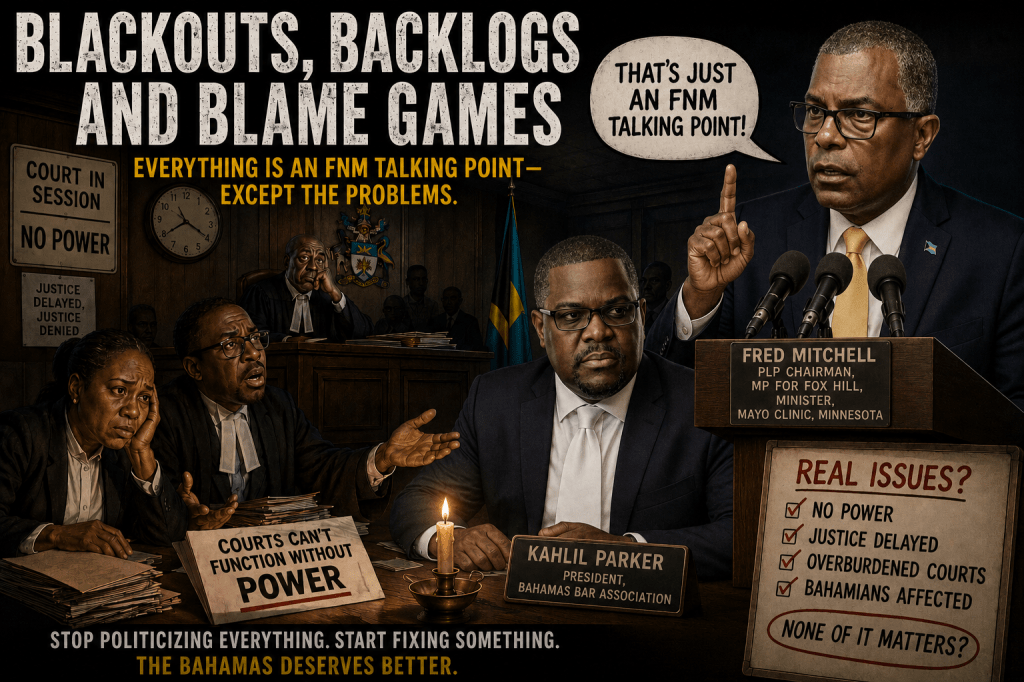
My Morning Paper – 17th August 2026 – When Did Everything Becomes an FNM Talking Point?

Apparently, here in the Bahamas of 2026, there is a new political theory emerging from the chairman of the Progressive Liberal Party (PLP): if the lights go out, look for an FNM talking point.

If the courts cannot function because of power interruptions, apparently that too is an FNM talking point.

And if the President of the Bahamas Bar Association raises concerns about the effect of those interruptions on the administration of justice, well, according to Fred Mitchell, perhaps he is not really talking about justice at all. Perhaps he is simply helping the FNM win an election that is still some 56 months away.

One has to admire the creativity.

But there is a problem with this argument.

The electricity went off.

That is not a political opinion.

That is not an FNM slogan.

That is not a headline manufactured by Kahlil Parker.

It is a practical problem when a court cannot operate normally because there is no electricity.

And when that happens, it is entirely legitimate for the President of the Bar Association to raise the issue of access to justice.

In fact, the Bahamas Bar Association’s own stated mission includes ensuring continued access to justice and preserving the rule of law.

So let us separate the politics from the facts.

Mitchell is correct about one important point: the courts are no longer simply another department of government operating under the old administrative structure.

The Court Services Act, 2023 established the Court Services Council and transferred responsibility for the administration and support services of the courts to an autonomous body. The Chief Justice himself described the legislation as a major step toward allowing the judiciary to manage its administrative and financial affairs.

But that fact does not make the problem of electricity disappear.

Nor does it make the Bar President’s concerns illegitimate.

And it certainly does not establish that Parker’s comments were politically motivated.

That is where Mitchell’s argument takes an unfortunate turn.

Instead of asking the obvious question — “Why are the courts experiencing power interruptions, and what is being done to ensure that justice is not disrupted?” — Mitchell spends much of his commentary attempting to establish the political pedigree of the person asking the question.

Apparently, Parker is using “FNM talking points.”

Apparently, he should have telephoned the Chief Justice rather than speaking publicly.

Apparently, his statement was more about his newspaper photograph than the functioning of the courts.

And apparently, somewhere in all of this, there is a grand conspiracy to help the FNM win the next election.

That is a remarkable amount of political analysis for a problem that could apparently be solved by keeping the electricity on.

More importantly, there is no evidence presented in Mitchell’s remarks establishing that Parker’s statement was politically motivated.

Parker is the elected President of the Bahamas Bar Association. The Bar’s own records identify him as its current president, and his professional biography describes his work in public law, litigation, appellate law and law reform.

The Chief Justice’s own 2026 opening-of-the-legal-year remarks also thanked Parker and the Bar Council for their work and described the relationship between the judiciary and the Bar as a continuing partnership.

So, the attempt to turn Parker into an FNM political operative requires evidence.

Where is it?

If Mitchell has evidence that Parker’s statement was coordinated with the FNM, he should produce it.

If he has evidence that Parker was acting politically rather than professionally, he should produce that too.

Otherwise, it is simply a political accusation being substituted for an answer to a substantive question.

And that brings us to the bigger issue.

Mitchell asks: what about all the cases that are delayed because lawyers routinely seek adjournments?

Fair question.

But it is also a spectacular example of changing the subject.

The existence of one problem does not cancel another.

If lawyers unnecessarily delay cases, deal with that problem.

If court administration is inefficient, fix it.

If the Court Services Council requires additional resources, provide them.

If the electricity infrastructure at court facilities is inadequate, correct it.

And if BPL’s reliability is affecting essential public institutions, explain why and tell the Bahamian people what is being done about it.

All of those things can be true at the same time.

What should not happen is the political sleight of hand whereby criticism of an infrastructure failure becomes an attack on the political affiliation of the person who points it out.

Because this is not merely about lawyers.

It is not merely about the Bar.

It is not merely about the FNM.

It is about whether a citizen can walk into a court expecting the machinery of justice to function.

The government may quite properly point out that the Court Services Council has administrative responsibility for the courts. But that does not absolve the wider government from answering questions about public infrastructure, financing, energy reliability or the resources being made available to institutions that perform essential public functions.

Indeed, the Chief Justice has previously publicly thanked the Minister of Finance and the Prime Minister for providing significant capital expenditure for the judiciary.

So, the real question is not whether Parker should have called the Chief Justice before speaking to the media.

Perhaps he did.

Perhaps he did not.

Unless Mitchell has evidence otherwise, we simply do not know.

The real question is much simpler:

Why are the courts losing power, what effect has that had on court proceedings, and what is being done to prevent it from happening again?

That is the question ordinary Bahamians can understand.

And it is a question that does not require a political party attached to it.

But this is where Fred Mitchell’s commentary becomes particularly revealing.

For a politician who has spent decades talking about the importance of public accountability, he seems remarkably uncomfortable when accountability points in his own government’s direction.

Electricity reliability is not an FNM issue.

Justice delayed is not a PLP issue.

Working courts are not an FNM issue.

Functional infrastructure is not a PLP issue.

They are Bahamian issues.

And that is precisely why the constant political reframing is so exhausting.

When BPL fails, blame somebody else.

When the courts complain, accuse the complainant of helping the opposition.

When citizens raise concerns, explain why their concerns are politically motivated.

When criticism becomes uncomfortable, change the subject.

Eventually, one begins to wonder whether the government’s greatest energy project is not fixing the electricity system but finding new ways to explain why every problem is somebody else’s fault.

And perhaps that is the most important question Mitchell should answer:

When does a problem stop being an FNM talking point and become a problem that the government is actually responsible for fixing?

Because the lights do not know which political party you support.

The courts do not know which party you voted for.

And justice certainly should not care.

The people of the Commonwealth of The Bahamian deserve much better.

END

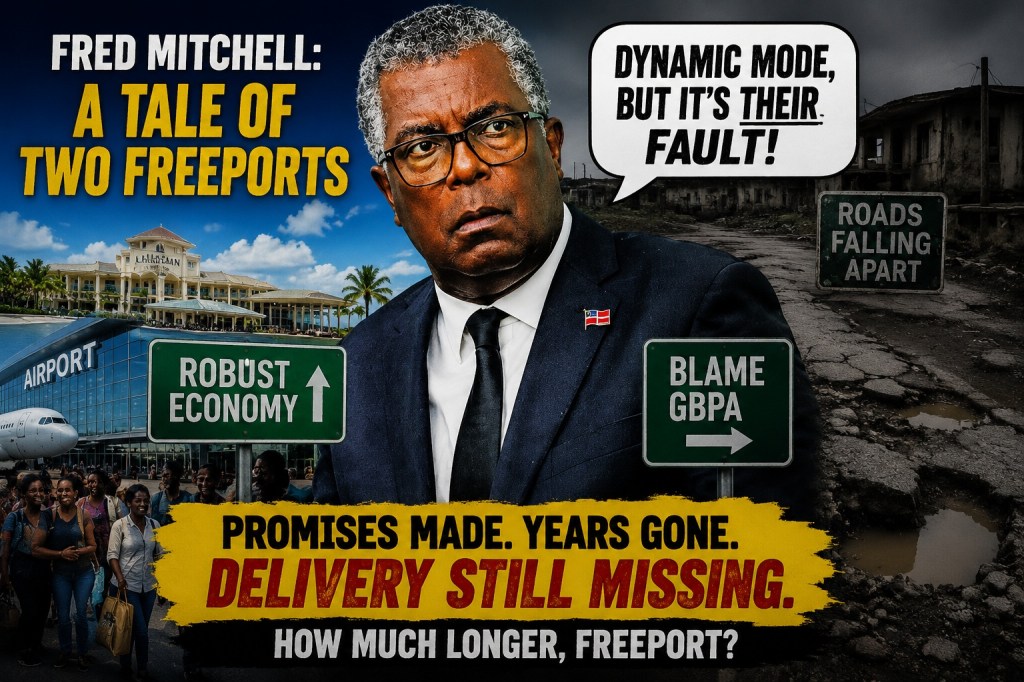
My Morning Paper – August 14th, 2026 – A Tale of Two Freeports: Robust Economy or Robust Political Spin?

There are moments in politics when the spin becomes so elaborate that you almost need a scorecard to keep track of which version of reality you are supposed to believe.

Fred Mitchell, Chairman of the Progressive Liberal Party, has now given us his version of Grand Bahama: the economy is in a “dynamic mode,” there is a comeback underway, there is a “positivity spirit” in Freeport — but somehow, at the same time, Freeport’s problems can be laid at the feet of the Grand Bahama Port Authority (GBPA).

Well, which is it, Mr. Chairman?

Is Freeport experiencing a robust economic revival under the stewardship of the Davis administration, or is Freeport being held back by an institution over which the government says it now has substantial regulatory authority?

Because you really cannot have it both ways.

Mitchell’s comments are particularly interesting in light of the government’s own history with the Grand Bahama Port Authority (GBPA). In March, following the international arbitration, the Davis administration celebrated what the Prime Minister described as a “historic victory,” emphasizing that the tribunal confirmed the government’s regulatory authority over Freeport and rejected most of GBPA’s counterclaims.

But there is another side to that arbitration which deserves to be remembered.

The government’s $357 million reimbursement claim against GBPA was dismissed. The tribunal also found that successive governments had failed to act in a timely manner on certain proposed environmental by-laws, although it did not immediately establish a basis for damages.

So perhaps the Chairman should explain something.

If the government has spent years telling Grand Bahamians that it needed to confront the GBPA because the Port Authority was standing in the way of Freeport’s development, and if the government then went to arbitration to settle precisely these questions, what exactly is the government doing with the authority it says the tribunal has now confirmed?

And while we are asking questions, let’s ask some that actually matter to the people of Grand Bahama.

What is happening with the airport?

Because the airport was not some minor detail in the grand political narrative of Grand Bahama’s revival.

The redevelopment of Grand Bahama International Airport has been discussed for years. In 2022, government officials described the airport redevelopment and the sale of the Grand Lucayan as major components of the island’s economic revitalisation strategy.

Indeed, when the earlier $100 million Electra America deal for the Grand Lucayan collapsed in 2022, the importance of the airport was hardly a secret. Former Lucayan Renewal Holdings chairman Michael Scott argued that a substantial airport commitment was essential to attracting serious investment into the resort.

The Davis administration itself said in November 2022 that it was in the final stages of selecting a provider for the airport’s redevelopment.

Fast-forward several years and Grand Bahamians are still entitled to ask:

Where is the finished airport?

And if the answer is that the airport is progressing, then show the people the schedule, the scope, the financing, the operator, the construction milestones and the completion date.

Because Grand Bahamians have heard enough announcements.

They need delivery.

The same applies to the Grand Lucayan.

The government eventually signed a Heads of Agreement in May 2025 to sell the 56-acre beachfront resort and adjacent Reef Golf Course to Ancient Waters Bahamas, a subsidiary of Concord Wilshire Capital, for $120 million. The redevelopment was presented as an approximately $827 million project.

There has subsequently been real movement around the project. The development has attracted Hilton branding, and MSC’s cruise division has committed to a beach club component. Officials have also said that airport redevelopment is important to the success of the Grand Lucayan project.

So, this is not an argument that absolutely nothing is happening.

It is an argument about time, delivery and political accountability.

Because there is a profound difference between saying:

“Grand Bahama is recovering.”

and saying:

“Grand Bahama’s economy is robust.”

The government’s own 2026 budget figures show that Grand Bahama recorded more than one million visitor arrivals in 2025, a 91.2 percent increase over the previous year, largely driven by the opening of Carnival’s Celebration Key. Arrivals continued strongly into 2026. Those are unquestionably positive numbers.

But visitor arrivals are not the entire economy.

A cruise passenger arriving at a private cruise destination is not automatically the same thing as a thriving Freeport economy.

A headline announcing billions in proposed investment is not the same thing as completed projects.

A promise of an airport is not an airport.

A Heads of Agreement is not a finished hotel.

And a political speech describing an economy as “robust” does not make it so.

That is where Mr. Mitchell’s version of the “tale of two cities” becomes problematic.

He talks about the positive spirit in Freeport while pointing toward the GBPA as the institution responsible for the roads, the airport and other failures.

But Grand Bahamians have every right to ask the government:

What part of this is now your responsibility?

The tribunal confirmed that the government has regulatory authority in Freeport. The government’s own case was that Freeport could no longer be treated as some private kingdom outside the reach of the Bahamian state.

Fine.

Then govern.

Fix what you have the authority to fix.

Build what you promised to build.

Finish what you promised to finish.

And stop treating every unfinished piece of Grand Bahama as somebody else’s fault.

Because that is the real problem with this latest political performance.

For years, Grand Bahamians were promised a new economic dawn.

They were promised the resurrection of the Grand Lucayan.

They were promised an airport capable of supporting that redevelopment.

They were promised investment.

They were promised jobs.

They were promised that Grand Bahama would be transformed.

And now, after years in office, the political conversation increasingly sounds like an exercise in explaining why somebody else is responsible for the things that remain undone.

First, it was COVID.

Then Dorian.

Then investors.

Then the Port Authority.

Then arbitration.

Then regulations.

Then somebody else.

At some point, Mr. Mitchell, the government has to become the adult in the room.

You cannot campaign as the government that will fix Grand Bahama and then, years later, become the government explaining why Grand Bahama’s problems are somebody else’s fault.

And perhaps that is the most important question arising from Mitchell’s “tale of two cities.”

If Freeport is truly as robust as he suggests, why does the government still have so much explaining to do?

Why are Grand Bahamians still asking about the airport?

Why are they still asking about the Grand Lucayan?

Why are they still asking about roads and infrastructure?

Why are they still asking when the promised transformation will actually be felt in their businesses, their paycheques and their communities?

And why, after nearly five years of a PLP government, are we still being offered political optimism where measurable delivery should be?

Grand Bahama does not need another inspirational speech.

It does not need another announcement.

It certainly does not need another political fairy tale.

It needs execution.

So, forgive Grand Bahamians if they are somewhat sceptical when Fred Mitchell tells them that Freeport is “dynamic,” “positive” and “coming back.”

They have heard that story before.

What they would really like to see is the next chapter.

And preferably, this time, with an airport, a functioning tourism anchor, functioning infrastructure and actual economic opportunity in it.

Because if this is what the PLP calls a “robust” economy, perhaps Grand Bahamians should be forgiven for asking the most politically inconvenient question of all:

Robust for whom?

The Bahamas deserves so much more.

END

My Morning Paper – August 13th, 2025 – Political Mercenaries, Foot Soldiers, and the Front Door They Came Through

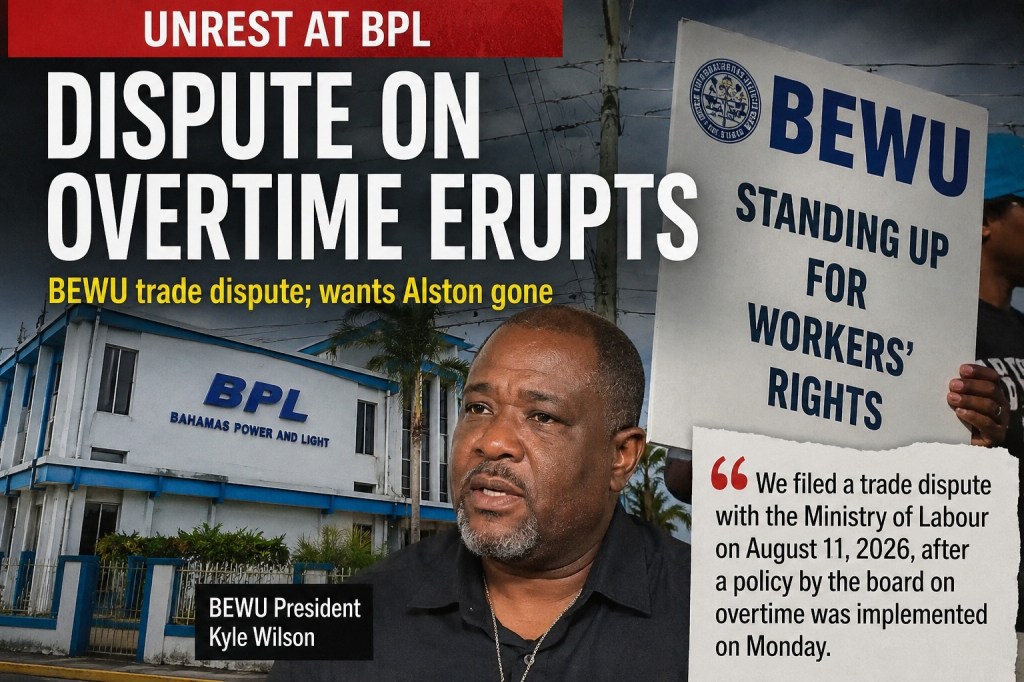
The headline in The Nassau Guardian reads: “Unrest at BPL – Dispute on overtime erupts – BEWU trade dispute; wants Alston gone.”

According to the report, the Bahamas Electrical Workers Union (BEWU) filed a trade dispute with the Ministry of Labour on August 11, 2026, after Bahamas Power and Light (BPL) implemented a new overtime policy earlier this week. The dispute comes at a time when the country is already grappling with persistent power outages and growing frustration over the state of the nation’s electricity provider.

Whether one agrees with the union’s position or not, the fact remains that industrial unrest at BPL is the last thing Bahamians need while the corporation struggles to stabilize an already fragile system.

But while the overtime dispute dominates the headlines, another issue deserves attention.

Former PLP MP Leslie Miller recently expressed concern about what he described as a new breed of political activist operating within the Progressive Liberal Party (PLP), whom he has labelled “Political mercenaries”. He questioned where some of these individuals came from, why they appear so quick to attack anyone who disagrees with the party, and why so much political discussion has descended into hostility, insults, and personal attacks.

It is a fair question.

It appears that BEWU President Kyle Wilson had already become the target of aggressive attacks from some of the party’s most vocal online supporters, something new for Mr. Miller to question the PLP party about.

Yet with all due respect to Mr. Miller, the answer may be far simpler than he thinks.

The people he is questioning did not arrive by boat, parachute, or divine intervention. They did not sneak into the PLP under the cover of darkness. They were invited in through the front door.

For years, some of the loudest and most aggressive political personalities on social media have been publicly embraced, celebrated, and defended by senior figures within the party. These individuals were often described as “foot soldiers” fighting for the cause. They were praised when they attacked political opponents. They were applauded when they dominated social media discussions. They were rewarded with recognition when they carried the party’s message into every online battlefield.

Now, suddenly, some within the PLP appear shocked that a few of these same individuals feel empowered enough to challenge party officials, issue public ultimatums, attack union leaders, and behave as though they are entitled to dictate the party’s direction.

But entitlement does not develop in a vacuum. It grows when it is encouraged. It flourishes when it is rewarded. And it becomes entrenched when those at the top decide that political loyalty is more valuable than political discipline.

That is why Mr. Miller may be looking for answers in the wrong place.

If he truly wants to understand how this culture developed, he may wish to start by examining the leadership that helped cultivate it. The names most often associated with publicly praising and encouraging these political warriors are not names from outside the party. They are names from within it.

Prime Minister Philip Davis. Foreign Affairs Minister Fred Mitchell. Former Senator Jerome Fitzgerald.

These are among the figures who have publicly acknowledged and praised many of the party’s most energetic online defenders over the years.

So, if Mr. Miller is wondering where these so-called “political mercenaries” came from, the answer may not be found on Facebook, WhatsApp, or social media platforms.

The answer may be found much closer to home.

After all, when someone walks through the front door, it is usually because somebody opened it.

The Bahamas deserves better.

END
My Morning Paper 11th August 2026 – Apparently, $265 Million Is Just Another Day at the Office

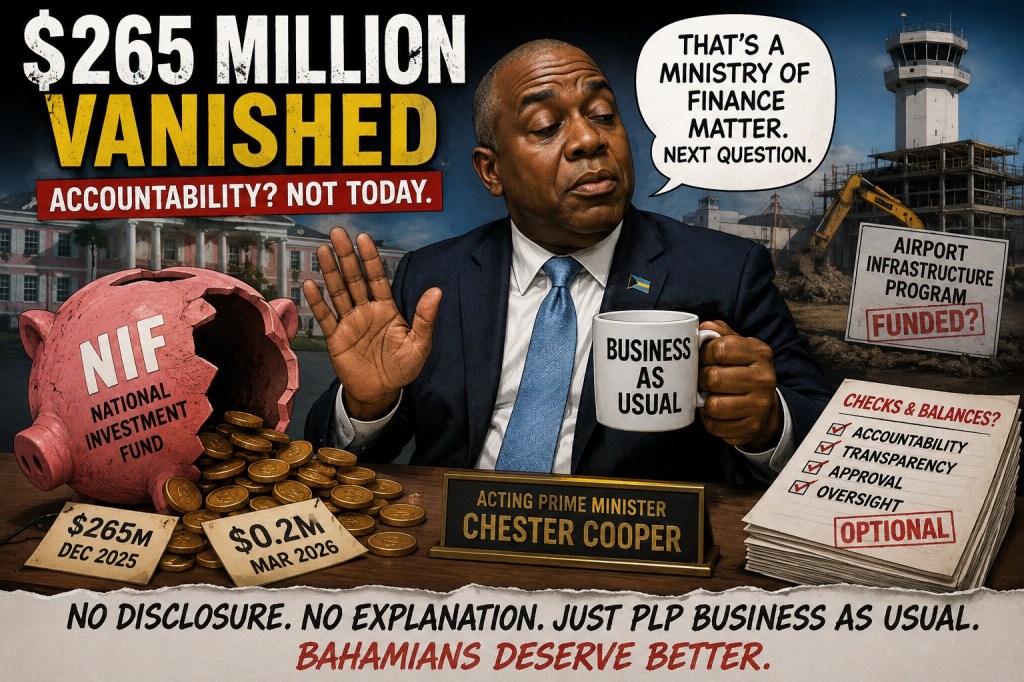
Today, Acting Prime Minister Chester Cooper was asked a rather inconvenient question: What happened to approximately $265 million that had been sitting in the National Investment Fund (NIF)?

His response, essentially, was that the Opposition is simply looking for relevance and that the matter is one for the Ministry of Finance.

Ah, yes.

The New Day Bahamian governmental tradition: when the question gets uncomfortable, find another ministry.

Except this isn’t a question about a missing office chair.

We are talking about approximately $265 million of public money.

And before anybody rushes to accuse the Opposition of inventing numbers, let’s deal with the facts.

Government’s own fiscal reporting showed that the National Investment Fund had approximately $265.3 million at December 2025. By the end of March 2026, the reported balance had fallen to approximately $0.2 million. That is a movement of roughly $265 million in a matter of months.

The government has now said the money was used to support its airport infrastructure programme.

Fine.

Then tell the Bahamian people exactly how.

Because that is where the government’s explanation begins to look less like transparency and more like a game of governmental hide-and-seek.

And, for the record, there is an important distinction that needs to be made.

The Government has already argued that the original $265.3 million placement into the NIF was authorized by Parliament under a March 10, 2025, resolution. Prime Minister Philip Davis made that position explicit during his mid-year budget contribution. Government reporting also states that the funds were intended for strategic infrastructure investments, including airport works.

So, the issue isn’t honestly presented by saying, “The government secretly put $265 million into the NIF without parliamentary approval.”

That claim is disputed by the government’s own parliamentary explanation.

The much more important question is what happened next.

The NIF is not supposed to be a governmental piggy bank with a convenient ATM card hanging off the side.

The National Investment Funds Act, 2022 established the fund as a statutory vehicle with specific governance arrangements. The legislation provides for the establishment and management of the Fund, including provisions dealing with deposits, allocations and withdrawals, a Board of Governors and investment-management structures.

That means Bahamians are entitled to ask some very basic questions:

Who authorized the withdrawals?

On what statutory authority were they made?

What resolutions or approvals were issued?

Which projects received the money?

How much went to each project?

Who sits on the Board governing the Fund?

What investment or allocation mandate governed the money?

What contracts, invoices, project approvals or expenditure records support the withdrawals?

And perhaps most importantly:

Where is the required reporting?

Because this is where Chester Cooper’s “it’s a Ministry of Finance matter” answer becomes rather unsatisfying.

Nobody is asking him to personally reconcile the government’s books on the back of a cocktail napkin.

The public is asking the government to account for $265 million.

And accountability is not supposed to depend on which ministry happens to have the file.

The Government’s own communications have acknowledged that the NIF has a statutory governance and reporting framework.

So, if the answer is that everything was properly authorized, properly documented and properly spent on airport infrastructure, then wonderful.

Open the book.

Show the authorization.

Show the Board decision.

Show the allocation.

Show the projects.

Show the contracts.

Show the expenditure.

Show the report.

Then everybody can go home.

But what we should not get is the increasingly familiar political response that goes something like:

“Nothing to see here. The Opposition is playing politics. Ask somebody else.”

That may be sufficient for a press conference.

It is not sufficient for $265 million of Bahamian public money.

And this is precisely where the PLP government’s attitude toward accountability needs to be challenged.

The people are not required to stop asking questions simply because the government finds the questions inconvenient.

The Opposition isn’t the only entity asking questions. Journalists, taxpayers, financial professionals and ordinary Bahamians have every right to ask what happened to hundreds of millions of dollars held in a statutory national investment vehicle.

This isn’t about whether Michael Pintard is relevant.

It isn’t about whether the FNM is “moaning.”

It isn’t even about whether the PLP thinks the Opposition is trying to score political points.

It is about whether government believes that public money requires public accountability.

There is also a delicious irony here.

The Government wants Bahamians to believe that everything is perfectly normal because the money is ultimately being used for infrastructure.

Well, congratulations.

But “we spent it on something useful” is not a substitute for financial accountability.

If that were the standard, every government in the world could simply say, “Don’t worry, we spent the money on something good,” and Parliament, auditors, oversight bodies and the public could all go home.

That isn’t how responsible government works.

The NIF was created by legislation precisely because public investment funds are supposed to operate within a framework of governance, professional management and accountability.

And there is another uncomfortable little detail.

The Government’s own budget reporting shows that the NIF was being used for strategic infrastructure investment, including airport projects.

So, there is nothing inherently outrageous about using the Fund for infrastructure if that use is authorized under the applicable framework and properly documented.

What is outrageous is expecting the Bahamian people to accept “trust us” as the entire accounting system.

Mr. Deputy Prime Minister, if this is truly a straightforward Ministry of Finance matter, then perhaps the Ministry of Finance should simply provide the answers.

And while you’re waiting for them, perhaps you can return your attention to making sure that the Grand Cay generator actually stays running.

Because Bahamians have become rather tired of governments treating basic questions about public money as though the public has committed some terrible political offence by asking them.

This isn’t “moaning.”

This isn’t “complaining.”

And it isn’t necessarily even partisan.

It is called accountability.

The PLP doesn’t get to decide that transparency is a constitutional virtue when it is in Opposition and an annoying political nuisance when it is in Government.

The standard has to remain the standard.

If the money was properly authorized, say so.

If it was properly withdrawn, show us.

If it was properly spent, account for it.

If the NIF Board approved it, identify the Board and publish the relevant documentation.

If the airport projects received the money, tell Bahamians exactly which projects, how much each received and what has actually been delivered.

And if all of that is already available, then there should be absolutely no reason to tell the public to wait while government officials complain about the Opposition asking questions.

Because $265 million isn’t a political talking point.

It is $265 million of the people’s money.

And apparently, in today’s PLP Bahamas, asking where it went is considered political mischief.

Perhaps the government should try something revolutionary:

Answer the damn question.

The Bahamas deserves so much better.

END

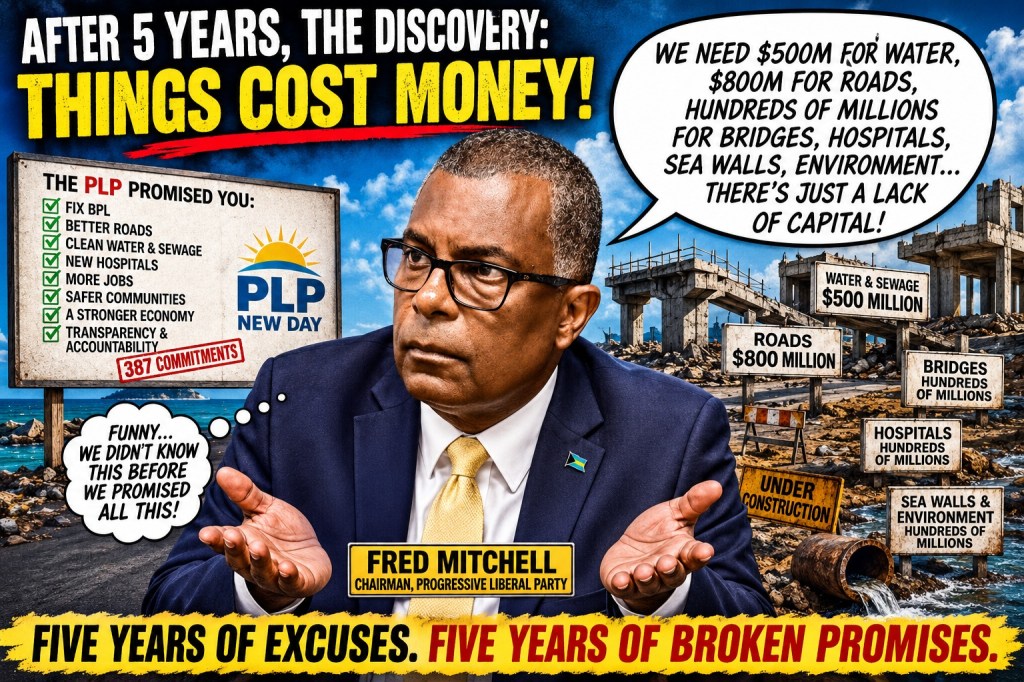
My Morning Paper -10th August 2026 – Ah, So Now We Need Money? — The Five-Year Discovery of the PLP

There are moments in politics when you almost must admire the sheer creativity of an experienced politician.

After five years in office, the Chairman of the Progressive Liberal Party (PLP), Fred Mitchell, appears to have made a remarkable discovery:

The Bahamas needs money to do things.

Who knew?

According to remarks attributed to Mitchell, the country is facing enormous demands for capital — nearly $500 million for water and sewage, approximately $800 million for roads, and hundreds of millions more for bridges, seawalls, environmental projects, public buildings and healthcare facilities.

And, of course, there is the small matter of keeping the lights on.

Mitchell describes it as a “lack of capital” in a “dynamic economy” and says the country needs both capital and labour.

Well, after five years of a PLP government, one is tempted to ask the most impolite question of all:

When exactly did the government discover that all of this was going to cost money?

Because this is the same Progressive Liberal Party (PLP) that went to the Bahamian people in 2021 with a Blueprint for Change containing 387 commitments and promising to “recover, rebuild and revolutionize” the country.

The PLP’s own recently published tracker now acknowledges that some commitments have been delivered, others remain in progress, and some have been delayed, revised, replaced or discontinued. In other words, even the government’s own scorecard does not suggest that every promise made on the campaign trail magically became reality.

And this is where Mr. Mitchell’s newfound fascination with capital becomes rather interesting.

The “Dynamic Economy” Excuse

When the PLP was campaigning, the message was not:

“Vote for us, but please understand that we may subsequently discover that there isn’t enough money to do what we promised.”

No.

The message was transformational.

The 2021 Blueprint promised major changes, including increased public investment through government expenditure and public-private partnerships. In its first budget after taking office, the Davis administration itself said it intended to increase public investment and described its programme as “bold,” “aggressive,” “reasonable,” “responsible” and “realistic.”

So, what happened?

Five years later, we are apparently being introduced to The New New Day:

The government has discovered that roads cost money.

Water systems cost money.

Bridges cost money.

Healthcare facilities cost money.

Power infrastructure costs money.

And — hold on to your chairs — workers cost money too.

This would all be perfectly understandable if this were a government that had just walked into office yesterday.

But it isn’t.

The PLP has had five years to govern, plan, prioritize, finance and execute.

And Mr. Mitchell is not some bewildered backbencher who accidentally wandered into Cabinet. He is a senior Cabinet minister and the Chairman of the governing party.

So, when he tells Bahamians that there is a shortage of capital, the obvious question is:

What happened to the grand financial strategy that was supposed to make all those promises possible?

Nobody Said Government Was Cheap

To be fair, there is a legitimate point buried somewhere underneath Mr. Mitchell’s argument.

The Bahamas is a small country with a population of roughly 400,000 people. It has an enormous infrastructure bill relative to its population, a narrow domestic tax base, high import dependence and significant exposure to external economic shocks.

And yes, infrastructure is expensive.

But that isn’t a revelation.

It is precisely the sort of thing political parties are supposed to understand before they write their manifestos.

The government’s own fiscal numbers show that the fiscal position has improved considerably from the depths of the COVID-era crisis. Government debt fell from about 88.7% of GDP in FY2020/21 to a projected 71.4% in FY2024/25, according to the Ministry of Finance’s 2025 budget documents. The government also moved from a primary deficit to primary surpluses.

So, the argument cannot simply be that the cupboard is bare.

The more appropriate question is:

How has the government chosen to allocate the resources available to it, and why haven’t the promised investments been delivered at the pace Bahamians were led to expect?

That’s a very different question.

And Then There Is the Little Matter of the Promises

This is where the political mathematics becomes particularly amusing.

You cannot spend five years telling people that you have a plan to fix the country and then, near the end of the political cycle, discover that fixing the country is rather expensive.

The PLP’s own 2021 budget rhetoric was extraordinarily confident. The government said it was going to stabilize the nation’s finances, increase revenue, grow the economy and increase public investment.

It even criticized the previous administration’s fiscal management and declared that the era of “mismanagement, shoddy fiscal discipline and indecisive governance” was over.

That was quite a statement.

Because once you assume the mantle of government, eventually the speeches must become projects.

Eventually the announcements must become contracts.

Eventually the contracts must become construction.

Eventually the construction must become something Bahamians can actually use.

And eventually somebody must pay the bill.

The Immigration Argument Is Another Matter

Mitchell’s comments about businesses struggling to find workers while some Bahamians say they cannot find jobs touch on a genuine economic problem: the mismatch between available skills and the labour demanded by employers.

That is a legitimate policy debate.

A government can reasonably argue that carefully managed immigration is necessary where local labour supply does not meet demand, while simultaneously investing in Bahamian training and employment.

But that debate should not be used as a substitute for confronting the government’s own failures in workforce development.

If contractors have been complaining for years that they cannot find skilled Bahamian labour, and Bahamians have been complaining that they cannot find suitable employment, then perhaps the country doesn’t merely have an immigration problem.

Perhaps it has a planning problem.

And after five years, that planning problem belongs to the government.

The Capital Problem Is Not an Excuse for Broken Promises

Here is the inconvenient truth for the PLP:

Governments inherit problems. Governments are elected to solve them.

They don’t get to campaign promising transformation and then, five years later, announce that transformation has turned out to be rather costly.

Imagine a contractor telling a client:

“Good news! I have completed the first five years of the project. Bad news: I have just discovered that concrete, steel, labour and plumbing cost money.”

The client might reasonably ask:

“Didn’t you prepare a budget?”

That is precisely what Bahamians should be asking.

Because the PLP didn’t simply promise to govern.

It promised a New Day.

It promised to “Recover, Rebuild and Revolutionize.”

It published 387 commitments.

And now, near the end of the five-year period, the party chairman is explaining that the country has a tremendous amount to do and — surprise, surprise — there isn’t unlimited capital available to do it.

Well, Mr. Chairman, welcome to government.

There never was unlimited money.

There never was unlimited labour.

There never was unlimited time.

There was, however, a campaign trail.

And on that trail, the PLP made a great many promises.

The question now isn’t whether The Bahamas needs $500 million for water, $800 million for roads, or hundreds of millions more for everything else.

Of course it does.

The question is much simpler:

Why did the people have to wait five years for the people making the promises to discover the price tag?

Perhaps the next election should come with a new campaign slogan:

“Vote PLP — Now With An Actual Budget.”

Because apparently the first five years were merely the trial period.

And if this is what happens when the New Day arrives, perhaps somebody should check whether the receipt comes with a return policy.

The people of The Bahamas deserve better.

END

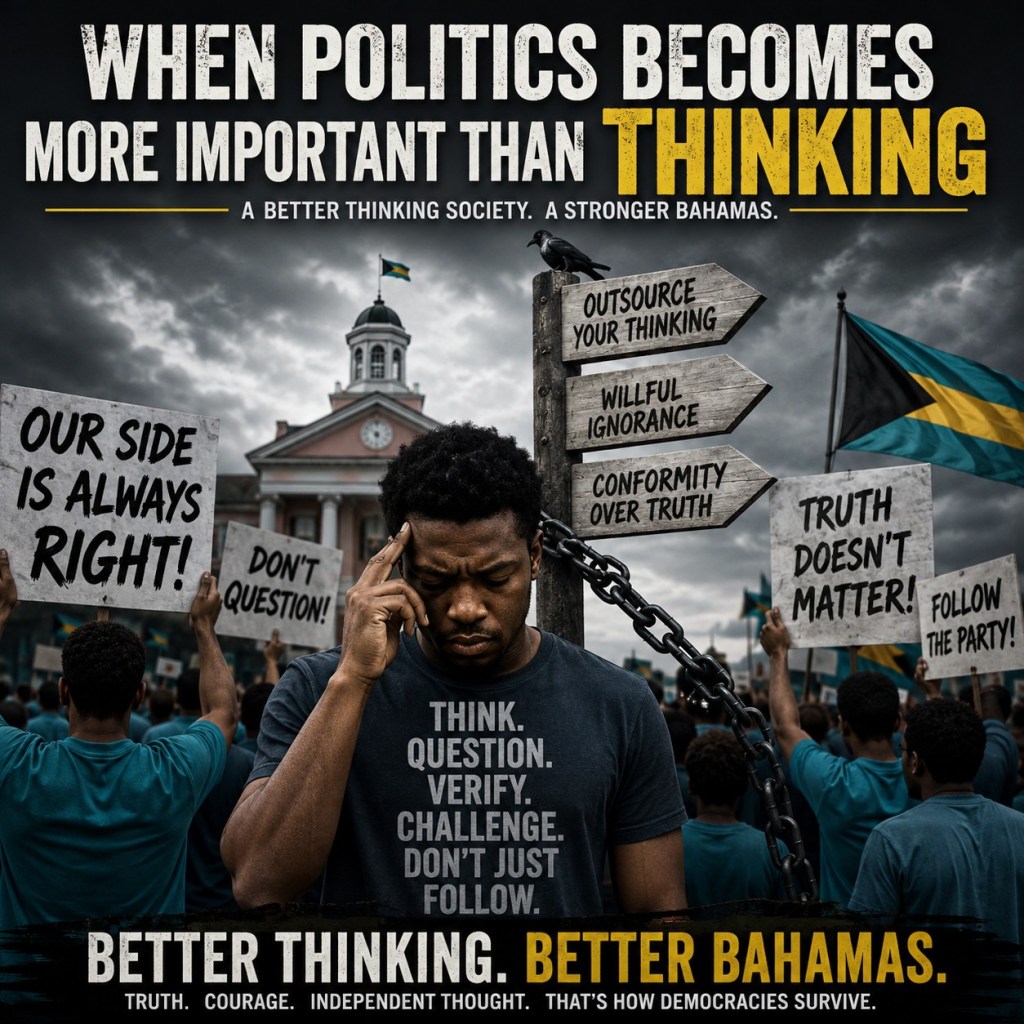
My Morning Paper 7th August 2026 – WHEN POLITICS BECOMES MORE IMPORTANT THAN THINKING

It appears that Bahamian politics has entered a realm that can only be described as deeply troubling — and, at times, downright absurd.

And before anyone gets offended, this is not an accusation that Bahamians are uniquely incapable of rational thought. Political tribalism, blind loyalty and the rejection of inconvenient facts are hardly exclusive to The Bahamas. They exist in democracies around the world.

What should concern us, however, is the extent to which our political loyalties increasingly appear to determine what we are willing to believe.

That is a dangerous place for any society to find itself.

The German theologian Dietrich Bonhoeffer, writing during the rise of Nazi Germany, reflected deeply on what he called stupidity. Importantly, Bonhoeffer was not simply talking about a lack of intelligence. He was describing something far more dangerous: the surrender of independent judgment.

His argument was essentially that a person can be perfectly capable of thinking, yet surrender that ability to a political movement, leader, ideology or group. At that point, slogans can replace thought, loyalty can replace judgment, and facts that contradict one’s beliefs can simply be dismissed.

And perhaps that is where we should pause and look at ourselves.

FIRST: OUTSOURCING OUR THINKING

When we allow a political party, politician or political tribe to tell us what to think about every issue, we have stopped exercising independent judgment.

If the party says it is good, we say it is good.

If the party says it is bad, we say it is bad.

If our political opponents make the identical argument, suddenly it becomes unacceptable.

That is not political conviction.

That is intellectual dependence.

And the irony is that some of the people who behave this way today would have fiercely condemned the very same behaviour when their political opponents were doing it.

SECOND: WILLFUL IGNORANCE

Ignorance is not necessarily stupidity.

None of us knows everything. That is perfectly normal.

The problem begins when we encounter information that challenges what we believe and deliberately refuse to investigate it.

We don’t read the report.

We don’t check the numbers.

We don’t examine the evidence.

We simply repeat what our political side has told us.

And when presented with facts that contradict our position, we dismiss them because they came from “the other side.”

That isn’t knowledge.

It is wilful ignorance dressed up as political loyalty.

THIRD: CONFORMITY

Then there is the pressure to belong.

We see what everyone around us is saying, so we say it too.

We repeat the same slogans.

We defend the same people.

We condemn the same people.

We laugh at the same political jokes.

We attack anyone who dares to question the accepted position.

Eventually, being part of the crowd becomes more important than determining whether the crowd is actually right.

And that is where conformity becomes particularly dangerous: truth becomes secondary to belonging.

Bonhoeffer’s warning was not that every person is inherently stupid. In fact, his reflections specifically caution against treating the majority of people as stupid in every circumstance. His concern was what happens when people surrender their inner independence to the power and influence surrounding them.

SO, WHERE DOES THAT LEAVE US?

I believe we need to ask ourselves some uncomfortable questions.

Can we criticize our own political party?

Can we acknowledge when our preferred politician is wrong?

Can we accept a fact even when it benefits our political opponent?

Can we change our position when the evidence changes?

Can we disagree with someone politically without assuming that they are stupid, evil or unpatriotic?

And most importantly:

Are we thinking for ourselves — or are we simply repeating what our political tribe has instructed us to think?

A healthy democracy does not require everyone to agree.

It requires people to think.

It requires citizens willing to question their own side.

It requires the courage to say, “I was wrong.”

It requires us to value truth over tribalism, evidence over emotion and principle over party.

Because political parties are temporary.

Politicians come and go.

Governments change.

But the habits of thought we allow to take root in our society can remain for generations.

We cannot continue down a road where political loyalty becomes more important than intellectual honesty and still expect to build a mature, civilized democracy.

The Bahamas does not need more people who simply know which side they are on.

We need more people willing to ask whether their side is right.

Think.

Question.

Verify.

Challenge.

And when the facts prove us wrong, have the courage to change our minds.

That is not weakness.

That is citizenship.

END

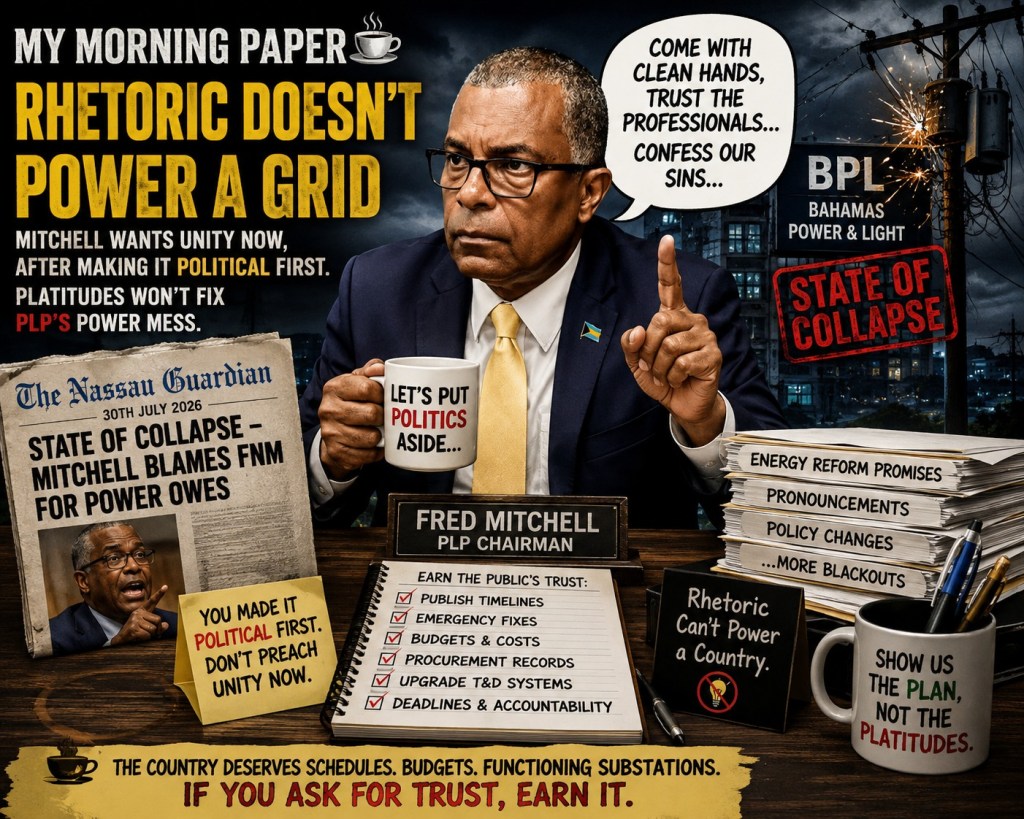
My Morning Paper – August 6th 2026 – Rhetoric Doesn’t Power the Grid: The Blackout Between Promises and Performance

I sat down to read the latest from Fred Mitchell — a press statement urging calm, praising “the professionals,” and scolding the opposition for “creating anxiety” over the Bahamas Power and Light mess. Charming. If only rhetoric powered a grid. 

It is simply amazing that now the PLP’s chairman would like “all hands of deck” and would like for persons to put politics aside on this matter when he was the first one to make it political and creating unnecessary anxiety; “State of collapse – Mitchell blames FNM for power owes” – The Nassau Guardian 30th July 2026.

Let’s cut to the chase: asking everyone to put politics aside while absolving your own party of responsibility is rich. Mitchell now wants “all hands-on deck” and for people to trust the experts — after the PLP’s loud energy-reform promises, after the pronouncements, after the changes that, by all appearances, left the system more fragile, not less. And no one is blaming the experts; the ones being blamed are those whose failed policies took us this far back.

And yet the chairman’s statement reads like a moral sermon: “come with clean hands,” “confess our sins,” “let us give the professionals an honest opportunity.” Fine. Start by putting the facts on the table. Publish the timelines, the emergency fixes, the budgets, the procurement records. Show the public the concrete steps being taken to finish transmission and distribution upgrades that everyone agrees are needed. Until then, pious calls for unity sound suspiciously like finger-pointing in a slow-motion collapse and we can all agree that the PLP’s hands are always “clean”, now this may be because they have never done anything wrong – that they would like you to believe or it is more likely because they really do not do any “heavy lifting”.

If Mitchell truly wanted bipartisanship, he’d show leadership by owning what his administration can fix immediately, admitting what it inherited, and committing to a clear, accountable plan with deadlines and costs. Instead, we get the rhetorical equivalent of a beach recommendation while the lights go out.

Final brew thought: if you ask for trust, earn it. Otherwise “leave it to the professionals” is just polite shorthand for “let us avoid responsibility.” The country deserves better than platitudes. It deserves schedules, budgets, and functioning substations.

END

My Morning Paper 4th August 2026 – Fred Mitchell Wants to Rewrite History. Bahamians Remember the Blackouts.

One would have thought that, out of respect for Emancipation Day, Fred Mitchell might have taken a day off from his now familiar pastime of political revisionism.

Apparently not.

Instead, Bahamians were treated to yet another broadside from the Chairman of the Progressive Liberal Party (PLP), this time directed at the Free National Movement (FNM), its leadership, and even the staff of The Nassau Guardian. Their apparent crime? Reporting and scrutinizing Mr. Mitchell’s own public comments on the continuing Bahamas Power and Light (BPL) crisis.

Imagine attacking the messenger because the message was your own.

What is truly astonishing is Mr. Mitchell’s latest attempt to convince Bahamians that today’s electricity crisis is somehow the FNM’s fault, despite the PLP having been in office since September 2021. Governments inherit challenges—that is true. But governments also inherit opportunities. The question is what they do with them.

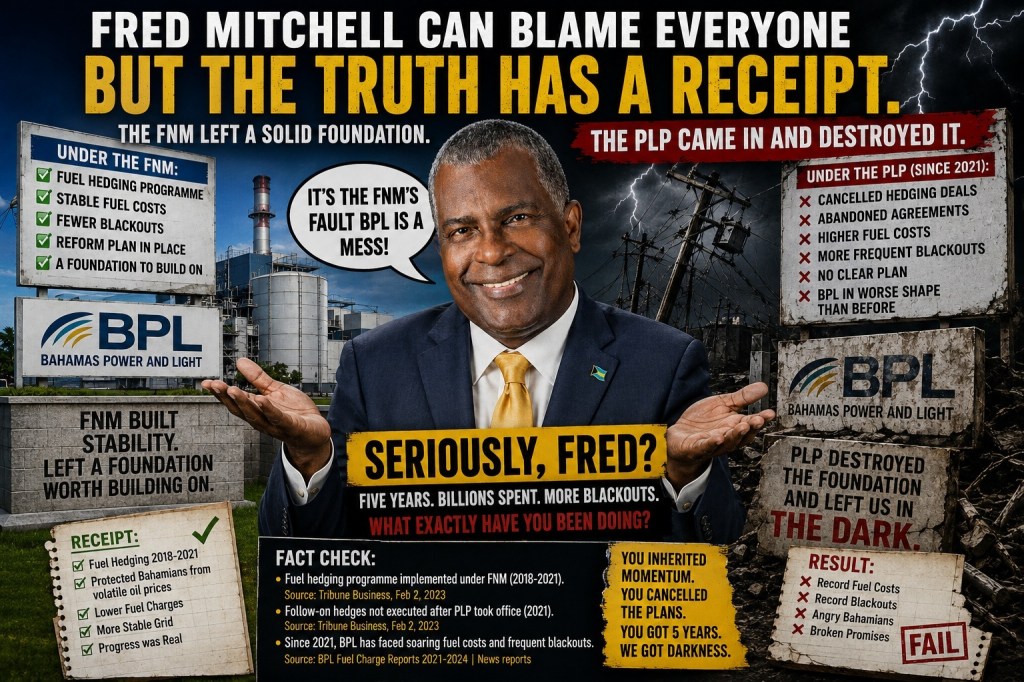
When the Davis administration took office, BPL certainly was not a perfect utility. Decades of underinvestment under successive governments had left major structural issues. However, the FNM administration had begun implementing a broader reform strategy that included fuel hedging, refinancing efforts, and plans for new generation intended to stabilize electricity costs and improve reliability.

The fuel hedging programme, negotiated with support from the Inter-American Development Bank (IDB), had already provided consumers with unusually stable fuel charges during a period of volatile oil prices. Planned follow-on hedge transactions scheduled after the 2021 general election were not executed by the incoming administration—a decision the Davis administration has defended but one that has remained highly controversial because critics argue it contributed to significantly higher fuel costs.

Whether one agrees with that decision or not, one fact is difficult to escape: the PLP did not continue every major element of the strategy it inherited. It chose a different course.

Five years later, Bahamians are asking a very simple question.

Has that course produced a better BPL?

The answer is written every time another island experiences widespread outages, every time businesses lose revenue because the power disappears, and every time families wonder whether the next thunderstorm will once again leave them sitting in darkness.

Mr. Mitchell insists the FNM “tried and failed.”

Perhaps.

But what exactly should we call five years of PLP management?

Because if the FNM supposedly failed after beginning a reform programme, what word describes an administration that dismantled significant parts of that programme and has still not delivered the reliable electricity system Bahamians were promised?

Mr. Mitchell also declared:

“The PLP does not stick its finger in the wind and pander…”

Indeed.

At this point it seems less like finger-in-the-wind politics and more like reading tea leaves—or perhaps consulting bones—hoping that political spin will somehow generate electricity where sound policy has not.

One has to wonder whether this statement is intended to justify not only the continuing problems at BPL, but also the government’s handling of other major national projects that have attracted public criticism over the past five years.

The irony is almost too rich.

Mr. Mitchell now complains that newspapers and political opponents have twisted his words.

No, Mr. Mitchell.

They quoted them.

There is a significant difference.

If your own words produce headlines you dislike, perhaps the problem is not the headlines.

Perhaps it is the words.

Political leadership requires accountability, especially after five years in office. The public is entitled to ask difficult questions, and the media is entitled to report the answers—or the absence of them.

Instead of blaming the FNM, blaming the newspapers, or blaming anyone else who dares point out the obvious, perhaps the PLP Chairman should answer the question Bahamians continue to ask:

After nearly five years in government, if the PLP inherited a foundation it believed was flawed, where is the stronger one it promised to build?

Because blaming yesterday’s government does not keep today’s lights on especially when that government is one administration removed.

The Bahamian people deserve better.

END