My Morning Paper – May 16th 2026 – The PLP Survival Guide: Controversy Is a Stepping Stone

The old saying warns us not to envy the apparent prosperity of wrongdoers, because sometimes people begin believing that power itself is proof of righteousness. And perhaps nowhere is that lesson more fitting than in the modern political theatre of the Progressive Liberal Party (PLP), where controversy often seems less like a disqualification and more like an item on a résumé.

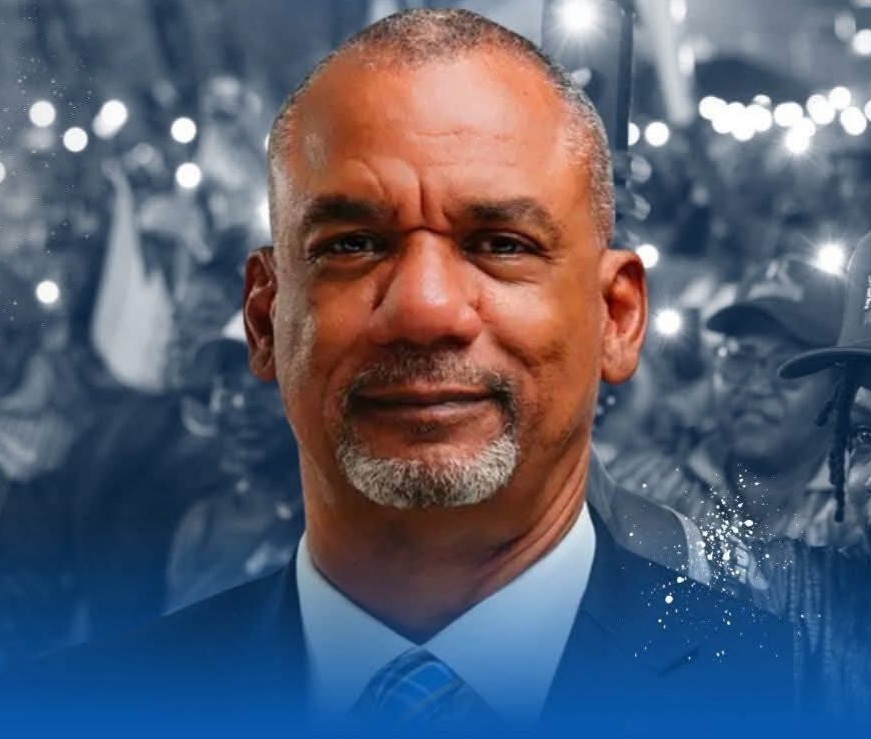
It is remarkable to now hear former PLP Cabinet Minister and Member of Parliament Jerome Fitzgerald spoken of as the supposed “architect” behind the PLP’s recent electoral success. In another era, one might think a political strategist’s legacy would be measured by vision, policy or national transformation. In today’s Bahamas, it seems surviving controversy may itself qualify as a special skill.

This, after all, is a political figure whose name became nationally associated with the Baha Mar email controversy, where private communications were dramatically read into the House of Assembly. Bahamians were left not only debating the content of the emails, but also asking the enduring question: how exactly did these private communications arrive in his possession? The explanation involving a “political garbage bin” may forever remain one of the more colourful additions to Bahamian political folklore.

Then came controversy surrounding contracts involving Bahamas Courier & Logistics and BPL, which raised questions and criticism regarding procurement and perceived political influence. No criminal findings emerged, but the public conversation around optics, favouritism and connections certainly had a life of its own.
There was also the dispute involving the disclosure of private information connected to Save The Bays — a matter that generated significant legal and public scrutiny and further fuelled criticism about the use of political power.

Yet critics argue the most troubling controversy was not about contracts or parliamentary theatrics, but concerns surrounding reports of fuel contamination affecting Marathon residents. Public concern centered around allegations that gasoline leakage had contaminated the water table and that residents suffered illnesses while questions lingered about transparency and the handling of information. For many residents and observers, the deepest frustration was not merely what happened, but whether those entrusted with protecting the public interest acted with enough urgency and openness. The concern voiced by critics was that political calculations appeared to overshadow public confidence.

Mr. Fitzgerald’s character seems to be son tarnished in certain circles that even when other allegations of wrongdoing surface in the PLP government, like the past Moorings deal in Exuma; his name is called.

And now, in the grand PLP tradition, figures wrapped in political controversy are not retired quietly into the sunset. No, they are often spoken of as master strategists, celebrated as heroes, and floated for further positions of influence. In Bahamian politics, controversy sometimes seems less like a scarlet letter and more like a stepping stone.

One almost begins to wonder whether in the PLP advancement system, the question is no longer: “What controversies followed you?” but rather: “How many did you survive?”

Is this what PROGRESS looks like?

END
My Morning Paper- 11 May 2026 – The Final Plea of a Fading ‘New Day’

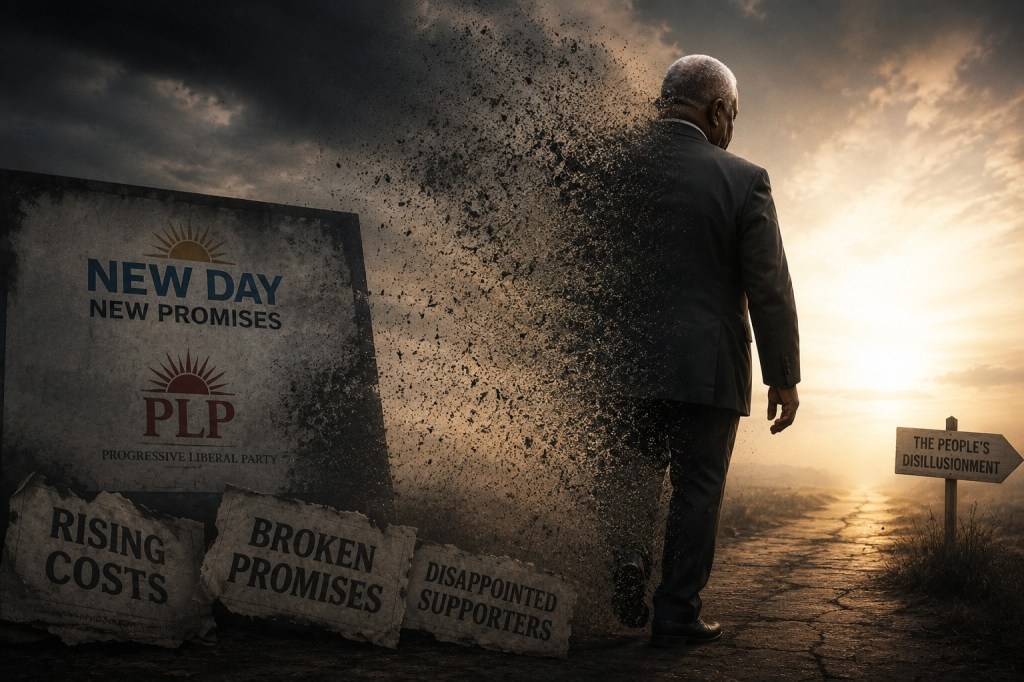
Last night, Philip Davis, leader of the Progressive Liberal Party, took to the campaign stage in what appeared to be one final theatrical appeal for five more years in office. According to The Nassau Guardian, Davis urged Bahamians to reject the Free National Movement while painting the Opposition as “petty, spiteful and weak.”

Apparently, after nearly five years in government, the Prime Minister has now discovered that the best defense of his administration is not results, accountability, or fulfilled promises, but schoolyard insults and emotional theatre.

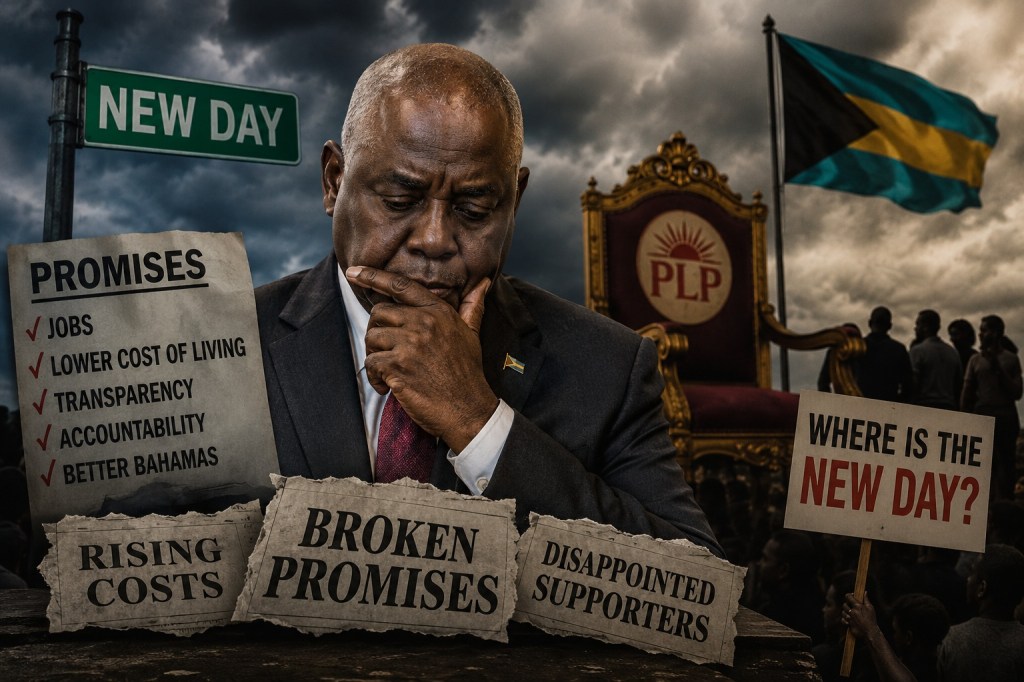
Davis claimed there are “many FNMs who are ashamed of their leadership.” Yet strangely absent from his speech was any acknowledgement of the many PLP supporters who are deeply disappointed in the way this administration has governed. The same supporters who voted enthusiastically for a so-called “New Day” now find themselves burdened by frustration, rising scepticism, and the uncomfortable realization that slogans are far easier to deliver than meaningful change.

The Prime Minister speaks of embarrassment in the FNM, but what of the Bahamians embarrassed by unfulfilled promises? What of those PLP supporters who believed they were voting for transparency, humility, and competent governance, only to witness arrogance, excuses, and endless political deflection? Those voices, apparently, do not merit a heartfelt appeal from the Prime Minister.

And then came the predictable attack on Michael Pintard and the FNM leadership. Davis attempted to mock Pintard by implying he had somehow “run back” to Hubert Ingraham, as though seeking counsel or drawing inspiration from respected party figures is somehow shameful. This criticism would carry far more weight if the PLP itself did not continuously rely on emotional invocations of the late Lynden Pindling at virtually every political opportunity.

One cannot help but notice the contradiction.

The PLP eagerly wraps itself in the legacy of Sir Lynden whenever convenient, summoning nostalgia and emotional loyalty from supporters, while simultaneously accusing others of relying on the influence of respected elder statesmen. The difference, however, is that many Bahamians now question whether this present PLP administration has remained faithful to the very mandate and principles Sir Lynden once championed. Invoking his memory has become easier than living up to the standard he set.

Prime Minister Davis also accused the FNM of being “bitterly divided.” That accusation might sound more convincing were it not for the fact that many of the very individuals who once worked tirelessly to sow discord within the FNM now comfortably reside within the PLP itself — welcomed with open arms and broad smiles. Political conversions, apparently, are only admirable when they benefit the governing party.

At this stage, the Prime Minister’s rhetoric is beginning to sound less like confidence and more like projection. The constant accusations of weakness, bitterness, and spite increasingly resemble a man staring into a political mirror and attempting to assign his own reflection to his opponents.

And now, Davis makes a final plea to disgruntled FNM supporters to “lend” him their votes.

Perhaps, then, it is only fair that disappointed and disillusioned PLP supporters consider lending their votes to Michael Pintard and the FNM in hopes of ending their frustration with this so-called “New Day.”

After all, Bahamians were promised a brighter future. Instead, many have concluded that the “New Day” was less a genuine transformation and more a carefully packaged campaign slogan — attractive in presentation, but painfully thin in delivery.

The Progressive Liberal Party (PLP) government fails for one reason; it is their nature.

END

My Morning Paper 8th March 2026 – Mitchell’s Meltdown Over Ingraham’s Return

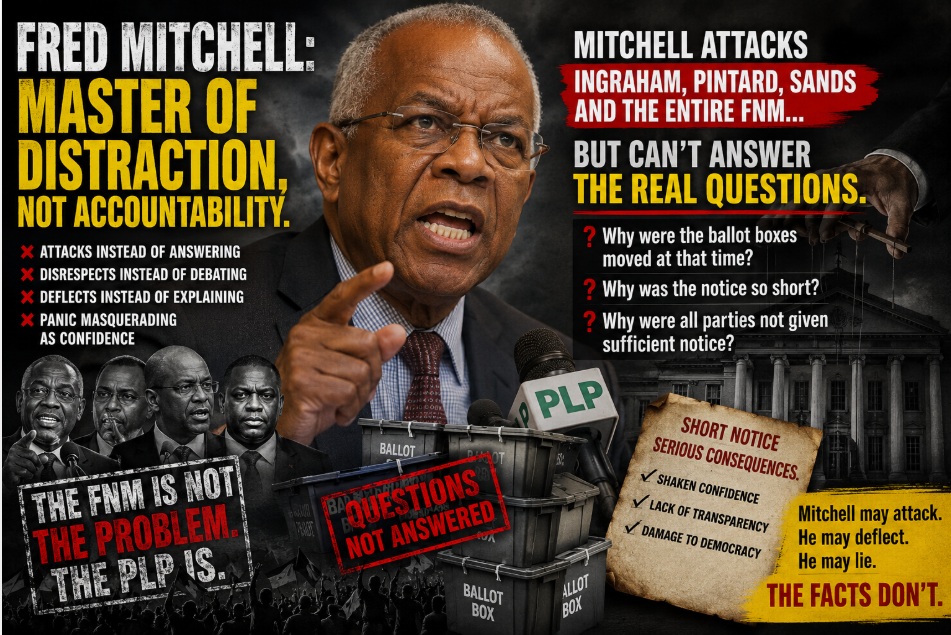
Fred Mitchell is at it again — and once again the Progressive Liberal Party (PLP) seems unable to distinguish between political debate and outright theatrical character assassination.

We have come to know Mitchell as having very little respect as he has turned into a bitter old man, this was seen in 2023 as Mitchell showed little to no respect to Dame Pindling a wreath laying ceremony on Memorial Day.  This time, the target of Mitchell’s latest disrespect through dramatic monologue is none other than former Prime Minister Hubert Ingraham, along with Michael Pintard, Duane Sands and practically anyone else associated with the Free National Movement. I mean why not just take all along for your ride, right Mr. Mitchell?

Apparently, in Mitchell’s world, the mere sight of Ingraham speaking at an FNM rally now qualifies as “bringing a man back from the grave.” One would think the PLP Chairman was announcing a séance rather than reacting to a political speech.

But beneath the overacting and insults lies something far more revealing: panic.

Because when the PLP cannot defend its own record, it resorts to attacking personalities, rewriting history, and hoping volume replaces credibility. Mitchell’s comments were not the words of a confident governing party. They were the words of a political operator desperately trying to diminish the image of Pintard, Sands, Ingraham, and the wider FNM because the PLP understands something very clearly — Bahamians are beginning to compare records again.

And comparisons are dangerous things for this administration.

Mitchell attempted to dismiss concerns raised by Sands regarding the government’s curious “arrangement” involving Leslie Miller. Yet despite all the PLP outrage, the central question still remains unanswered. If there is no special arrangement, then why does every explanation coming from the government sound like it was assembled five minutes before a press conference?

Bahamians remember well that Miller reportedly sought financing through the Bank of The Bahamas during the Christie administration and was unsuccessful. Reports also circulated that similar efforts failed under the Minnis administration. Yet somehow, under the Davis administration, the matter suddenly found an almost smooth landing strip.

Mitchell may dislike the questions, but irritation is not clarification.

And then there is the ballot box controversy — perhaps the most telling portion of this entire episode.

Mitchell insists the movement of ballot boxes was “normal procedure.” Fine. If it was so normal, then why did the situation trigger such visible alarm and confrontation? Why were concerns raised not only by the FNM, but also publicly by figures such as Jobeth Coleby-Davis on the day of early election and others who questioned the timing, handling, and communication surrounding the exercise?

More importantly:

Why were the boxes moved at that particular time?

Why was the notice reportedly so short?

And why were all political parties not given sufficient advance warning to ensure complete transparency and public confidence?

Those are not extremist questions. Those are democratic questions.

Mitchell wants Bahamians to believe that simply because parties were “eventually notified,” everyone should quietly accept the process without scrutiny. That is not how electoral confidence works in a mature democracy. Transparency is not something governments provide after public outrage; it is something ensured before controversy begins.

And if everything was so perfectly routine, then what exactly happened in Elizabeth involving the confrontation reportedly surrounding senior Parliamentary Registration Department officials? Strange behaviour for people supposedly witnessing an entirely ordinary administrative exercise.

The deeper irony here is that Mitchell and the PLP continue trying to portray the FNM as reckless or dangerous while simultaneously displaying visible hostility whenever legitimate concerns are raised. The government seems to believe that asking questions is somehow an act of political aggression.

It is not.

What Bahamians are witnessing is a governing party increasingly uncomfortable with scrutiny and increasingly dependent on distortion to protect the Prime Minister from criticism.

Mitchell insists Pintard needs protection. In reality, it appears to be Prime Minister Philip Davis who is surrounded by protectors — political loyalists willing to dismiss concerns, attack critics, and stretch credibility in defense of the administration.

The FNM does not need to “protect” Pintard from Fred Mitchell’s commentary. Bahamians have heard Mitchell for decades. They know the performance by now.

The real issue is whether this government can answer straightforward questions without turning every criticism into a dramatic political sideshow. Because the louder the PLP becomes, the more it sounds like a government trying to drown out transparency and accountability with noise.

The Progressive Liberal Party (PLP) fails for one reason; it is their nature.

END

My Morning Paper- 7th May 2026 – If Hubert Ingraham Is So Irrelevant… Why The Panic?

The New Day Progressive Liberal Party (PLP) seems to have found itself in a rather awkward political balancing act when it comes to former Prime Minister Hubert Ingraham.

On one hand, they insist he is “out of touch,” “irrelevant,” and politically retired somewhere between memory lane and the history books. On the other hand, the moment he appears on a campaign stage for the Free National Movement (FNM), the PLP reacts like somebody just announced the return of a final boss in a video game.

While the Hon. Michael Pintard was reportedly travelling from a political rally in the Berry Islands back to New Providence, Mr. Ingraham addressed supporters at an FNM rally. Apparently, what he had to say struck such a nerve within the PLP that an official statement quickly emerged from Latre Rahming, who now appears to be serving in the dual role of government communications director and emergency campaign firefighter for the PLP.

Rahming accused the FNM of “using” Hubert Ingraham to “hide the weak leadership” of Michael Pintard. But that argument raises an obvious question: if Mr. Ingraham is supposedly irrelevant and disconnected from modern politics, why does his mere appearance require an official political counterattack from the Office of the Prime Minister?

That is a lot of energy to spend fighting a man they claim nobody is listening to.

The statement itself was loaded with the familiar PLP campaign trilogy: “lies, confusion and chaos.” Ironically, critics of the PLP would argue that this is rich coming from a party that faced heavy criticism during previous election cycles over accusations of exaggeration and political fearmongering related to the handling of the COVID-19 pandemic and the aftermath of Hurricane Dorian. Those debates remain politically contentious to this day.

Latrae and the PLP also challenged the FNM for supposedly not speaking about plans for governance, which the FNM has done but out of political convenience it appears that the PLP just glossed over. Yet Bahamians may reasonably ask whether the government itself has clearly articulated a consistent long-term direction beyond campaign slogans and glossy branding exercises like the “Blueprint for Progress.”

Because somewhere between the ribbon cuttings, press conferences, billboards, and dramatic speeches, many ordinary Bahamians are still waiting to feel this so-called “progress” in their grocery bills, electricity costs, rent, and day-to-day quality of life.

And then there is the comedy hidden in the PLP’s repeated reference to Hubert Ingraham as “the former chairman of the PLP.” One almost gets the sense they are trying to remind voters that Mr. Ingraham once belonged to the PLP before becoming one of the most electorally successful leaders in FNM history.

But that line of attack creates another uncomfortable contradiction.

If the PLP keeps invoking Ingraham’s former ties to the PLP as some sort of political stain, what exactly are they saying about their own party?

After all, you cannot simultaneously claim:

  • Hubert Ingraham is politically irrelevant,
  • Hubert Ingraham is dangerously influential,
  • Hubert Ingraham is “out of touch,”
  • and Hubert Ingraham is secretly propping up Michael Pintard’s momentum.

At some point, the script starts contradicting itself.

And perhaps the funniest part of all is this: the PLP’s statement may have unintentionally elevated the very appearance they were trying to diminish. What could have simply been another rally speech suddenly became headline material because the government responded with the urgency of a five-alarm political fire.

For a party insisting that Michael Pintard is weak and Hubert Ingraham is irrelevant, they certainly seem deeply concerned whenever the two appear in the same sentence.

The Progressive Liberal Party (PLP) fails for one reason; it is their nature.

END

My Morning Paper – 06th March 2026 – From Reset to ‘Cancel Everything’: The PLP’s Creative Translation

What we are witnessing from the Progressive Liberal Party (PLP) is less “interpretive framing” and more Olympic-level mental gymnastics—with a straight face and a political ad.

Let’s start with the first trick.

Turning a metaphor into a manifesto
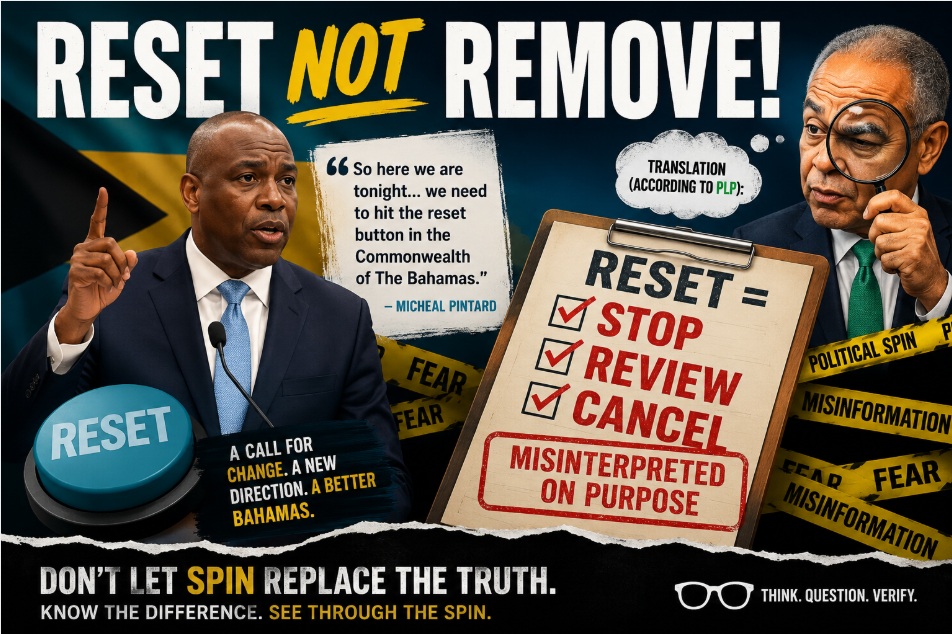
Apparently, in PLP translation services, “reset” doesn’t mean recalibrate, refocus, or rethink—it means grab the scissors, unplug the system, and cancel everything in sight.
When Michael Pintard said the country needs a reset, he was speaking in the broad, almost cliché language politicians have used for decades. But somehow, the PLP heard: “Ladies and gentlemen, we will now begin deleting government programs one by one.”
That’s not interpretation—that’s creative writing. And when presented as fact, it crosses the line from politics into pure misdirection.

Speculation dressed up as certainty
Then comes the second act: bold predictions with absolutely no receipt.
The Free National Movement has not laid out any documented plan to cancel specific programs in that statement. Yet the PLP speaks with the confidence of someone reading from a script that doesn’t exist.
If guessing were governance, we’d all be in excellent hands. But in reality, presenting speculation as settled fact is exactly the kind of behavior the PLP has become known for—especially when election season rolls around and imagination starts working overtime.

Fear for dramatic effect
And of course, no political performance is complete without a little suspense.
By tying this so-called “reset” to the idea that programs will disappear overnight, the PLP conveniently introduces a sense of panic: “Vote wrong, and everything you rely on vanishes.”
It’s a well-worn tactic—take a vague phrase, attach the worst possible outcome, and hope fear does the rest. Effective? Sometimes. Honest? That’s another matter entirely.

Let’s deal with reality for a moment
What can actually be said—without the theatrics—is simple:

  • Pintard’s statement points to a desire for change, not a demolition exercise.
  • It does not outline cuts, cancellations, or reviews—full stop. Suggesting otherwise requires a leap of imagination that would make a novelist proud.
  • The PLP’s version of events is political framing, not a quotation, not a policy, and certainly not confirmed fact.

So, what’s really going on?
The issue isn’t that the PLP responded—politics would be boring if they didn’t. The issue is that they’ve taken an opinion, polished it up, and are now trying to pass it off as gospel truth.

And that’s the real problem:
You can spin, you can interpret, you can even exaggerate—but at some point, you have to stop pretending your opinion is the same thing as reality.

The Progressive Liberal Party (PLP) fails for one reason; it is their nature.

END

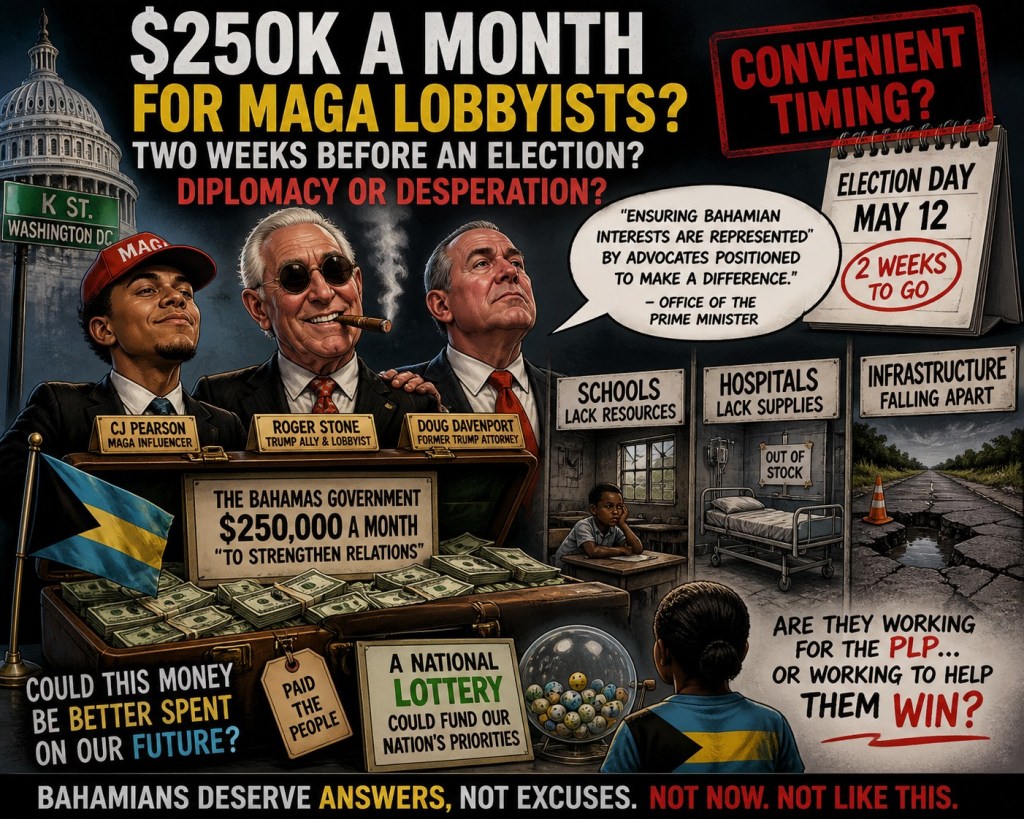
My Morning Paper – 5th May 2026 – Strengthening Relations… Just in Time for Election Day

It’s getting harder to tell whether this is governance or a last-minute campaign episode of “Scandal: Nassau Edition.” Because when a government signs off on a reported $250,000-a-month lobbying contract weeks before an election, the public is entitled to raise an eyebrow… and maybe the other one too.

Let’s deal with the facts first.

According to reporting by The Nassau Guardian, the administration of Prime Minister Philip Davis entered into a contract with U.S.-based firm DCI Group AZ to “strengthen relations” with the United States. Filings under the U.S. Foreign Agents Registration Act (FARA) reportedly list figures such as Coreco “CJ” Pearson, Roger Stone, and Doug Davenport as part of the lobbying effort.

So yes—the contract appears real. The price tag appears real. And the timing? Also, very real.

Now comes the part where the public is expected to nod politely and accept that this is all just routine business in “the best interest of the country.”

That’s a tough sell.

Because if “strengthening relations” with the United States is so critical, why does that urgency suddenly materialize two weeks before a general election? Were relations perfectly fine for the last four and a half years? Or did diplomacy, like roadworks and ribbon cuttings, just happen to peak right before voters head to the polls?

Even more puzzling is when these lobbyists weren’t hired.

When The Bahamas was pushing for action on climate vulnerability and access to green financing—particularly around carbon credit frameworks—there was no high-powered Washington lobby blitz.

When tensions arose over Cuban medical professionals and U.S. scrutiny complicated healthcare staffing, there was no emergency deployment of politically connected intermediaries to “uncomplicate” matters.

But now, suddenly, the cavalry has arrived—complete with American political operatives tied to the orbit of Donald Trump.

So naturally, people are asking: advocating for what, exactly?

Because at $250,000 per month, Bahamians are not unreasonable for expecting more than vague phrases like “strengthening relations.” That’s not a policy—that’s a brochure tagline.

And then there’s the opportunity cost.

At a time when:

  • Schools face resource gaps
  • Hospitals reportedly struggle with basic supplies
  • Infrastructure projects are being rushed to completion before election day

…we’re told that a quarter-million dollars per month for foreign lobbyists is the best use of public funds?

That’s not just questionable—it borders on theatrical.

One might even ask—purely as a thought exercise, of course—whether this contract is about national interest or political interest. Because the timing, the personalities involved, and the proximity to an election create a rather inconvenient perception problem.

And perception matters in politics. Sometimes more than reality.

This is where the opposition, led by Michael Pintard and the Free National Movement, has floated alternatives like a regulated national lottery as a revenue stream for public services. Whether one agrees or disagrees with that idea, it at least raises a broader question: should the country be exploring sustainable domestic revenue solutions instead of writing sizable monthly checks abroad under unclear circumstances?

Because if the goal is truly to strengthen The Bahamas, then investments in education, healthcare, and infrastructure tend to deliver far more visible returns than political consultants in Washington.

Unless, of course, the return being sought isn’t entirely national.

And that’s the question lingering in the background—quiet, persistent, and increasingly difficult to ignore:

Is this contract about improving The Bahamas’ standing internationally…
or improving someone’s standing electorally?

Because right now, the line between the two looks… conveniently blurred.

The Progressive Liberal Party (PLP) fails for one reason; it is their nature.

END

My Morning Paper 4th March 2026 – The  Billboard That Ate The Campaign

It seems Fred Mitchell and the ever-dramatic Progressive Liberal Party have found their latest blockbuster storyline — “The Billboard That Ate The Campaign.”

Apparently, in a country facing real issues, this sign has now been promoted to public enemy number one… complete with a full theatrical performance from the Bimini stage.

Mitchell would have you believe that the Free National Movement (FNM) is masterminding some grand, villainous billboard conspiracy. No evidence, no proof — just vibes, outrage, and a microphone. One might think CSI: Nassau has already wrapped the case.

But here’s where things get… interesting.

When accusations are flying this wildly, it’s usually worth asking a simple question: who actually benefits? Because while fingers are being pointed outward, the timing feels almost too convenient. Right as uncomfortable headlines begin to bubble up — like that eyebrow-raising chatter about hefty payments to a MAGA-linked lobbyist — suddenly, the nation must drop everything and focus on… a sign.

Coincidence? Maybe.

Or maybe this “offensive billboard” is less of an attack and more of a distraction — a shiny object tossed into the road to pull attention away from something far more politically inconvenient.

And let’s not ignore the possibility that the call may be coming from inside the house. Politics, after all, is not just a battle between parties — sometimes it’s a wrestling match within them. When a narrative emerges that paints the leadership as a victim while simultaneously stirring chaos, you have to wonder: is this about winning an election… or positioning for what comes after losing one?

Because if someone wanted to weaken the standing of the current leadership, embarrass them publicly, and create internal instability — all while blaming the opposition — this would be a rather creative way to do it.

But of course, that would require a level of political chess that goes beyond roadside signage… wouldn’t it?

Meanwhile, Mitchell spent what sounded like an entire rally not outlining solutions, not presenting vision, but shadowboxing with a billboard like it personally insulted him at breakfast. If this is the centrepiece of the campaign, one has to ask: where are the ideas?

It is rather interesting that Mitchell would even bring up Beaches and Parks, given the controversy of unanswered questions that they are caught up in but it appears that Mitchell has become desperate.

In the end, the Bahamian people are left watching a production where outrage replaces evidence, deflection replaces accountability, and suspicion hangs in the air thicker than the accusations themselves.

One thing is certain:

If this is the strategy, then the real message on display isn’t on any billboard — it’s the lengths some will go to control the narrative.

And that, more than anything, should have people asking questions.

The Progressive Liberal Party (PLP) fails for one reason; it is their nature.

END

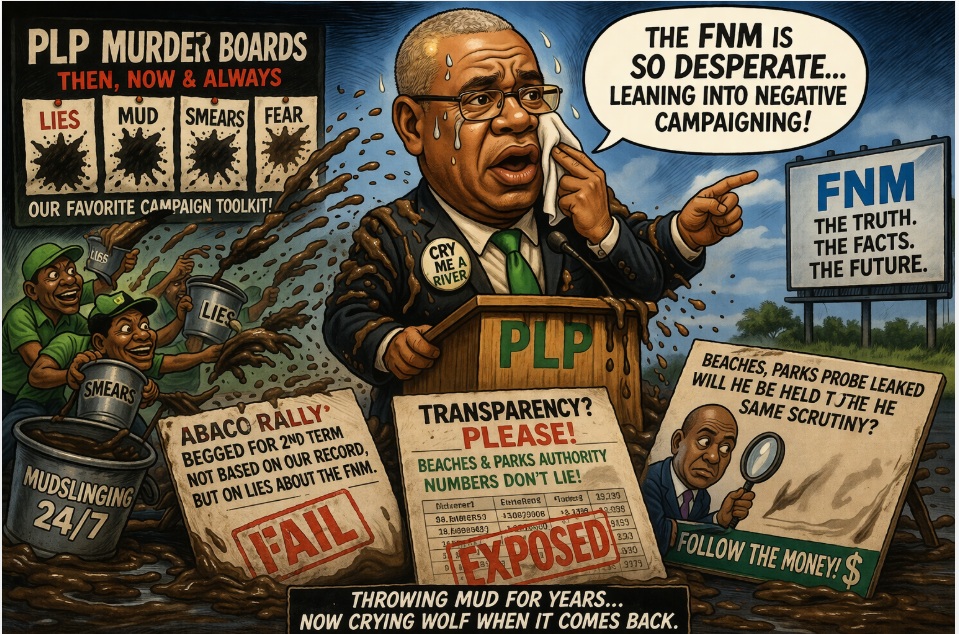
My Morning Paper – 27 Apr. 2026 – Crying Foul in a Game He Perfected

It seems the Chairman has suddenly discovered a most tragic affliction: selective outrage. One minute he’s cruising to the airport, the next he’s clutching his pearls over FNM billboards like they’ve committed some unprecedented crime against humanity. Apparently, in his world, political messaging only becomes “nasty” when someone else does it better.

His lament reads less like a statesman’s concern and more like a man shocked—shocked!—to find mudslinging happening in a game his own team practically invented. After all, this is the same PLP playbook that gave us years of relentless attacks in opposition, followed by an encore performance while in government. But now, suddenly, the tone is too harsh? The irony could power the entire national grid.

And let’s not pretend this is about “desperation.” If the FNM is leaning into negative campaigning, then by the Chairman’s own standard, they’re simply excelling at a craft the PLP has spent years perfecting. The only difference now is that the criticisms hitting the New Day PLP are landing a little too close to home—less fiction, more uncomfortable fact.

The Chairman’s call for a “vigorous and punchy defense” is particularly amusing. Translation: when they attack, it’s righteous; when others respond, it’s reckless. One might even admire the consistency—if not for the complete lack of self-awareness.

Take Abaco, for example. The recent rally wasn’t so much a presentation of achievements as it was a nostalgic tour of alleged FNM failures—many of which were generously seasoned with exaggeration, if not outright fiction. It worked once, and now the hope is lightning will strike twice, even as the island waits for tangible progress that never quite seems to arrive.

And then we arrive at the pièce de résistance: the claim of transparency. According to the Chairman, everything is “in plain sight.” Indeed—so plain, in fact, that the numbers themselves appear to be staging a quiet protest. If transparency were truly the hallmark of this administration, then the leadership at Beaches and Parks would be subjected to the same forensic-level scrutiny applied to others. Funny how accountability always seems to be a one-way street.

In the end, the Chairman crying foul over “nasty campaigning” feels less like a genuine concern and more like a seasoned boxer complaining about punches mid-fight—after years of throwing the first and hardest blows.

If nothing else, it’s a reminder: in politics, the loudest cries of victimhood often come from those most fluent in the art of attack.

The Progressive Liberal Party (PLP) fails for one reason, it is their nature.

END

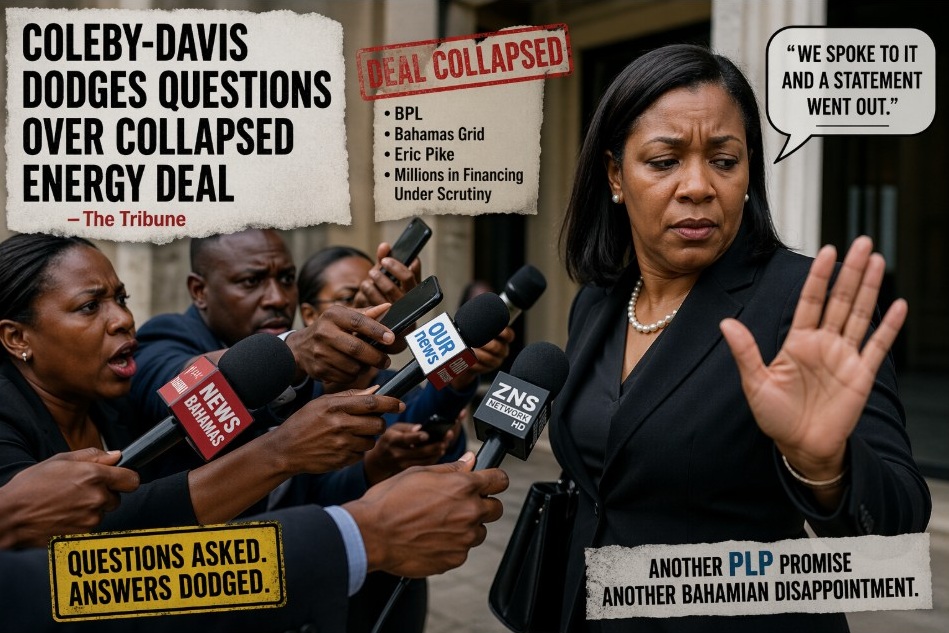
My Morning Paper – 24th April 2026 – Accountability Deferred, Transparency Denied

From the very moment JoBeth Coleby-Davis told Opposition Leader Michael Pintard that she would only answer his parliamentary questions if he first survived an internal leadership contest within the Free National Movement (FNM), the tone was set—not for accountability, but for deflection. It was a remark that revealed more about the government’s posture than any formal statement ever could. Years later, those questions remain unanswered, and the pattern has only deepened.

Now we arrive at the latest episode involving Bahamas Power and Light (BPL), Bahamas Grid Company, and the much-touted energy reform arrangement tied to U.S. executive Eric Pike. According to reporting from The Tribune, a deal described as central to modernizing New Providence’s grid has effectively unravelled less than two years into what was supposed to be a 25-year agreement. When pressed, Minister Coleby-Davis offered little more than a rehearsed line — “a statement went out”—before cutting off further inquiry.

That is not transparency. That is choreography.

The government’s attempt to rebrand what appears to be a breakdown as a “transition” follows a now-familiar script. Bahamians have seen this before, most notably with the Our Lucayan situation in Grand Bahama, where optimistic framing was used to soften hard realities. In this case, the public is again being asked to accept reassurance in place of explanation, confidence in place of clarity.

But the facts, as presented, raise legitimate concerns. A key partner has exited. A flagship agreement has faltered prematurely. Millions in financing are under scrutiny. Yet, the level of detail provided to the public remains minimal, controlled, and carefully filtered.

This is where the broader criticism of the Progressive Liberal Party (PLP) finds its footing—not in partisan rhetoric, but in observable governing habits. The administration campaigned heavily on accountability and transparency, presenting these as cornerstones of its mandate. However, instances like this BPL matter, alongside others such as the Beaches and Parks controversy, suggest a governing style that prefers managed messaging over open scrutiny.

Even when responses are eventually given, they often generate more questions than answers—sometimes contradicting earlier positions or introducing new ambiguities. Press engagements become limited. Questions are deflected. And substantive engagement is replaced with carefully staged communication.

It creates the impression of a government more comfortable speaking at the public than to it.

The irony is hard to ignore. The same administration that once championed a “Blueprint for Change” now promotes a “Blueprint to Progress.” But progress, by any reasonable standard, requires measurable outcomes, clear communication, and public trust built on transparency—not semantics.

So, the question naturally follows: what exactly constitutes this “progress”?

Because for many observers, the list of unanswered questions—from Parliament to press briefings to national projects—continues to grow. And until those questions are met with direct, consistent, and verifiable answers, the gap between promise and practice will remain impossible to ignore.

The Progressive Liberal Party (PLP) fails for one reason; it is their nature.

END

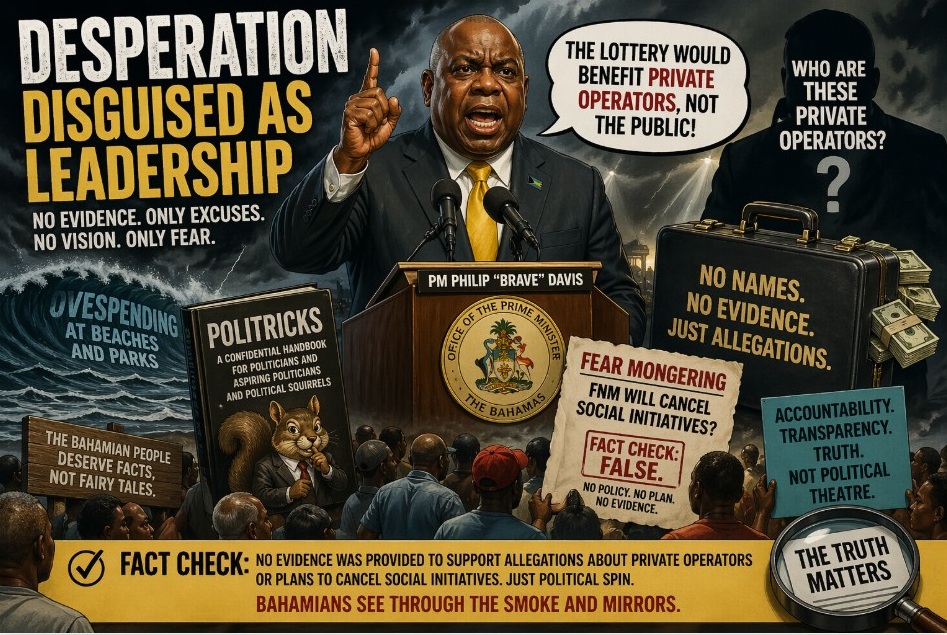
My Morning Paper- 22 April 2026 – A Desperate Plea from a Desperate Man – Midweek Edition

On Monday night, Philip Davis took to the national stage—not to clarify policy, not to account for governance, but to mount what can only be described as a carefully dressed act of political desperation. This came, of course, after sidestepping growing public concern over issues like reported overspending within Beaches and Parks—matters that demand transparency but instead receive theatrical deflection.

Prime Minister Davis ran the full gamut of what Bahamians have come to recognize as “politicks”: a blend of insinuation, selective outrage, and a not-so-subtle pivot into fearmongering. The irony is almost too neat. While referencing the satirical book Politricks – “A Confidential Handbook for Politicians and Aspiring Politicians and Political Squirrels”, the Prime Minister and his Progressive Liberal Party seem less amused by its humour and more committed to turning its caricature into governing strategy—weaponizing satire against Michael Pintard while embodying its very lessons.

A headline from The Tribune reads: “Davis: Lottery would benefit private operators rather than public.” It is a striking claim—serious, consequential, and notably unsupported by any publicly presented evidence. The Prime Minister asserts that the Free National Movement’s (FNM’s) proposal for a national lottery would enrich unnamed “private operators” at the expense of the Bahamian people. But who are these operators? Where is the documentation? What contractual framework is being referenced?

In the absence of specifics, the accusation reads less like policy critique and more like a calculated attempt to seed suspicion and fear. If such a claim were grounded in fact, it would demand immediate disclosure and national scrutiny. Instead, Bahamians are left with an allegation suspended in midair—heavy enough to alarm, but too vague to verify.

Equally concerning is the Prime Minister’s pivot into familiar territory: fear. The suggestion that a future FNM administration would dismantle social initiatives such as the National School Breakfast Programme or the National Youth Guard is a serious charge. Yet, again, no direct policy statements, manifesto excerpts, or verifiable commitments have been cited to substantiate this claim. Political debate is expected; unsubstantiated warnings presented as inevitabilities are something else entirely.

This raises an uncomfortable question: who, exactly, is being “desperate” here?

The Davis administration has been quick to label the Opposition as such. Yet the pattern on display tells a different story—one where allegations are made without evidence, and hypothetical rollbacks are presented as certainties. That is not the language of confidence; it is the language of a campaign searching for traction.

The Prime Minister also took aim at Michael Pintard’s leadership, suggesting he is unable to command his party. This line of attack appears rooted in internal political shifts—members who have chosen to depart. But political parties, by their nature, evolve. Individuals make decisions, alliances shift, and leadership is ultimately measured not by unanimity but by the confidence of those who remain. By that standard, the FNM’s base continues to signal its support.

What remains unanswered, however, is perhaps more telling than what was said. If the government opposes a national lottery so vigorously, whose interests are being protected? The Bahamas already operates within a legalized gaming environment—one in which domestic “number houses” function openly. The question is not whether gaming exists, but how it is structured, regulated, and who ultimately benefits. Opposition to reform, without clarity, invites scrutiny.

As PLP supporters hung on the Prime Minister’s every word at the rally, the scene may have felt energizing in the moment. But beyond the applause, beyond the rhetoric, the substance was thin. What emerged was not a roadmap for governance, but a portrait of a government leaning heavily on accusation and apprehension—hoping, perhaps, that one will compensate for the absence of the other.

In the end, the “wave” the Prime Minister referenced may indeed be real—but not in the way he intended. It is a wave of public frustration, built not on opposition slogans, but on unanswered questions, unmet expectations, and a growing impatience with politics that substitutes clarity with conjecture.

And if that wave is now turning, it is not because of what the Opposition has done—but because of what the government has failed to convincingly explain.

The Progressive Liberal Party (PLP) government fails for one reason; it is their nature.

END