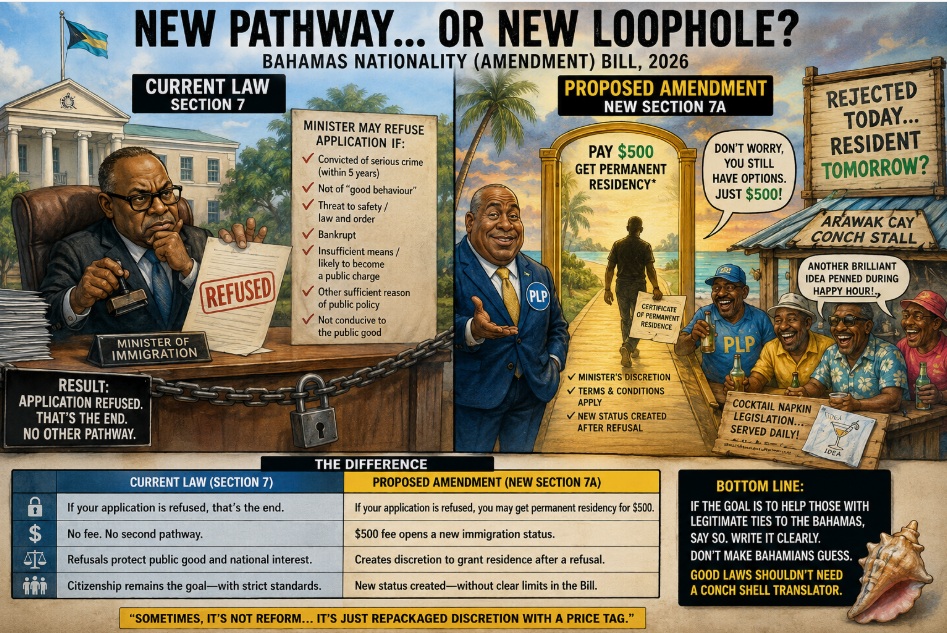
My Morning Paper – June 4th, 2026 – The Language of it all – A New Pathway or a New Loophole? Examining the Bahamas Nationality (Amendment) Bill, 2026

Yesterday, much of the political attention was focused on headlines surrounding the Free National Movement’s decision regarding its 2026 convention. Predictably, that story was seized upon by supporters of the governing Progressive Liberal Party (PLP) as evidence of turmoil within the Opposition.

However, buried beneath the political theatre was another headline that arguably deserved far greater scrutiny: proposed amendments to the Bahamas Nationality Act that would create a new pathway to permanent residency.

Unlike convention politics, immigration and nationality laws have consequences that can endure for generations.

So let us examine what the law currently says and what the proposed amendment would change.

Where We Are Now;

Section 7 of the Bahamas Nationality Act deals with persons who are constitutionally entitled to apply for Bahamian citizenship through registration. These include categories such as persons born in The Bahamas to non-Bahamian parents who apply within the constitutional window, certain spouses of Bahamians, and persons born abroad to Bahamian mothers in circumstances recognized by the Constitution.

The current law provides that the Minister may refuse an application where there are concerns relating to criminal convictions, public policy, national security, good character, financial self-sufficiency, bankruptcy, or other reasons deemed contrary to the public good.

In other words, while the Constitution may create an entitlement to apply, the Minister retains discretion in certain circumstances to refuse registration where legitimate public interest concerns arise.

What The Amendment Appears to Do;

The Bahamas Nationality (Amendment) Bill, 2026 proposes the creation of a new Section 7A.

The proposed provision would allow the Minister, after refusing a citizenship application under Section 7, to grant the applicant a certificate of permanent residence upon payment of a $500 fee and subject to any terms and conditions the Minister considers appropriate.

That is a significant departure from the existing framework.

Under the current system, a refused citizenship application remains exactly that — refused.

Under the proposed amendment, a refusal could potentially become the gateway to another immigration status entirely.

That is not merely an administrative adjustment. It is a substantive policy change.
Is This Progressive?

Potentially, yes.

If the government’s objective is to assist persons who have legitimate constitutional connections to The Bahamas, but who missed application deadlines or encountered technical barriers, then creating a pathway to permanent residence could be viewed as a practical and humane reform.

For example, there have long been concerns about persons born in The Bahamas to non-Bahamian parents who miss the narrow constitutional application window between ages 18 and 19. Article 7 of the Constitution provides that entitlement, but the deadline is strict.

A carefully drafted permanent residency pathway could help address those situations without automatically conferring citizenship.

Many jurisdictions create intermediate statuses between temporary residence and citizenship.

If that is the policy objective, it could arguably be considered a progressive reform.

The Problem: The Bill Does Not Explicitly Say That

Here is where questions arise.

If the intention is to assist persons who missed constitutional deadlines or who risk becoming long-term residents without status, why does the amendment not expressly state that?

Instead, the wording appears broader.

As currently described, the proposed Section 7A would apply after a citizenship application has been refused under Section 7.

That naturally raises an important question:

If an applicant is refused because of concerns relating to public policy, national security, criminal conduct, insufficient means of support, or other factors deemed contrary to the public good, why should that same refusal immediately qualify the applicant for consideration for permanent residency?

The bill, at least from the language currently reported, does not clearly distinguish between administrative refusals and substantive refusals.

Nor does it appear to specify that the provision is limited to persons who missed constitutional deadlines.

If that limitation exists, it should be clearly stated.

Good legislation should not require citizens to guess at the government’s intentions.

The Constitutional Question

There is another issue.

For decades, many Bahamians have argued that the more pressing nationality reform remains constitutional equality.

The Constitution still contains provisions that prevent Bahamian women from passing citizenship in the same manner as Bahamian men in certain circumstances. These provisions have been the subject of multiple constitutional reform efforts.

If the objective is to resolve long-standing nationality inequities, many would argue that constitutional reform remains the more direct and comprehensive solution.

Permanent residence and citizenship are not the same thing.

Permanent residence allows an individual to live in The Bahamas indefinitely, but it does not confer the full rights and privileges of citizenship.

The Bottom Line

The government may well have identified a genuine problem.

The challenge is that the proposed solution, as currently described, appears broader than the problem it claims to solve.

If the intention is to protect persons who have strong constitutional claims to belong in The Bahamas, then the legislation should say so clearly.

If the intention is to create a discretionary pathway from rejected citizenship applications to permanent residency, then Bahamians deserve a fuller explanation of why that authority is necessary and how it will be exercised.

Because when legislation requires lengthy explanations from ministers, party officials, and social media defenders to explain what it “really means,” that is often a sign that the drafting itself has failed the clarity test.

And once again, the PLP finds itself defending a bill that raises more questions than it answers.

The government insists the amendment is straightforward.

The public is left reading the text and wondering whether the legislation was carefully crafted by policy experts—or hastily scribbled on the back of a cocktail napkin somewhere between happy hour and closing time at Arawak Cay.

The Bahamian people deserve better.

END
My Morning Paper- 01st June 2026 – The Curious Priority List of Fred Mitchell

Earlier in the day, there was a serious question to be asked about governance.

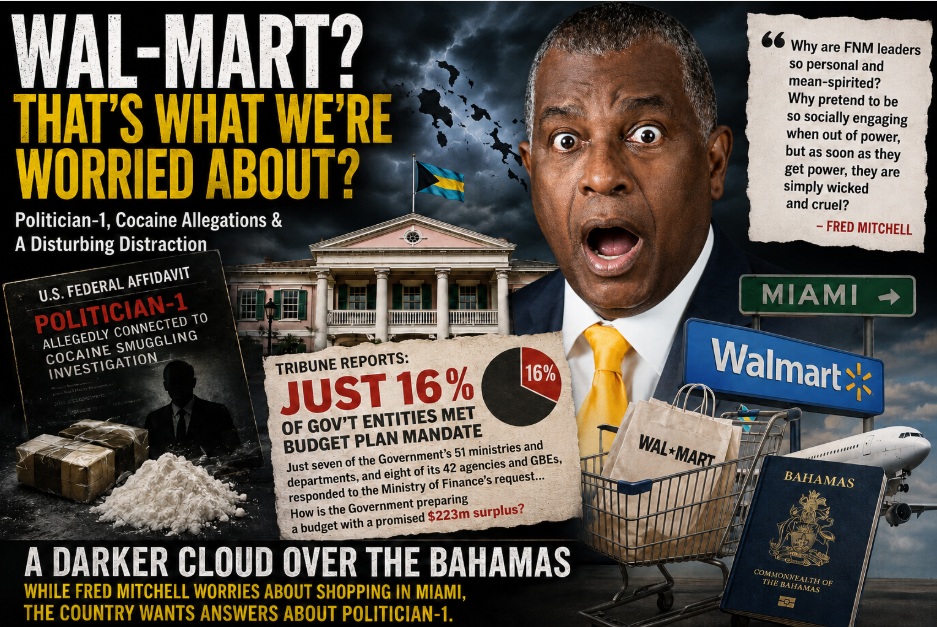
According to reporting in The Tribune, only 16 percent of government ministries, departments, agencies and government business entities reportedly complied with requests to submit the plans and documentation required to assist with preparation of the 2026-2027 Budget.

That alone should raise eyebrows. If only a fraction of government entities are providing the information required under the Public Finance Management Act, then it is reasonable to ask how officials are arriving at precise projections, including the Government’s promised $223 million surplus.

But that is not the issue that appears to have captured the attention of Progressive Liberal Party Chairman Fred Mitchell.

No. In the middle of a controversy involving allegations contained in a U.S. federal affidavit that references a mysterious “Politician-1,” Mr. Mitchell has apparently decided that the pressing national concern is whether Bahamian politicians will be able to travel to Miami and shop at Wal-Mart.

Read that sentence again.

A document tied to an international cocaine-trafficking investigation has cast a shadow over Bahamian politics. Questions are being asked around the world. International media outlets have reported on the matter. Citizens are demanding transparency. Yet somehow the conversation is being redirected toward retail excursions and visa hypotheticals.

One might have expected outrage over allegations that could potentially tarnish the reputation of The Bahamas.

One might have expected demands for clarity.

One might have expected concern about whether a sitting politician could be connected to a criminal network.

Instead, the country is being treated to a lecture about shopping.

The badges worn by FNM Members of Parliament stating that they are “not Politician-1” were clearly intended to draw attention to a question that remains unanswered: who exactly is Politician-1?

Whether one agrees with the tactic or not, the underlying issue is obvious. The public is not focused on Wal-Mart. The public is focused on whether a Bahamian politician is being referenced in connection with allegations involving cocaine smuggling.

That is the cloud hanging over the country.

That is the headline attracting international attention.

That is the story affecting confidence in public institutions.

Yet Mr. Mitchell appears more concerned about speculative consequences to travel than addressing the far more damaging possibility that a Bahamian political figure could be linked—at least through allegations contained in a law-enforcement affidavit—to a major criminal enterprise.

The irony is remarkable.

If there is anything capable of damaging The Bahamas’ reputation internationally, it is not opposition politicians asking questions.

It is the unanswered questions themselves.

And while Mr. Mitchell accuses others of being “personal” and “mean-spirited,” many Bahamians may find themselves wondering why the focus seems to be on attacking those demanding answers rather than helping provide them.

After all, concerns about who may or may not shop at Wal-Mart seem rather small when compared to allegations involving international cocaine trafficking.

The real question is not whether Bahamians can visit Miami.

The real question is why some people appear determined to discuss everything except the identity of Politician-1.

And the longer that question goes unanswered, the larger the shadow grows.

The Progressive Liberal Party (PLP) government fails for one reason; it is their nature.

END

My Morning Paper May 29th, 2026 – The Affidavit, The Fake Outrage, and The Deflection

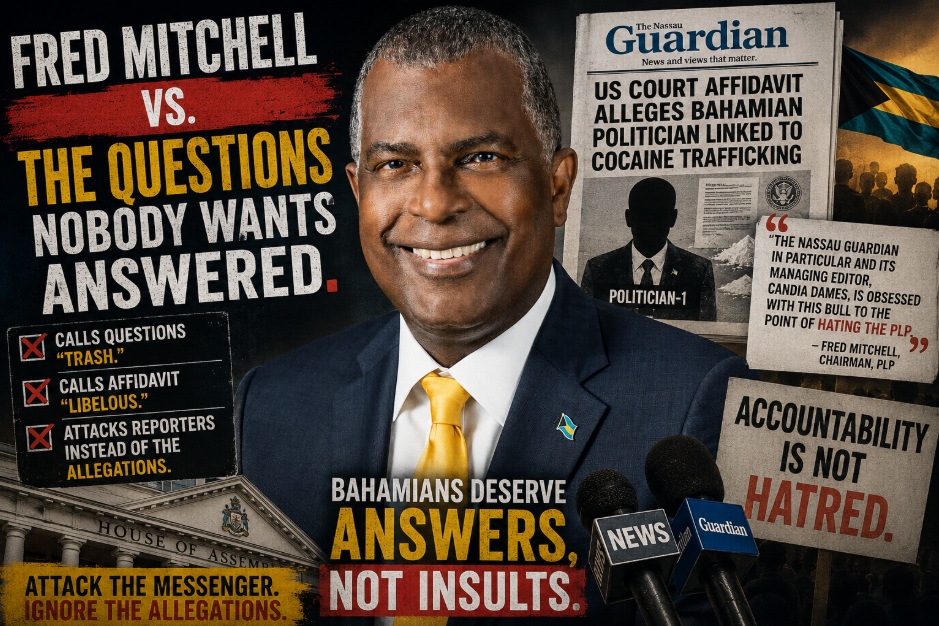
Fred Mitchell’s latest outburst over questions surrounding a United States court affidavit is yet another example of a veteran politician mistaking scrutiny for persecution and journalism for political sabotage.

Speaking outside the House of Assembly, Mitchell dismissed reporters’ questions regarding the affidavit as “trash questions” and described the document filed in a U.S. federal court as “certainly libelous.” He then launched into a familiar performance: attacking the media, attacking the opposition, and in particular targeting Candia Dames of The Nassau Guardian for daring to ask questions that many Bahamians themselves are asking.

What is remarkable here is not that journalists are investigating the matter. That is literally their job. What is remarkable is that the sitting chairman of the Progressive Liberal Party (PLP) appears more outraged by public discussion of the allegations than by the allegations themselves.

The affidavit in question reportedly references “Politician-1” in connection with an alleged conspiracy involving cocaine trafficking. That is not some random Facebook rumour created in somebody’s WhatsApp group chat. It is a sworn filing made before a court in the United States. Whether the allegations are ultimately proven true or false is a matter for due process and evidence, but any reasonable person would understand why such claims involving a Bahamian political figure would attract enormous public interest.

Yet instead of calmly encouraging transparency, accountability, and cooperation with any lawful investigations, Mitchell has decided to go to war with reporters and critics. Apparently, in today’s PLP, asking questions is “hatred,” journalism is “obsession,” and public concern is somehow the real scandal.

If Mitchell truly believes the affidavit is defamatory and completely fabricated, then he has legal remedies available to him and others. Courts exist for precisely that purpose. But instead of threatening the actual parties responsible for the filing, Mitchell seems far more comfortable lashing out at local journalists whose only crime is informing the public. It is difficult not to notice the contradiction.

Candia Dames did not file the affidavit. The Nassau Guardian did not draft the allegations. The Free National Movement (FNM) did not swear the statements before an American court. Reporting on a matter of major public concern is not evidence of political hatred. It is evidence that journalism still exists in this country despite the obvious discomfort of some politicians.

Mitchell’s response also highlights a deeper and increasingly troubling political culture where criticism is automatically framed as conspiracy, and scrutiny is treated as betrayal. Instead of addressing the substance of concerns, the strategy becomes attack the messenger, insult the media, and hope loyal supporters clap loudly enough to drown out the questions.

At times Mitchell’s performance sounded less like the measured response of a statesman and more like someone deeply frustrated that the public is refusing to simply “move along” from allegations connected to drug trafficking and political influence. Bahamians are not wrong for demanding answers. In fact, they would be irresponsible not to.

The reality is simple: allegations involving narcotics trafficking and political connections are serious matters in any democracy. They cannot be laughed away, insulted away, or shouted away at a press scrum outside Parliament.

Fred Mitchell may view these questions as inconvenient. The Bahamian people view them as necessary.

And perhaps that is the real source of his frustration.

The Progressive Liberal Party (PLP) fails for one reason; it is their nature.

END

My Morning Paper- 27th May 2026 – PMH Suddenly Matters Again… Conveniently After a Second Election Victory

Today, the people of the Commonwealth of The Bahamas are apparently expected to rejoice as though a brand-new Minister of Health has just descended from the heavens in the person of Dr. Michael Darville.

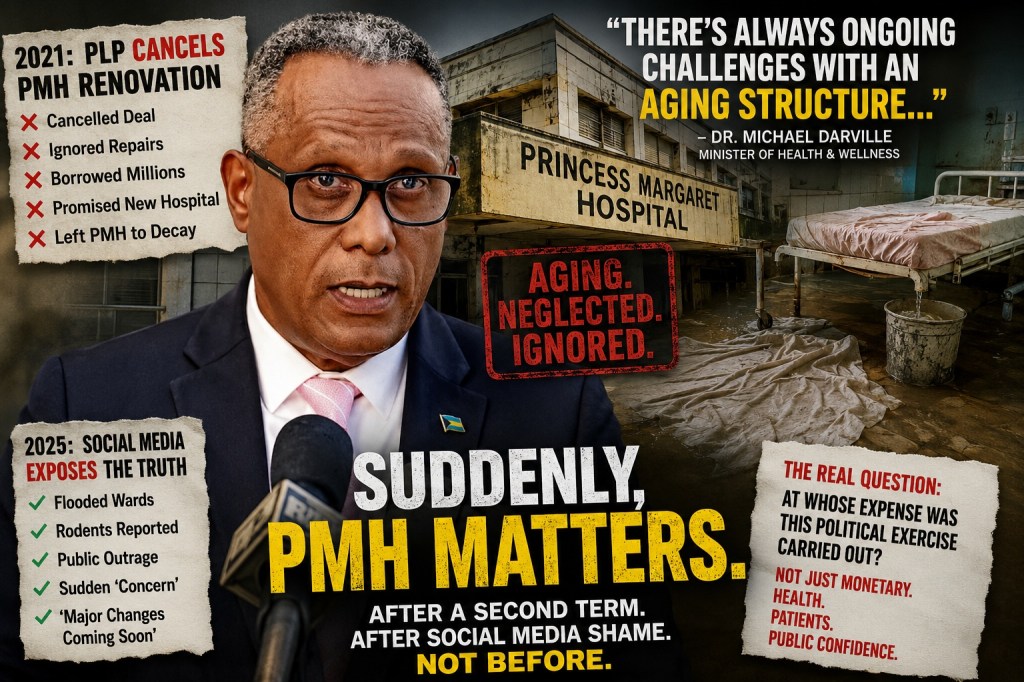
One could be forgiven for assuming this is Dr. Darville’s very first week on the job given the latest declarations that Princess Margaret Hospital (PMH) is an “aging structure” in desperate need of repairs and “major changes.”

Because naturally, after nearly five years in office, this shocking revelation has only now been discovered.

According to The Nassau Guardian, Dr. Darville recently promised that “major changes” are coming to PMH after viral photographs circulated online showing deplorable conditions inside the hospital, including flooding reportedly being soaked up with bed sheets and allegations of rodents inside a ward.

The minister stated:

“There’s always ongoing challenges with an aging structure…”

An astonishing discovery indeed.

One almost wonders whether PMH only became an aging structure after the photographs began circulating on social media. Perhaps the leaks, deterioration and complaints were invisible before Facebook got involved.

The truly remarkable part is not that PMH needs repairs. Bahamians have known this for years. The remarkable part is the political amnesia now on display.

When the Progressive Liberal Party (PLP) returned to office in 2021 under the slogan “A New Day,” many Bahamians understandably believed this would include urgently addressing the country’s primary public hospital. Instead, one of the first major healthcare decisions made by the new administration was to cancel the Minnis administration’s planned redevelopment and renovation agreement for PMH.

At the time, the PLP argued that it wanted to review the arrangement and pursue a broader healthcare vision, including plans for a new specialty hospital. The optics were excellent. The press conferences were polished. The promises were ambitious.

Unfortunately, leaking ceilings are apparently unimpressed by optics.

While government officials spoke grandly about “transformational healthcare,” PMH continued to deteriorate in real time. Bahamians continued sitting in overcrowded clinics. Patients continued enduring conditions unworthy of a modern healthcare system. Staff continued working under increasingly difficult circumstances. And now, after securing a second consecutive term in office and after social media outrage forced public attention back onto PMH, the administration has suddenly rediscovered urgency.

Now the public is being told funding has been allocated. Now repairs are being prioritized. Now “major changes” are coming soon.

Soon.

That magical political word that always seems to arrive after elections instead of before them.

What many right-thinking Bahamians are now asking is painfully simple: if these repairs were so necessary today, why were they not treated as urgent in 2021? Why cancel an existing renovation path only to circle back years later to the exact same reality everyone already understood — that PMH was collapsing under age, neglect and deferred maintenance?

And perhaps the most uncomfortable question of all is this: at whose expense was this political exercise carried out?

Not merely monetary expense.

Health expense.

Patient expense.

Public confidence expense.

Because while governments conduct reviews, issue talking points and rehearse slogans about “vision,” ordinary Bahamians are the ones sitting in flooded wards waiting for healthcare in a system everyone acknowledges is failing.

The tragedy is not that PMH is old. The tragedy is that it apparently took viral embarrassment and a second election victory for the government to publicly behave as though the condition of the country’s primary hospital was finally worth serious attention.

Just shameful.

The Progressive Liberal Party (PLP) government fails for one reason; it is their nature.

END

My Morning Paper- 26th May 2026 – Fred Mitchell and The Nothing Berger

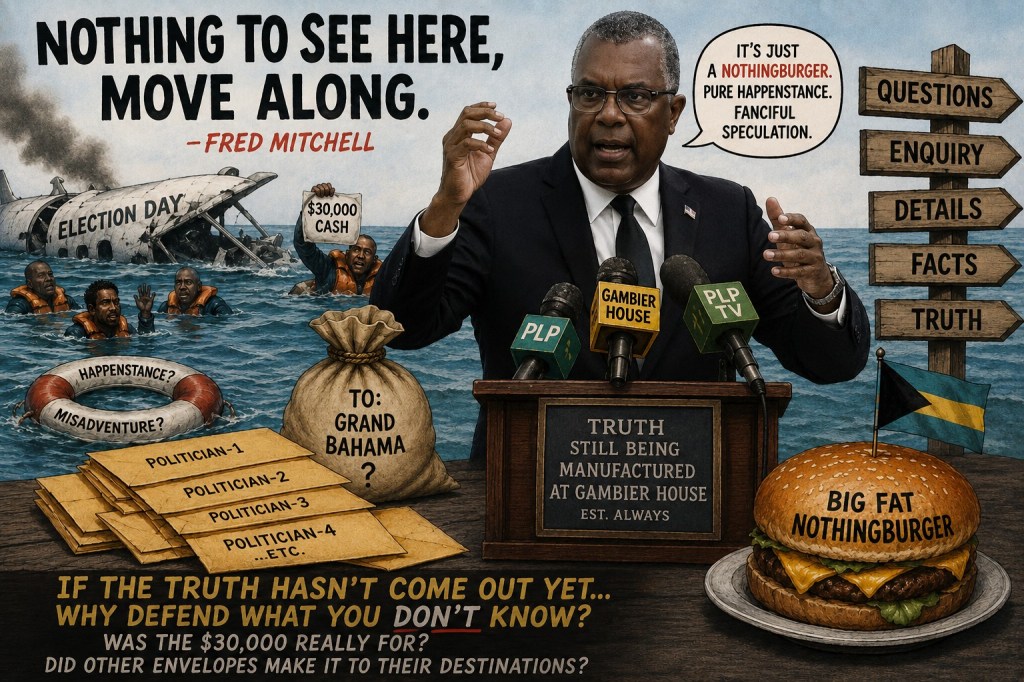
Fred Mitchell and the art of the political “nothingburger” may deserve its own national heritage designation at this point. Because when faced with a story involving a plane crash on election day, political supporters aboard, cash in transit, and a passenger later facing serious U.S. allegations, the official response apparently is, move along everyone, absolutely nothing to see here.

One almost must admire the confidence.

According to reports, Fred Mitchell dismissed the Election Day plane controversy as a “nothingburger,” reducing concerns to mere “happenstance,” “misadventure,” and what he called fanciful speculation from political opponents.

And that is where things become fascinating.

Because if this entire affair is such an obvious nothing, if it is all so self-evidently innocent, if there is absolutely no story here at all — then why does Mr. Mitchell sound like a man passionately defending conclusions that he simultaneously insists nobody truly knows yet?

That is quite an impressive balancing act.

On one hand: No one knows the full facts.

On the other hand: Trust me, there is definitely nothing there.

It is political quantum mechanics. The controversy both exists and does not exist at the same time — until observed.

And perhaps that is the central question here.

If the truth, as Mr. Mitchell himself suggests, has not yet fully emerged, then what exactly is being defended? Is this certainty based on evidence the public has not seen? Divine revelation? Political instinct? Or perhaps the famous Gambier House Early Detection System, capable of identifying a “nothingburger” long before inconvenient questions arrive.

Because ordinary people might ask rather simple things:

What exactly was the purpose of the reported $30,000 being transported on Election Day?

Why was it being moved?

And perhaps most importantly: if public concern is supposedly ridiculous, why object to calls for a proper inquiry that could settle the matter once and for all?

Because inquiries are strange things. They have an unfortunate habit of replacing speculation with facts.

And then there are the questions that make political strategists suddenly discover urgent appointments elsewhere.

If one envelope reportedly had a politician’s name attached to it, are Bahamians unreasonable for wondering whether there were others? Were there additional deliveries? Additional recipients? Additional intended destinations?

Notice: asking a question is not making an accusation.

It is called curiosity.

And curiosity tends to appear whenever a story contains an election day, a plane crash, cash, political associations, and a controversy serious enough to dominate public discussion.

The irony here is that Mr. Mitchell closes by saying he believes this will become “a big fat nothingburger when the truth comes out.”

An interesting statement.

Because if the truth has not yet come out, then perhaps political leaders should be slightly less enthusiastic about issuing definitive conclusions before the facts arrive.

Otherwise, it begins to look less like defending the truth and more like reserving a table for it before it shows up.

And Bahamians have seen enough politics to know the difference.

The people voted for PROGESS, is tis what it looks like under a Progressive Liberal Party (PLP) government?

END

My Morning Paper – 21st May 2026 – Iran–Contra, Bahamian Style? Questions That Refuse to Stay Buried

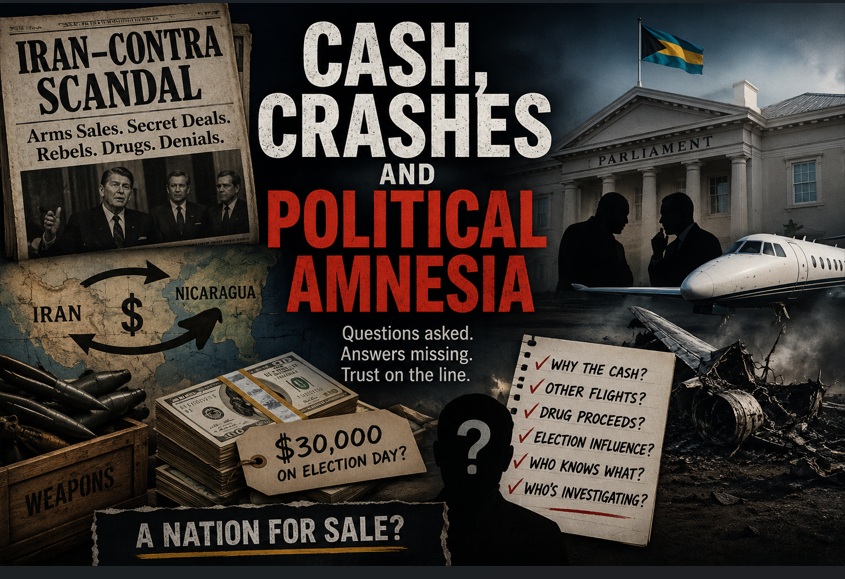
The Iran–Contra affair remains one of history’s more astonishing examples of what happens when governments decide rules are more like “general suggestions.” During the administration of Ronald Reagan, senior U.S. officials secretly facilitated arms sales to Iran—despite public positions and restrictions that made such dealings politically explosive. Proceeds from those sales were then diverted to support the anti-communist Contra rebels in Nicaragua. That part is not conspiracy theory; it is historical fact.

And because apparently one scandal simply wasn’t enough, allegations later emerged that elements associated with the Nicaraguan Contras had links to cocaine trafficking. Multiple investigations followed. Reports—including findings from inspectors general and congressional inquiries— concluded there was evidence that individuals connected to the Contra movement had engaged in drug trafficking activities, though the extent of knowledge or involvement by senior U.S. officials remained heavily disputed and politically contested.

So, to summarize this remarkable chapter of political creativity: weapons moved one direction, money moved another direction, anti-communist rebels were funded, drug allegations surfaced, and for years everyone involved seemed engaged in an Olympic-level relay race of finger-pointing.

Which brings us to the Bahamas—because apparently political discomfort travels internationally.

Recently, a criminal complaint filed in a U.S. court alleged that a Bahamian politician met with a drug trafficker and a cooperating source in Parliament in October 2024 to discuss a possible $30 million drug transaction. Those allegations became even more unsettling after reports surrounding a plane crash and allegations that an individual associated with that matter allegedly had approximately $30,000 on his person on Election Day.

Now before anyone rushes to the nearest podium to scream “misinformation,” a few distinctions matter: allegations are not convictions; criminal complaints are not findings of guilt; and accusations alone do not establish facts. Those distinctions matter in every democracy and something that the PLP and its sycophants should have remembered as they attacked Marvin Dames.

But here is where the political choreography becomes fascinating. Citizens ask questions, and instead of answers they often get what appears to be the governmental equivalent of waving car keys in front of a distracted toddler.

Because right-thinking Bahamians are left asking questions that are neither outrageous nor unreasonable:

Why was someone allegedly traveling with such a large amount of cash on Election Day?

Were there additional flights or movements that escaped detection?

Have investigators fully accounted for what happened?

And perhaps most importantly: have all legitimate concerns been pursued with the seriousness they deserve?

Notice what is not being asked here. No one is claiming proven drug proceeds financed an election. No evidence publicly establishes that conclusion. But when allegations involving politicians, drug traffickers, large sums of money, and Election Day timelines all begin appearing in the same sentence, citizens are not irrational for wanting more than blanket dismissals and offended expressions.

Because history offers an uncomfortable lesson. Public confidence rarely collapses from the scandal itself. It collapses from the suspicion that powerful people seem far more interested in managing perception than confronting facts.

And that leaves a larger concern: what do foreign investors see?

Do they see a country confronting allegations openly and transparently? Or do they see a nation where difficult questions are treated like uninvited guests at a political fundraiser?

Because reputations are fragile things. They take decades to build and moments to damage.

And no country wants old labels revived.

Especially not one as haunting as “A Nation For Sale.”

END

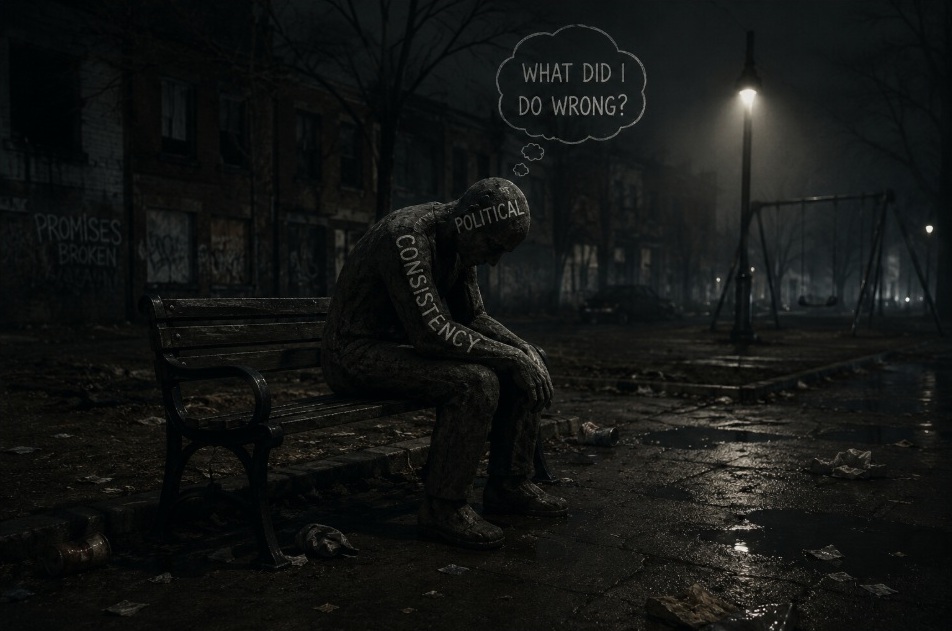
My Morning Paper May 20th, 2026 – Political Consistency Is Sitting Alone on a Park Bench – Dying

There are political pivots, there are political U-turns, and then there is whatever acrobatic event the Chairman of the Progressive Liberal Party (PLP), Fred Mitchell, has just performed. At this point, Olympic judges may need to create an entirely new scoring category: Synchronized Deflection with Advanced Spin Rotation.

In his latest production, Mitchell assures us that criticism from the opposition is proof that democracy is alive and well. Which is true, of course. Criticism in a democracy is normal. But then, in a move so sudden it could cause political whiplash, he immediately abandons discussing the criticism itself and launches into what appears to be an emergency change of subject.

Because apparently concerns over cabinet appointments and the size of government are not really the issue. No, no. The real issue—according to Mitchell—is whether Michael Pintard should continue leading the opposition and why Shanendon Cartwright is “out in the cold.”

Ah yes. The oldest move in the political handbook: “Please ignore the house fire and focus instead on whether the neighbour trimmed his hedges properly.”

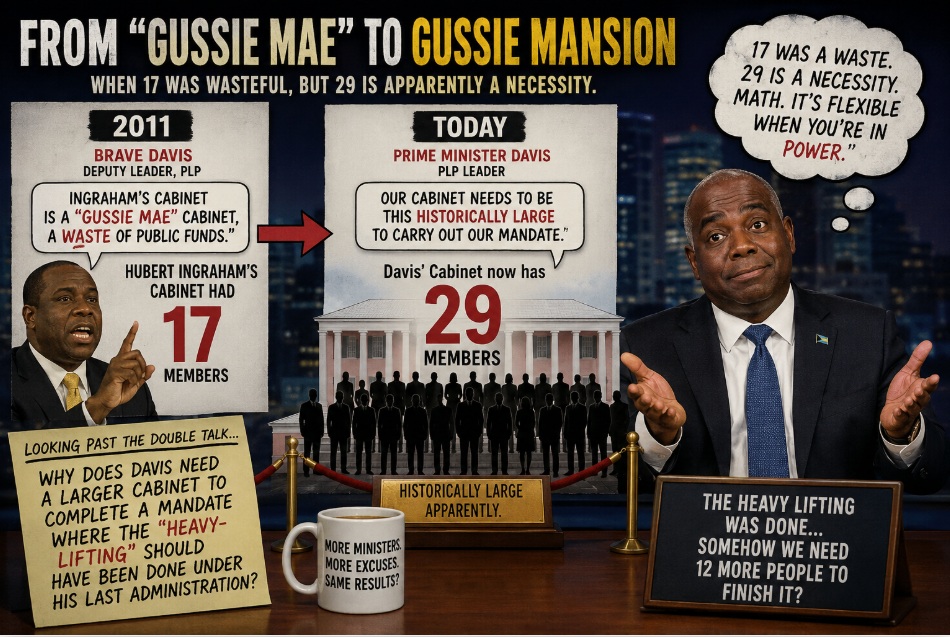
And speaking of cabinet size, one almost has to admire the confidence. Not long ago, Prime Minister Philip Davis famously criticized the FNM’s larger cabinet arrangements and invoked the now legendary phrase “Gussie Mae Cabinet,” arguing such expansion represented unnecessary spending and waste of taxpayer money.

Back then, large cabinets were apparently symbols of reckless excess. Today? Apparently, they’re symbols of visionary governance. Somewhere out there, political consistency is sitting alone on a park bench asking itself what it did wrong.

And let’s pause for a moment to appreciate the evolution here. Yesterday: “Too many ministers? Wasteful!” Today: “Too many ministers? Nation-building!” Tomorrow perhaps: “Actually, every Bahamian should receive a ministerial title.”

Then there is the question critics continue to raise regarding the concentration of executive appointments among governing members. Opponents argue that assigning executive roles broadly among elected members can create the appearance of reducing internal dissent or minimizing independent voices. Supporters, naturally, would likely frame it as ensuring broad participation in governance. But it remains a legitimate political question—and one worthy of discussion.

Instead, Mitchell pivots back toward opposition personalities and internal FNM dynamics, appearing to suggest division and dysfunction elsewhere. Yet there remains a rather large topic still hovering over the national conversation—the political equivalent of an elephant standing in the middle of the room wearing a fluorescent vest and setting off smoke alarms.

Because no matter how many side quests are introduced by Mitchell, many people are still asking the same question:

Can we get back to the issue everyone was discussing yesterday the day before and maybe even five minutes ago – WHO IS POLITICAN-1?

The remarkable thing is not disagreement—that’s politics. The remarkable thing is the speed. Less than a week after an election victory, the national conversation somehow already feels like we’ve skipped three seasons ahead and landed directly in the episode titled: “Distraction: The Reboot.”

And perhaps that is the most astonishing thing of all: not that criticism exists, but that the response sometimes appears to be less, “Let’s answer the concern,” and more, “Quick — release another shiny object.”

The Bahamas deserves better.

END

My Morning Paper 19th May 2026 – Economists Shocked to Learn 29 Is Smaller Than 17 in Political Math

Back in 2011, Philip “Brave” Davis, then Deputy Leader of the PLP, took aim at former Prime Minister Hubert Ingraham’s Cabinet and branded it a “Gussie Mae” Cabinet — a phrase intended to suggest something bloated, oversized, and unnecessarily expensive. He went further, calling it “a waste of public funds.”

Strong words. Especially considering that at the time Hubert Ingraham’s Cabinet consisted of 17 members.

Fast forward to today, and the Progressive Liberal Party (PLP) government now boasts a Cabinet of 29 members under Prime Minister Davis, just four less than PLP elected members of parliament — a figure so historically generous it appears less like a Cabinet and more like a convention with assigned portfolios. And we are now being told, with a straight face, that this unprecedented size is necessary to fulfill the government’s mandate.

Now politics does occasionally require flexibility. Circumstances change. Priorities evolve. But there is a difference between evolving and performing ideological gymnastics so aggressive they deserve their own Olympic category.

Because if 17 ministers represented reckless waste in 2011, what exactly does 29 represent in 2026? A public-sector family reunion? A buy-one-get-one-free government promotion? At what point does a Cabinet stop being an executive body and become a cruise ship excursion group?

And setting aside the obvious issue of political amnesia — because Bahamian politics often treats past statements the way people treat gym memberships in February — there is a more obvious question: Why exactly is such a massive Cabinet necessary now?

After all, Davis and the PLP are not newcomers arriving at an abandoned worksite with shovels in hand. This is not a government stepping into a blank slate. The Prime Minister himself has repeatedly argued that much of the “heavy lifting” for national development occurred during previous PLP administrations.

Which raises an awkward question: if the foundation was already poured, the machinery already assembled, and the difficult groundwork supposedly completed under prior PLP stewardship… why does finishing the job suddenly require enough ministers to field a small football league?

Because from the outside, it begins to resemble one of those situations where government starts to look less like an exercise in efficiency and more like a group project where somehow everyone insists they deserve equal credit for writing the title page.

Apparently, what was once called “wasteful excess” has undergone one of politics’ most remarkable transformations: it is now being sold as essential leadership.

Funny how government expansion always seems to become more acceptable once you’re the one handing out the chairs.

If this is the route for of this Progressive Liberal Party (PLP) government and if this is the how “progress” looks; then unfortunately we are in are a long ride.

END

My Morning Paper 18th May 2026 – When Drug Allegations Surface, the PLP Suddenly Discovers the Fine Art of Misdirection

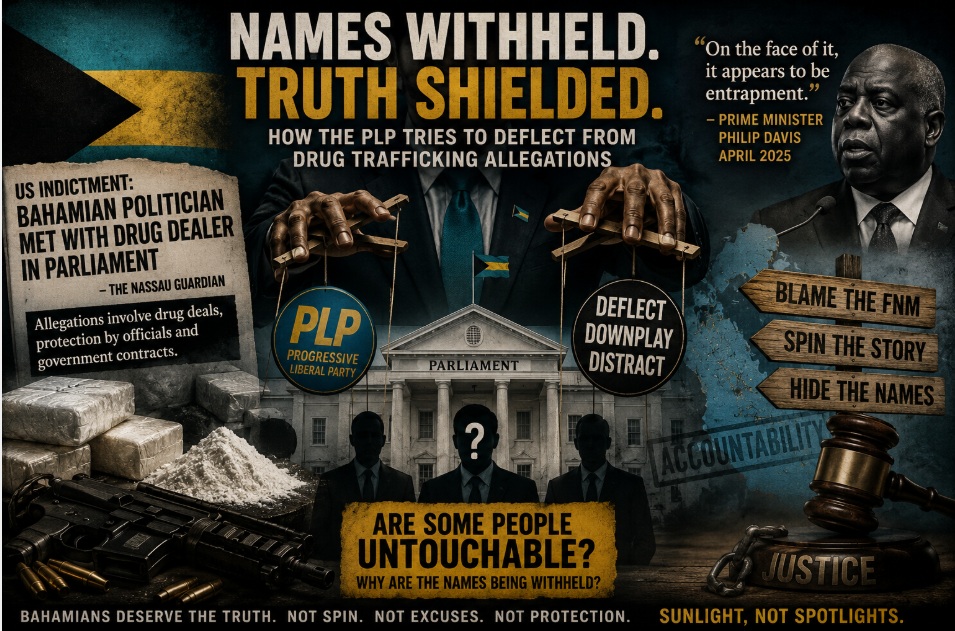
Back in April 2025, Prime Minister Philip Davis raised more than a few eyebrows when he publicly expressed concern over a major U.S. drug trafficking indictment and suggested that aspects of the operation appeared, “on the face of it,” to resemble entrapment.

Now, that was an interesting moment. Not because governments should not be concerned about due process—they absolutely should—but because many Bahamians were left wondering why the Prime Minister suddenly sounded less like the head of government and more like counsel preparing a pretrial argument. The question naturally arose: why move so quickly toward discussing possible entrapment before the public even knew the full scope of who may have been involved?

At the time, the indictment involved allegations against senior Bahamian law enforcement figures and referenced an unnamed politician. Importantly, no public identification of that politician had been made.

Then came what appears to be another layer to an already troubling story.

Recent reporting cited a U.S. criminal complaint alleging that a Bahamian politician met in Parliament in 2024 with individuals connected to an alleged drug trafficking operation. The complaint further alleged links involving government contracts and protection from high-ranking officials. These remain allegations in U.S. court documents and are not convictions.

But here is where the political theatre becomes especially fascinating.

When the earlier allegations surfaced, many observers recall efforts by PLP voices and supporters to steer public conversation toward suggestions involving the previous administration or figures connected to the opposition. Political smoke machines suddenly went into overdrive. One almost expected a narrator to emerge saying: “Pay no attention to the allegations behind the curtain—look over there instead!”

Yet if these cases are in fact connected through overlapping names, allegations, or investigative threads—as reporting suggests may be possible—the attempt to politically redirect the conversation begins looking less like strategy and more like a magician whose audience noticed where the rabbit actually went.

And then comes the question that continues hanging over the entire matter like a tropical storm cloud refusing to move offshore: the names.

Not convictions. Not guilt. Names.

Because when references are made to unnamed politicians and unnamed government figures, and the public is told little else, a vacuum forms. Nature hates a vacuum, and politics hates one even more. Vacuums get filled with speculation.

The unfortunate reality is that withholding identities—whether for legitimate investigative reasons or otherwise—creates an atmosphere where citizens begin asking uncomfortable questions. Is there a procedural reason? Is there an ongoing investigation? Or does the public begin wondering whether there are people so politically connected that accountability somehow moves at island time while ordinary citizens face express delivery?

That perception alone is damaging.

The larger issue here is not whether one party gains points over another. Drug trafficking allegations touching law enforcement and political circles represent something far bigger than campaign warfare. If politicians—of any stripe, PLP, FNM, or otherwise—are implicated, the public deserves transparency and a serious response, not a national game of political hot potato.

Because when allegations of corruption emerge, governments are supposed to lead with transparency and accountability.

My Morning Paper – May 16th 2026 – The PLP Survival Guide: Controversy Is a Stepping Stone

The old saying warns us not to envy the apparent prosperity of wrongdoers, because sometimes people begin believing that power itself is proof of righteousness. And perhaps nowhere is that lesson more fitting than in the modern political theatre of the Progressive Liberal Party (PLP), where controversy often seems less like a disqualification and more like an item on a résumé.

It is remarkable to now hear former PLP Cabinet Minister and Member of Parliament Jerome Fitzgerald spoken of as the supposed “architect” behind the PLP’s recent electoral success. In another era, one might think a political strategist’s legacy would be measured by vision, policy or national transformation. In today’s Bahamas, it seems surviving controversy may itself qualify as a special skill.

This, after all, is a political figure whose name became nationally associated with the Baha Mar email controversy, where private communications were dramatically read into the House of Assembly. Bahamians were left not only debating the content of the emails, but also asking the enduring question: how exactly did these private communications arrive in his possession? The explanation involving a “political garbage bin” may forever remain one of the more colourful additions to Bahamian political folklore.

Then came controversy surrounding contracts involving Bahamas Courier & Logistics and BPL, which raised questions and criticism regarding procurement and perceived political influence. No criminal findings emerged, but the public conversation around optics, favouritism and connections certainly had a life of its own.

There was also the dispute involving the disclosure of private information connected to Save The Bays — a matter that generated significant legal and public scrutiny and further fuelled criticism about the use of political power.

Yet critics argue the most troubling controversy was not about contracts or parliamentary theatrics, but concerns surrounding reports of fuel contamination affecting Marathon residents. Public concern centered around allegations that gasoline leakage had contaminated the water table and that residents suffered illnesses while questions lingered about transparency and the handling of information. For many residents and observers, the deepest frustration was not merely what happened, but whether those entrusted with protecting the public interest acted with enough urgency and openness. The concern voiced by critics was that political calculations appeared to overshadow public confidence.

Mr. Fitzgerald’s character seems to be son tarnished in certain circles that even when other allegations of wrongdoing surface in the PLP government, like the past Moorings deal in Exuma; his name is called.

And now, in the grand PLP tradition, figures wrapped in political controversy are not retired quietly into the sunset. No, they are often spoken of as master strategists, celebrated as heroes, and floated for further positions of influence. In Bahamian politics, controversy sometimes seems less like a scarlet letter and more like a stepping stone.

One almost begins to wonder whether in the PLP advancement system, the question is no longer: “What controversies followed you?” but rather: “How many did you survive?”

Is this what PROGRESS looks like?

END